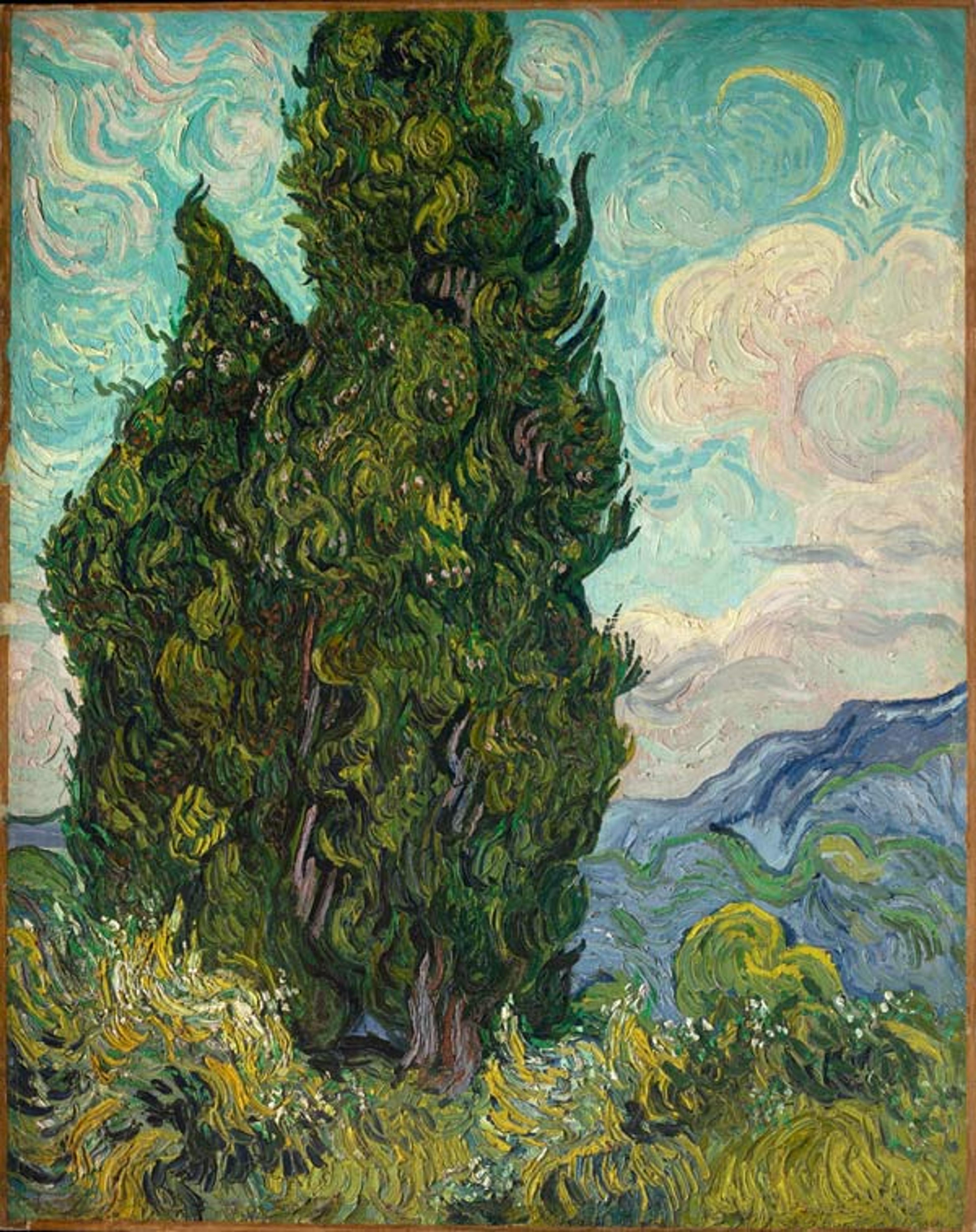
«Vincent van Gogh painted a series of cypress trees during his stay in an asylum in Saint-Remy, France, but one work in particular—Cypresses—has always stood out to me.»
The colors catch my eye at first glance: deep-green cypresses with accents of yellow and light green, mustard-yellow grass around the trees, and dots of white that depict beautiful white lilies.
If you let your eye follow one curve or sliver painted on the canvas, it seems like you could follow it around the whole painting. It's as though Van Gogh painted the entire scene with one stroke of his paintbrush.
Everything is painted in curves: the cypresses, grass, baby-blue sky, clouds, the silver hills that rise and fall in the background, and the crescent-shaped yellow moon that stands out against the blue backdrop. The objects are so organic, so fluid. The trees and the grass in the foreground look like they're swaying in the wind, the clouds seem to be in a constant, gentle drift, and even the hills seem to be in silent motion. The sky seems turbulent and windy, and the moon smiles down on the beguiling landscape, proud of the earth.
What strikes you the most about this painting?