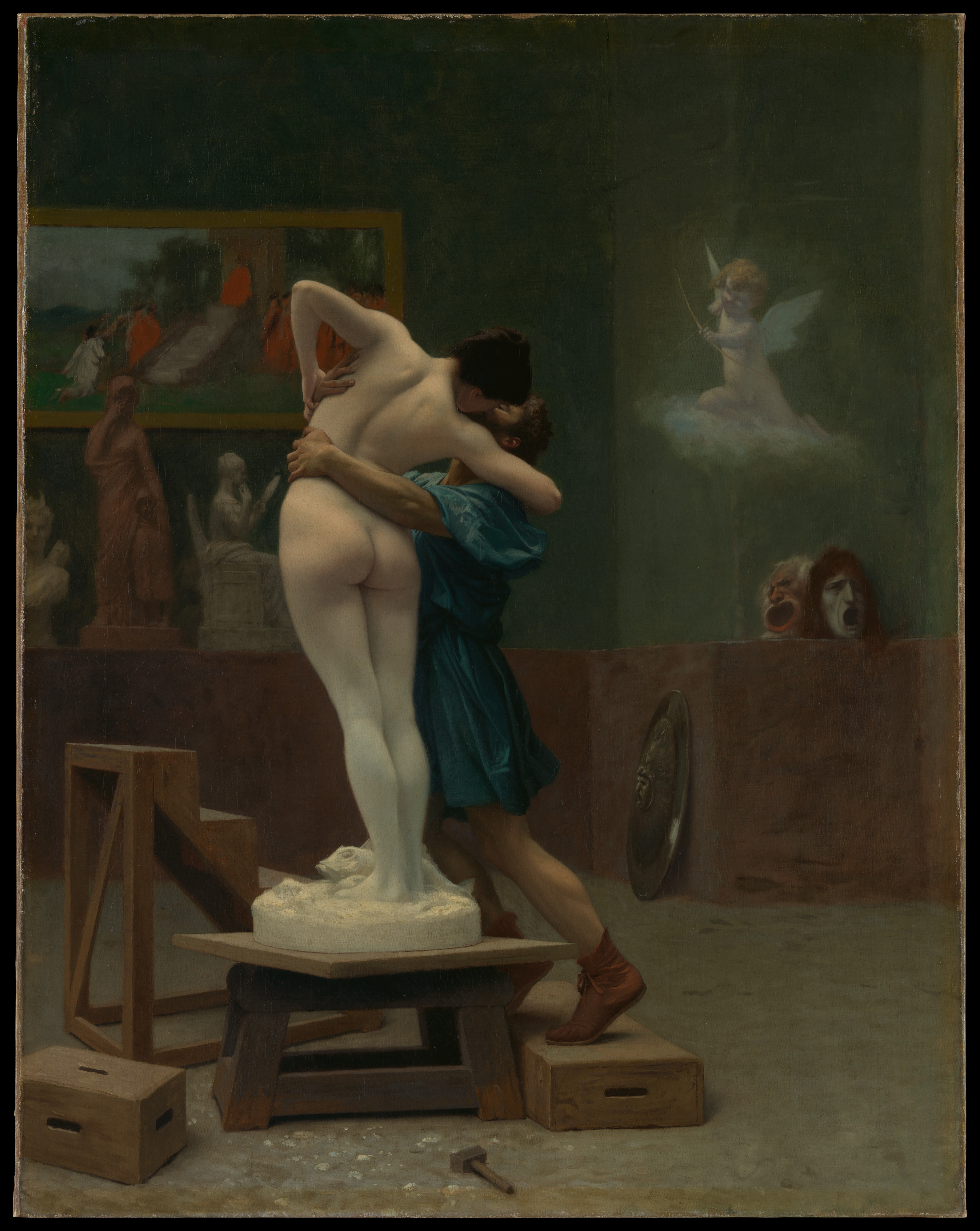
Between 1890 and 1892, Gérôme made both painted and sculpted variations on the theme of Pygmalion and Galatea, the tale recounted in Ovid’s Metamorphoses. All depict the moment when the sculpture of Galatea was brought to life by the goddess Venus, in fulfillment of Pygmalion’s wish for a wife as beautiful as the sculpture he created. This is one of three known versions in oil that are closely related to a polychrome marble sculpture, also fashioned by Gérôme (Hearst Castle, San Simeon, Calif.). In each of the paintings, the sculpture appears at a different angle, as though it were being viewed in the round.
Between 1890 and 1892, Gérôme made both painted and sculpted variations on the theme of Pygmalion and Galatea, the tale recounted in Ovid’s Metamorphoses (Book X, lines 243–97). All depict the moment when the sculpture of Galatea was brought to life by the goddess Venus, in fulfillment of Pygmalion’s wish for a wife as beautiful as the sculpture he created. Gérôme’s correspondence with his biographer Fanny Field Hering (see References) provides information about the origins of the present work. In 1890, the artist remarked that he had begun painting the subject, which he thought very hackneyed, in an attempt to rejuvenate it. In November 1890, he mentioned Pygmalion and Galatea among several works that he had painted the prior summer, which were nearly finished.
In January 1891, Gérôme wrote to Hering that he would soon sculpt a marble version of this subject; it has been suggested that he based the marble sculpture on a plaster original that had served as the model for the earlier painted versions (Ackerman 1986, 2000). Gérôme sold the present work to his dealer Boussod, Valadon on March 22, 1892; the firm sold it to Chicago collector Charles Tyson Yerkes early the following month, on April 7. The marble (Hearst Castle, San Simeon, California) was completed in 1892 and exhibited at the Paris Salon that year; originally polychromed, it has lost its color.
In each of the paintings, the sculpture appears at a different angle, as though it were being viewed in the round. There are two known painted versions of this subject showing Galatea frontally (both in private collections; Ackerman 2000, nos. 388 and 388.2, as 1890). A third version shows Galatea at a diagonal (presumed lost; Ackerman no. 386, as ca. 1892). A fourth version, identifiable in a photograph of Gérôme's studio, has been described as representing Galatea "seen fully en face" (presumed lost; Ackerman no. 387, as ca. 1892). Gérôme also painted a "reduction" of the present composition (whereabouts unknown), which he sold to Boussod, Valadon on May 5, 1892, two months after The Met's painting; they sold it to the Czar of Russia on September 24, 1892 (dealer stock no. 22251; see Lafont-Couturier 2000; not in Ackerman).
The Met's painting appears on the back wall of Gérôme's studio in The Artist's Model (1892; Haggin Museum, Stockton, California; Ackerman no. 419). A later version of The Artist's Model (1895; Dahesh Museum of Art, New York; Ackerman no. 419.3) shows a different version of Pygmalion and Galatea (Ackerman no. 388) in the background.
Asher Ethan Miller 2016
Inscription: Signed (on base of statue): J.L. GEROME.
[Boussod, Valadon & Cie, Paris, 1892; stock no. 22149; purchased from the artist on March 22, for Fr 11,250; sold on April 7, for Fr 17,250, to Yerkes]; Charles Tyson Yerkes, Chicago (1892–d.1905; his estate 1905–10; cat., 1893, no. 111, ill.; his estate sale, Mendelssohn Hall, New York, April 5–8, 1910, no. 21, sold for $4000 to Dugro); Justice P. H. Dugro, New York (from 1910); Louis C. Raegner, New York (until 1927)
New York. The Metropolitan Museum of Art. "The Taste of the Seventies," April 2–September 10, 1946, no. 110 (as "Pygmalion and Galatea").
Art Gallery of Toronto. "The Classical Contribution to Western Civilization," December 15, 1948–January 31, 1949, not in catalogue.
New York. The Metropolitan Museum of Art. "The Classical Contribution to Western Civilization," April 21–September 5, 1949, not in catalogue.
Lexington, Va. Washington and Lee University. "Humor in Painting," November 13–December 10, 1955, no catalogue.
Museum of the City of New York. "Perennial Pygmalion," January 20–May 1958, no catalogue.
Williamstown, Mass. Sterling and Francine Clark Art Institute. "In the Studio: The Making of Art in Nineteenth-Century France," September 12–October 25, 1981, no. 26.
Saitama, Japan. Museum of Modern Art. "Adam & Eve," October 10–December 6, 1992, no. 3.
Atlanta. High Museum of Art. "Rings: Five Passions in World Art," June 24–September 29, 1996, unnumbered cat.
Canberra. National Gallery of Australia. "Paris in the Late 19th Century," November 30, 1996–February 23, 1997, unnumbered cat. (as "Pymalion [sic] et Galatée [Pygmalion and Galatea]").
Brisbane. Queensland Art Gallery. "Paris in the Late 19th Century," March 15–May 22, 1997, unnumbered cat.
Munich. Städtische Galerie im Lenbachhaus. "Pygmalions Werkstatt," September 8–November 25, 2001, no. 79 (as "Pygmalion und Galatea").
Cologne. Wallraf-Richartz-Museum. "Wettstreit der Künste: Malerei und Skulptur von Dürer bis Daumier," May 25–August 25, 2002, no. 184 (as "Pygmalion").
Galleria d'Arte Moderna Bologna. "Il Nudo fra Ideale e Realtà: Dal Neoclassicismo ad Oggi," January 22–May 9, 2004, no. 32.
Oklahoma City Museum of Art. "Artist as Narrator: Nineteenth Century Narrative Art in England and France," September 8–November 27, 2005, no. 43.
Museum of Fine Arts, Houston. "The Masterpieces of French Painting from The Metropolitan Museum of Art: 1800–1920," February 4–May 6, 2007, no. 40.
Berlin. Neue Nationalgalerie. "Französische Meisterwerke des 19. Jahrhunderts aus dem Metropolitan Museum of Art," June 1–October 7, 2007, unnumbered cat.
Los Angeles. J. Paul Getty Museum. "The Spectacular Art of Jean-Léon Gérôme (1824–1904)," June 15–September 12, 2010, no. 175.
Paris. Musée d'Orsay. "Jean-Léon Gérôme (1824–1904). L'Histoire en spectacle," October 19, 2010–January 23, 2011, no. 175.
Madrid. Museo Thyssen-Bornemisza. "Jean-Léon Gérôme (1824–1904)," February 15–May 22, 2011, no. 53.
New York. The Metropolitan Museum of Art [The Met Breuer]. "Like Life: Sculpture, Color, and the Body," March 21–July 22, 2018, no. 36.
Brisbane. Queensland Art Gallery | Gallery of Modern Art. "European Masterpieces from The Metropolitan Museum of Art, New York," June 12–October 17, 2021, unnumbered cat.
Osaka. Osaka City Museum of Fine Arts. "European Masterpieces from The Metropolitan Museum of Art, New York," November 13, 2021–January 16, 2022, no. 51.
Tokyo. National Art Center. "European Masterpieces from The Metropolitan Museum of Art, New York," February 9–May 30, 2022, no. 51.
Amsterdam:. Rijksmuseum. "Changing Bodies: Ovid's Metamorphoses and the Arts," February 5, 2026–May 25, 2026.
Rome. Galleria Borghese. "Changing Bodies: Ovid's Metamorphoses and the Arts," June 22, 2026–September 20, 2026.
Jean-Léon Gérôme. Letter. [1890] [Engl. transl. published in Fanny Field Hering, "The Life and Works of Jean Léon Gérôme," New York, 1892, p. 283], remarks that he has begun a painting of "Pygmalion and Galatea," calling it a very hackneyed subject that he is trying to rejuvenate; describes its depiction of the statue coming to life.
Jean-Léon Gérôme. Letter to Fanny Field Hering. November 1890 [English transl. published in Fanny Field Hering, "The Life and Works of Jean Léon Gérôme," New York, 1892, p. 285], mentions "Pygmalion and Galatea" among several pictures that were painted in the summer and are now almost finished.
Jean-Léon Gérôme. Letter to Fanny Field Hering. January 1891 [English transl. published in Fanny Field Hering, "The Life and Works of Jean Léon Gérôme," New York, 1892, p. 286], remarks that soon he will sculpt a marble version of this picture.
Charles T. Yerkes. Catalogue from the Collection of Charles T. Yerkes. Chicago, 1893, unpaginated, no. 111, ill., notes its inclusion within the painting "The Artist's Model" (1890–92; Haggin Museum, Stockton, Calif.; A419), which depicts Gérôme working on his statue "Tanagra" (Ackerman 2000, no. S17).
F. G. Stephens. "Mr. Yerkes' Collection at Chicago.—III. The Modern Masters." Magazine of Art 18 (1895), p. 168.
Albert Soubies. J.-L. Gérôme (1824–1904): Souvenirs et notes. Paris, 1904, p. 9.
Josephine L. Allen and Elizabeth E. Gardner. A Concise Catalogue of the European Paintings in The Metropolitan Museum of Art. New York, 1954, p. 41.
Charles Sterling and Margaretta M. Salinger. French Paintings: A Catalogue of the Collection of The Metropolitan Museum of Art. Vol. 2, XIX Century. New York, 1966, pp. 172–73, ill., tentatively date it "sometime after 1881," from the same time the artist made a sculpted group of the subject (Hearst Castle, San Simeon, Calif.; Ackerman 2000, no. S24).
Gerald M. Ackerman. "Thomas Eakins and His Parisian Masters Gérôme and Bonnat." Gazette des beaux-arts, 6th ser., 73 (April 1969), pp. 246–47, states that Gérôme used his sculpted version as the model for his paintings on this theme.
Richard Ettinghausen inJean-Léon Gérôme, 1824–1904. Exh. cat., Dayton Art Institute. 1972, p. 95, calls it probably the version shown in "The Artist's Model" (Haggin Museum; A419); describes the figure of Galatea in the MMA painting as indicative of Gérôme's "effort to bring sculpture to life by color," noting that the sculpted version, shown at the Salon of 1892, was originally painted although the colors have now faded.
John Jacobus. "Matisse's Red Studio." Art News 71 (September 1972), p. 32, ill.
John Rewald. "Should Hoving Be De-accessioned?" Art in America 61 (January–February 1973), p. 28.
Francis Haskell. Rediscoveries in Art: Some Aspects of Taste, Fashion and Collecting in England and France. Ithaca, N.Y., 1976, p. 116, pl. 255.
David B. Cass. In the Studio: The Making of Art in Nineteenth-Century France. Exh. cat., Sterling and Francine Clark Art Institute. Williamstown, Mass., 1981, pp. 36–37, 43, 48, no. 26, ill., tentatively dates it to the 1880s; suggests that the three sculptures depicted in the background of this picture may relate to the Pygmalion theme: the bust of Diana the Huntress representing the chaste modesty Pygmalion sought among the licentious women of Cyprus; the mother and child referring to Paphos, the daughter later born to Pygmalion and Galatea; and the seated woman with her back turned, holding a mirror, representing the women of Cyprus whom Pygmalion scorned; notes that Gérôme painted another, unfinished version of this painting with the couple seen from the front, followed by the marble version exhibited at the Salon of 1892.
Gerald M. Ackerman. The Life and Work of Jean-Léon Gérôme, with a catalogue raisonné. London, 1986, pp. 134–36, 145, 268–69, 318, no. 385, ill. (color and black and white), dates it 1890; based on photographs, lists three other versions of this subject, each depicting the couple from a different angle (nos. 386, 387, 388), and an oil sketch (no. 388b), all location unknown; mentions a replica sold by Boussod, Valadon to the Emperor of Russia in 1892 [stock no. 22251; see Ref. Lafont-Couturier 2000]; states that the paintings were probably based on the plaster cast for the statue [see Ref. Ackerman 2000]; confirms that The Met's version is that depicted in "The Artist's Model" (Haggin Museum; no. 419).
Gary Tinterow et al. The Metropolitan Museum of Art. Vol. 8, Modern Europe. New York, 1987, p. 78, ill. (color), date it about 1881.
Mechthild Schneider. "Pygmalion—Mythos des schöpferischen Künstlers." Pantheon 45 (1987), p. 118, fig. 15, dates it 1881 and erroneously states that it was shown in the Salon that year.
Andreas Blühm. Pygmalion: Die Ikonographie eines Künstlermythos zwischen 1500 und 1900. Frankfurt, 1988, pp. 149–50, 273–74, no. 140a, pl. 140a, states that a pair of Tanagra statuettes visible in the background betrays that the location is the artist's own studio.
19th-Century European Paintings, Drawings and Sculpture. Sotheby's, New York. November 1, 1995, unpaginated, under no. 80, calls it the final version of the Pygmalion paintings; calls "The Artist's Model" now owned by the Dahesh Museum of Art, New York (A419.3) the first version, noting that it was painted in 1890 with a pair of drawings by Barye depicted in the left background, but that was then repainted about 1891–95 to include "Pygmalion and Galatea" (A388).
Katharine Baetjer. European Paintings in The Metropolitan Museum of Art by Artists Born Before 1865: A Summary Catalogue. New York, 1995, p. 436, ill.
Marc Gotlieb inRings: Five Passions in World Art. Ed. Michael Shapiro. Exh. cat., High Museum of Art, Atlanta. New York, 1996, pp. 44, 54–55, ill. (color).
Jane Kinsman inParis in the Late 19th Century. Exh. cat., National Gallery of Australia. Canberra, 1996, pp. 74–75, 182, ill. (color), suggests that while in progress, the sculpture would have remained in the artist's studio for some time and could have then formed the basis for the three known paintings.
Jennifer Montagu inRings: Five Passions in World Art. Ed. Michael Shapiro. Exh. cat., High Museum of Art, Atlanta. New York, 1996, p. 34, calls this the version with the most emotional impact because it is the only one depicting Galatea from behind.
Andreas Blühm inThe Colour of Sculpture 1840–1910. Ed. Andreas Blühm and Penelope Curtis. Exh. cat., Van Gogh Museum, Amsterdam. Zwolle, The Netherlands, 1996, p. 47, fig. 47 (color), calls it "Pygmalion and the Statue" and dates it 1890.
Sunanda K. Sanyal. "Allegorizing Representation: Gérôme's Final Phase." Athanor 15 (1997), pp. 38–40, fig. 3, observes that by presenting the couple from different angles in the painted versions, just as the viewer would experience before the sculpted version, Gérôme successfully mediated between the disciplines of painting and sculpture; discusses the inclusion of this picture in "The Artist's Model," and the presence of masks in both, as allegories of representation.
Hélène Lafont-Couturier. Gérôme. Paris, 1998, pp. 88–89, ill. (color).
Gerald M. Ackerman. Jean-Léon Gérôme: Monographie révisée, catalogue raisonné mis à jour. 2nd rev. ed. [1st ed., 1986]. Paris, 2000, pp. 330, 338, 390, no. 385, ill. pp. 159, 331 (color and black and white), dates it 1892, and states that without doubt, the "Pygmalion and Galatea" paintings were made after the plaster cast of the statue; notes the difficulty in distinguishing between the other painted versions, but lists two finished versions, now lost (about 1892; nos. 386, 387) and two oil sketches, both in private collections (1890; nos. 388, 388.2).
Hélène Lafont-Couturier inGérôme & Goupil: Art and Enterprise. Exh. cat., Musée Goupil, Bordeaux. Paris, 2000, pp. 21, 42 n. 109, 53 [French ed., 2000], notes that two months after buying this painting from the artist, Boussod, Valadon bought a reduction of the work (stock no. 22251), also by Gérôme, which was eventually sold to the Russian emperor; erroneously cites another work under the Goupil stock no. for the present work; states that Gérôme focused on the theme of Pygmalion and Galatea between 1890 and 1893.
Barbara Eschenburg. Pygmalions Werkstatt. Exh. cat., Städtische Galerie im Lenbachhaus. Munich, 2001, pp. 73, 172, 210–11, no. 79, ill. (color), dates it 1890–92.
Bernard Vouilloux. Le Tableau vivant: Phyrné, l'orateur et le peintre. Paris, 2002, pp. 162, 397 n. 97, pl. 30.
Françoise Forster-Hahn. "Public Concerns—Private Longings: Adolph Menzel's 'Studio Wall' (1872)." Art History 25 (April 2002), p. 224, pl. 33, calls it "Pygmalion" and dates it 1892; compares the "moment of psychological shock" depicted in this painting with a photograph of Gérôme next to the model for his statue "Omphale" and the statue itself (Ackerman S12).
Andreas Blühm inWettstreit der Künste: Malerei und Skulptur von Dürer bis Daumier. Ed. Andreas Büttner. Exh. cat., Haus der Kunst München. Wolfratshausen, 2002, pp. 150–51, fig. 5 (color).
Ursula Weber-Woelk inWettstreit der Künste: Malerei und Skulptur von Dürer bis Daumier. Ed. Andreas Büttner. Exh. cat., Haus der Kunst München. Wolfratshausen, 2002, pp. 394, 404–5, no. 184, ill. (color), dates it about 1892.
Susan P. Casteras inArtist as Narrator: Nineteenth Century Narrative Art in England and France. Ed. Hardy George. Exh. cat., Oklahoma City Museum of Art. Oklahoma City, 2005, pp. 63, 135, no. 43, ill. p. 4 (color).
Petra ten-Doesschate Chu. Nineteenth-Century European Art. 2nd ed. Upper Saddle River, N.J., 2006, pp. 280–81, fig. 12-13 (color).
Frédéric Chappey. "L'iconographie de Pygmalion et Galatée aux XIXe et XXe siècles: entre introspection et exhibition." L'artiste et sa muse. Ed. Virginie Schmitt. Rome, 2006, pp. 7–8, 17 n. 17, dates it 1892; states that Gérôme painted numerous versions of "Pygmalion and Galatea" from 1890–92, after the plaster model for the sculpture.
Gary Tinterow inThe Masterpieces of French Painting from The Metropolitan Museum of Art: 1800–1920. Exh. cat., Museum of Fine Arts, Houston. New York, 2007, fig. 15 (installation photo, color).
Kathryn Calley Galitz inThe Masterpieces of French Painting from The Metropolitan Museum of Art: 1800–1920. Exh. cat., Museum of Fine Arts, Houston. New York, 2007, pp. 63, 217, no. 40, ill. (color and black and white).
Kathryn Calley Galitz inMasterpieces of European Painting, 1800–1920, in The Metropolitan Museum of Art. New York, 2007, pp. 72, 254, no. 66, ill. (color and black and white).
Víctor I. Stoichita. The Pygmalion Effect: From Ovid to Hitchcock. Chicago, 2008, pp. 170–72, fig. 88, comments that the presence of this painting within "The Artist's Model" (Haggin Museum; A419) "must be perceived as a dramatization and an aggregate of the peaceful session" that is the subject of the latter picture.
Edouard Papet inThe Spectacular Art of Jean-Léon Gérôme (1824–1904). Ed. Laurence des Cars, Dominique de Font-Réaulx, and Edouard Papet. Exh. cat., J. Paul Getty Museum, Los Angeles. Paris, 2010, pp. 302, 304–6, no. 175, ill. (color), dates it 1890; states that Gérôme worked on the sculpted and painted versions of this theme at the same time, mentioning only the MMA and one other canvas (private collection; A388).
Dominique de Font-Réaulx inThe Spectacular Art of Jean-Léon Gérôme (1824–1904). Ed. Laurence des Cars, Dominique de Font-Réaulx, and Edouard Papet. Exh. cat., J. Paul Getty Museum, Los Angeles. Paris, 2010, pp. 220–21.
Dominique Païni inThe Spectacular Art of Jean-Léon Gérôme (1824–1904). Ed. Laurence des Cars, Dominique de Font-Réaulx, and Edouard Papet. Exh. cat., J. Paul Getty Museum, Los Angeles. Paris, 2010, pp. 334–35.
Susan Waller. "'Fin de partie': A Group of Self-Portraits by Jean-Léon Gérôme." Nineteenth-Century Art Worldwide 9 (Spring 2010), n. 63 [http://www.19thc-artworldwide.org/spring10/group-of-self-portraits-by-gerome].
Dominique de Font-Réaulx inBenjamin-Constant: Marvels and Mirages of Orientalism. Ed. Nathalie Bondil. Exh. cat., Musée des Augustins, Toulouse. Montreal, 2014, p. 338 [French ed., 2014], states that it represents a variant on his own sculptor's studio, transposed to a scene of classical mythology.
The Venus Paradox. Ed. Loukia Loizou Hadjigavriel, Myrto Hatzaki, and Demetra Theodotou Anagnostopoulou. Exh. cat., A. G. Leventis Gallery. Nicosia, 2017, p. 217.
Alison Smith inThe Venus Paradox. Ed. Loukia Loizou Hadjigavriel, Myrto Hatzaki, and Demetra Theodotou Anagnostopoulou. Exh. cat., A. G. Leventis Gallery. Nicosia, 2017, p. 90, ill. p. 92 (color), compares it to Edward Burne-Jones's "Pygmalion and the Image: The Soul Attains" (1868–78, Birmingham Museum and Art Gallery).
Jasper Sharp inThe Shape of Time. Ed. Sabine Haag and Jasper Sharp. Exh. cat., Kunsthistorisches Museum, Vienna. Cologne, 2018, p. 42, discusses The Met's version as the source for a central panel of Birgit Jürgenssen's "Untitled" (1991, Estate of Birgit Jürgenssen).
Sheena Wagstaff inLike Life: Sculpture, Color, and the Body. Exh. cat., The Metropolitan Museum of Art [The Met Breuer]. New York, 2018, pp. 5, 8.
Hillel Schwartz inLike Life: Sculpture, Color, and the Body. Exh. cat., The Metropolitan Museum of Art [The Met Breuer]. New York, 2018, p. 62.
Emerson Bowyer inLike Life: Sculpture, Color, and the Body. Exh. cat., The Metropolitan Museum of Art [The Met Breuer]. New York, 2018, pp. 140, 283, no. 36, ill. p. 142 (color), calls it a kind of self-portrait related to the artist's sculptural prowess and notes that Gérôme was "perhaps the most visible proponent of polychromy in the late nineteenth century"; compares it to John De Andrea's "Self-Portrait with Sculpture" (1980, Foster Goldstrom collection).
Andreas Blühm inEn couleurs: La sculpture polychrome en France, 1850–1910. Ed. Edouard Papet. Exh. cat., Musée d'Orsay. Paris, 2018, p. 14, fig. 02 (color), as "Pygmalion"; compares it to Rodin's sculpture of the same subject.
European Art. Christie's, New York
. April 30, 2019, unpaginated, fig. 1 (color), under no. 33, calls it the prime version of the painting.
Katharine Baetjer inEuropean Masterpieces from The Metropolitan Museum of Art, New York. Exh. cat., Queensland Art Gallery | Gallery of Modern Art. South Brisbane, 2021, pp. 190, 231, ill. p. 191 (color).
The Met's Libraries and Research Centers provide unparalleled resources for research and welcome an international community of students and scholars.
The Met Collection API is where all makers, creators, researchers, and dreamers can connect to the most up-to-date data and public domain images for The Met collection. Open Access data and public domain images are available for unrestricted commercial and noncommercial use without permission or fee.
Feedback
We continue to research and examine historical and cultural context for objects in The Met collection. If you have comments or questions about this object record, please complete and submit this form. The Museum looks forward to receiving your comments.