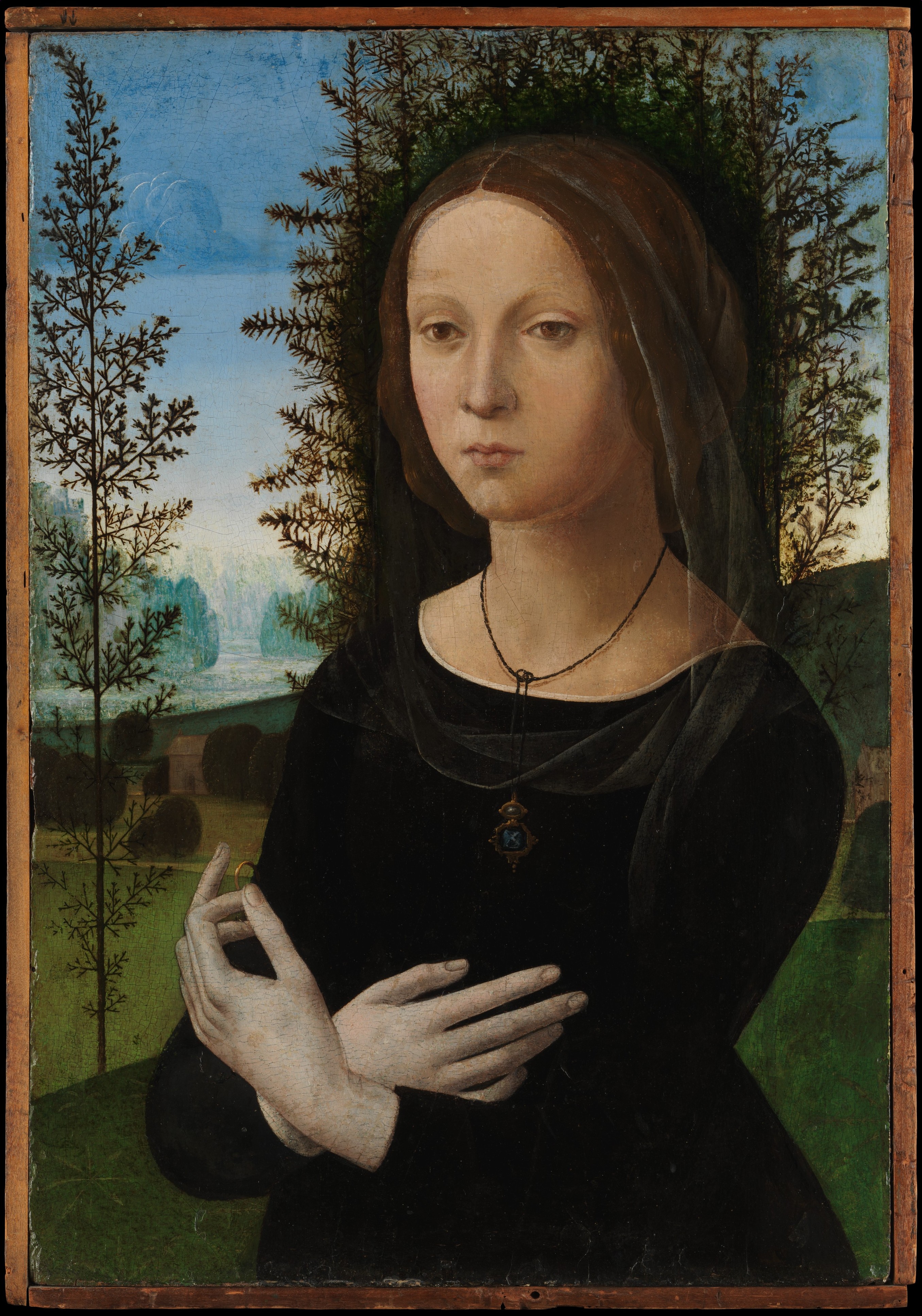
An inscription on the back of this painting, possibly dating to the 1500s, identifies the subject as "Ginevra d’Amerigo de Benci." The juniper bush (ginevro in old Italian) behind her could evoke her first name. The painting signals an important shift in Florentine portraits of women. Rather than appearing bust length and in strict profile, this sitter turns to the viewer, her hands visible, providing a greater sense of her inner psychology. The picture was likely inspired by Leonardo da Vinci’s portrait Ginevra de’ Benci in the National Gallery of Art, Washington.
This image cannot be enlarged, viewed at full screen, or downloaded.
Open Access
As part of the Met's Open Access policy, you can freely copy, modify and distribute this image, even for commercial purposes.
API
Public domain data for this object can also be accessed using the Met's Open Access API.
Use your arrow keys to navigate the tabs below, and your tab key to choose an item
Title:Portrait of a Young Woman
Artist:Lorenzo di Credi (Lorenzo d'Andrea d'Oderigo) (Italian, Florence 1456/59–1536 Florence)
Date:ca. 1490–1500
Medium:Oil on wood
Dimensions:23 1/8 x 15 3/4 in. (58.7 x 40 cm)
Classification:Paintings
Credit Line:Bequest of Richard De Wolfe Brixey, 1943
Object Number:43.86.5
This painting reflects an important step in the evolution of Florentine portraits of women: earlier examples almost always show them bust-length and in profile. The change came about in the mid-1470s in the work of the young Leonardo da Vinci and, slightly later, in the work of Botticelli. In the new format, women turn their faces toward the spectator, giving artists greater opportunity to describe their personalities. By increasing the length of portraits, artists could include the sitters' hands and show the sitters in more natural poses.
An old, probably sixteenth-century, inscription on the back of The Met's panel identifies the sitter as Ginevra d'Amerigo de' Benci, the same young woman whom Leonardo depicted in a portrait in the National Gallery of Art, Washington. Ginevra, the daughter of a wealthy Florentine banker, was born in 1457; in 1474 she married Luigi di Bernardo Niccolini. Leonardo probably painted her portrait about the time of their marriage. The Met's painting is clearly inspired by Leonardo's portrait. Although the pose of the sitter is reversed, the format of the two pictures is virtually the same, and the resemblance is even greater if one bears in mind that the portrait in Washington has been cut by about seven inches at the bottom and about one-half inch on the right side, so that both portraits originally were about the same size. Although a drawing by Leonardo in the Royal Library, Windsor Castle, has often been cited as a study for the missing hands of Leonardo's portrait in Washington, The Met's portrait probably provides more reliable evidence.
The attribution to Lorenzo di Credi was proposed by Berenson (1896). Credi received his training in Andrea del Verrocchio's workshop when Leonardo da Vinci and Perugino were also employed there. Vasari wrote that "since Lorenzo [di Credi] took an extraordinary pleasure in the manner of Leonardo, he contrived to imitate it so well that there was no one who came nearer to it than he did in the high finish and thorough perfection of his works" (de Vere trans., 1996, vol. 1, p. 800). Credi's free copy of Leonardo's Benois Madonna in the Gemäldegalerie, Dresden, not to speak of his variant of the Ginevra de' Benci in The Metropolitan Museum, lends credence to Vasari's account.
The attribution to Credi is widely accepted today, though it occasionally has been questioned: Bode (1921) tentatively gave it to Credi's student Giovan Antonio Sogliani, Alazard (1924) dismissed it as "a work of no great artistic value," and David Alan Brown (1998) ascribed it to the prolific follower of Credi known as Tommaso. Doubts about the attribution may be due to the portrait's compromised condition. Unlike Leonardo's picture in Washington, the surface of which is well preserved, The Met's version is badly abraded—the face is badly damaged, the dark pigments have deteriorated, and little detail remains in the clothing and the landscape. The surface is so poorly preserved that it shows no sign of the high finish for which Credi was known in his time.
The poor condition of the portrait also precludes any firm conclusion about the identity of the sitter. Nevertheless, some scholars (Bode 1903, Walker 1967, Schuyler 1976, Garrard 2006) maintain that it portrays Ginevra de' Benci; while others (Carnescchi 1909, Sirén 1916, Alazard 1924, Brown 1998) believe that it does not. In the earliest published reproduction of the portrait (Bode 1903), in which it appears to be in much better condition than it is today, the sitter's features correspond closely with those of the Washington portrait. A radiograph of the The Met's panel shows various contours for the position of the woman's head, changes presumably due to the artist's inexperience. The radiograph also reveals that the neckline of her dress was originally rectangular and cut much lower, in fact, exactly like the neckline of the dress in the Washington portrait.
Discounting the old inscription on the back, Gigetta Dalli Regoli (1966) suggested that the portrait depicts a different Ginevra—Ginevra di Giovanni di Niccolò, the reputed widow of Lorenzo di Credi's older brother Carlo, who was a goldsmith. The juniper foliage, behind the sitters' heads in both the New York and Washington portraits, alludes to their Christian name, the Italian word for the plant—ginepro—being a play on the name Ginevra. The ring held by the sitter in The Met's portrait could refer to her late husband's profession, but it might also have had some connubial significance. On balance, making allowances for its compromised condition, the portrait probably does represent Ginevra de' Benci.
Dalli Regoli (1966) at first proposed that The Met's picture dates from about 1490–95. Thirty years later (1996) she wrote that the design of the portrait reflects Leonardo's Mona Lisa, thereby dating the picture considerably later, because Leonardo began the Mona Lisa about 1505 and did not complete it until 1514. Judging from style alone, The Met's portrait probably dates from the late 1470s when Credi copied early works by Leonardo.
[2011; adapted from Fahy 2011]
marchesi Pucci, Palazzo Pucci, Florence (by 1896); marchese Emilio Pucci, Florence (until at least 1912); ?[A. S. Drey, Munich, about 1912]; [Arthur Ruck, London, until 1920; sold to Duveen]; [Duveen, London and New York, 1920–25; sold to Brixey]; Richard De Wolfe Brixey, New York (1925–d. 1943)
Cincinnati Art Museum. "Special Exhibition of Italian Paintings of the Fourteenth, Fifteenth and Sixteenth Centuries," April 16–24, 1921, no catalogue.
New York. Duveen. "Early Italian Paintings," April 17–May 3, 1924, no. 1 (as "Portrait of Genevra di Amerigo Benci," lent by Andrew W. Mellon [sic]).
New York. M. Knoedler & Co. "Loan Exhibition of Primitives," February 1929, no. 10 (lent by Richard de Wolfe Brixey).
London. Royal Academy of Arts. "Italian Art, 1200–1900," January 1–March 8, 1930, no. 237 (lent by Mr. and Mrs. Richard de Wolfe Brixey, New York) [commemorative ed., 1931, no. 279].
New York. M. Knoedler & Co. "Fifteenth Century Portraits," April 15–27, 1935, no. 14 (as "Portrait of Ginevra di Benci," lent anonymously).
New York. The Metropolitan Museum of Art. "Florentine Paintings in the Metropolitan Museum," June 15–August 15, 1971, no catalogue.
New York. The Metropolitan Museum of Art. "Art and Love in Renaissance Italy," November 11, 2008–February 16, 2009, no. 131.
Fort Worth. Kimbell Art Museum. "Art and Love in Renaissance Italy," March 15–June 14, 2009, no. 131.
Bode Museum, Staatliche Museen zu Berlin. "Gesichter der Renaissance: Meisterwerke italienischer Portrait-Kunst," August 25–November 20, 2011, no. 44.
New York. The Metropolitan Museum of Art. "The Renaissance Portrait from Donatello to Bellini," December 21, 2011–March 18, 2012, no. 44.
New York. The Cloisters Museum & Gardens, The Metropolitan Museum of Art. "Treasures and Talismans: Rings from the Griffin Collection," May 1–October 18, 2015, no catalogue.
Giuseppe Magni, Giovanni Battista Benigni, Gesualdo Ferri, Carlo Coltellini, and Giacinto Fabbroni. Attestato di pittori sopra l'autenticità d'un quadro di Leonardo. 1795, attribute it to Leonardo da Vinci, identifying it with the portrait of Ginevra di Amerigo Benci mentioned by Vasari.
Bernhard Berenson. The Florentine Painters of the Renaissance. New York, 1896, p. 109, lists it as by Lorenzo di Credi, in the collection of marchese Pucci, Florence.
Wilhelm [von] Bode. "Leonardo's Bildnis der Ginevra dei Benci." Zeitschrift für bildende Kunst, n.s., 14 (1903), p. 276, ill. p. 275, calls it a free school copy after Leonardo's portrait of Ginevra de' Benci now in the National Gallery of Art, Washington, and credits Fritz Knapp for first discovering it in the Pucci collection; reports the inscription on the back of the panel.
Carlo Carnesecchi. "Il ritratto leonardesco di Ginevra Benci." Rivista d'arte 6 (1909), p. 292, cites Bode's [see Ref. 1903] opinion that it is a free copy of the Washington portrait, but observes no similarity between the two sitters; mentions the suggestion, supported by the inscription, that it is a copy of an original portrait of Ginevra di Amerigo Benci by Leonardo.
Adolfo Venturi. Storia dell'arte italiana. Vol. 7, part 1, La pittura del quattrocento. Milan, 1911, p. 818 n., attributes it to Lorenzo di Credi.
Jens Thiis. Leonardo da Vinci: The Florentine Years of Leonardo & Verrocchio. London, [1913], pp. 109–10, ill., tentatively attributes it to Lorenzo di Credi; rejcts Bode's [see Ref. 1903] identification of the sitter as Ginevra de' Benci and calls it a portrait of a widow.
Wilhelm von Bode. "Leonardos Bildnis der jungen Dame mit dem Hermelin aus dem Czartoryski-Museum in Krakau und die Jugendbilder des Künstlers." Jahrbuch der königlich preuszischen Kunstsammlungen 36 (1915), p. 204.
Osvald Sirén. Leonardo da Vinci: The Artist and the Man. New Haven, 1916, p. 24, ill. between pp. 24 and 25, considers it Florentine and calls it "possibly the copy of an older work which may have been Leonardo's lost early original" of Ginevra de' Benci; rejects the suggestion that the MMA and Washington portraits are of the same person, stating that "there is no actual likeness between the two ladies".
Bernard Berenson. Letter to Duveen. November 30, 1920, rejects the attribution to Leonardo and ascribes it to Lorenzo di Credi; notes the juniper in the background and the traditional identification of the sitter as Ginevra de' Benci.
Wilhelm von Bode. Studien über Leonardo da Vinci. Berlin, 1921, pp. 34–35, fig. 18, hesitantly attributes it to Giovanni Antonio Sogliani.
Jean Alazard. Le portrait florentin de Botticelli à Bronzino. Paris, 1924, pp. 58–59, 86, rejects Bode's hypothesis [see Ref. 1903] and the identification of it as the portrait of Ginevra de' Benci by Leonardo, attributing it to a clumsy imitator of Lorenzo di Credi or a poor pupil of Leonardo.
Richard Offner. "A Remarkable Exhibition of Italian Paintings." Arts 5 (May 1924), ill. p. 254, as by Lorenzo di Credi.
"Early Italian Paintings." International Studio 79 (June 1924), ill. p. 213, as "Portrait of Genevra di Amerigo Benci," erroneously as in the collection of Andrew W. Mellon.
W. R. Valentiner. A Catalogue of Early Italian Paintings Exhibited at the Duveen Galleries New York: April to May, 1924. New York, 1926, unpaginated, no. 16, ill., attributes it to Lorenzo di Credi and calls it a portrait of a Florentine lady, "originally in the Convent of the Annunciata, Florence, whence it passed into the possession of Marchese Simone Pucci (1482–1522), in whose family it remained until recently".
Osvald Sirén. Léonard de Vinci: L'artiste et l'homme. Paris, 1928, vol. 1, p. 18; vol. 2, pl. 14A.
Wilhelm Suida. Leonardo und sein Kreis. Munich, 1929, p. 26, calls it a later variant of the Washington portrait, painted not before the beginning of the sixteenth century.
A[ndré]. [de] H[evesy]. "New-York." Pantheon 3 (January–June 1929), p. 196, ill. p. 205.
Carlo Gamba. "Dipinti fiorentini di raccolte americane all'esposizione di Londra." Dedalo 11 (1930–31), p. 598, ill. p. 591, attributes it to Lorenzo di Credi and tentatively dates it in the sixteenth century, suggesting it may be a partial replica of the unknown original by Leonardo representing Ginevra de' Benci.
Raimond van Marle. The Development of the Italian Schools of Painting. Vol. 13, The Renaissance Painters of Florence in the 15th Century: The Third Generation. The Hague, 1931, p. 276, fig. 184, attributes it to Lorenzo di Credi, notes the resemblance between the background and that of the Washington portrait, and rejects the identification of the sitter as Ginevra de' Benci.
Bernhard Degenhart. "Studien über Lorenzo di Credi: Credis Porträtdarstellung II." Pantheon 8 (July–December 1931), p. 463, attributes it to Lorenzo di Credi and dates it to the beginning of the sixteenth century.
Bernhard Berenson. Italian Pictures of the Renaissance. Oxford, 1932, p. 297.
Bernhard Degenhart. "Die Schüler des Lorenzo di Credi." Münchner Jahrbuch der bildenden Kunst, n.s., 9 (1932), pp. 122, 160.
Lionello Venturi. Italian Paintings in America. Vol. 2, Fifteenth Century Renaissance. New York, 1933, unpaginated, pl. 282, attributes it Lorenzo di Credi and considers it a portrait of a lady in mourning.
Kenneth Clark. A Catalogue of the Drawings of Leonardo da Vinci in the Collection of His Majesty the King at Windsor Castle. New York, 1935 [vol. 1], p. 89, under no. 12558.
Bernhard Berenson. Pitture italiane del rinascimento. Milan, 1936, p. 255.
Emil Möller. "Leonardos Bildnis der Ginevra dei Benci." Münchner Jahrbuch der bildenden Kunst 12 (1937–38), pp. 205–6, fig. 10, attributes it to Sogliani and rejects the identification of the sitter as Ginevra di Amerigo Benci.
"Metropolitan to Get Bache Collection As Permanent Gift: $12,500,000 Paintings To Be Kept in Reconstructed Museum After War." New York Herald Tribune (January 18, 1944), p. 25, as "an Italian primitive".
Josephine L. Allen and Elizabeth E. Gardner. A Concise Catalogue of the European Paintings in The Metropolitan Museum of Art. New York, 1954, p. 24.
Bernard Berenson. Italian Pictures of the Renaissance: Florentine School. London, 1963, vol. 1, p. 116, as "Portrait of a young Woman with a Ring, called 'Ginevra de' Benci'".
Gigetta Dalli Regoli. Lorenzo di Credi. Milan, 1966, pp. 44–45, 145, no. 89, fig. 111, attributes it to Lorenzo di Credi, calls it a portrait of a widow, and suggests identifying the sitter as Credi's sister-in-law, Ginevra di Giovanni di Niccolò; notes the Leonardesque influence and dates it it to Credi's mature period, either 1490–95 or early sixteenth century.
John Walker. "'Ginevra de' Benci' by Leonardo da Vinci." Report and Studies in the History of Art, 1967 (National Gallery of Art) (1967), pp. 13–18, 20, figs. 12, 13, 15 (overall, infrared detail, and composite x-ray), considers the MMA and Washington portraits representations of the same person, stating that x-rays of the MMA work reveal a head shaped very much like that of the Washington sitter; compares the MMA portrait to another by Credi in the Galleria Sabauda, Turin, and suggests both were inspired by a lost engraving of the Washington portrait; postulates that the MMA portrait may have been ordered by Ginevra's family when the original was taken to Venice; interprets her black costume as symbolic of her religious devotion, and the addition of the ring as a sign of fidelity to her marriage vows.
Calvin Tomkins. Merchants and Masterpieces: The Story of The Metropolitan Museum of Art. New York, 1970, p. 340 [rev., enl. ed., 1989].
Federico Zeri with the assistance of Elizabeth E. Gardner. Italian Paintings: A Catalogue of the Collection of The Metropolitan Museum of Art, Florentine School. New York, 1971, pp. 154–57, ill., attribute it to Lorenzo di Credi, but hesitate to date it due to its damaged condition and the fact that the artist's style changed very little between 1490 and the end of his career; tentatively accept the identification of the sitter as Ginevra di Giovanni di Niccolò, wife of Lorenzo di Credi's older brother Carlo, and probably a widow at the time the portrait was painted; note the influence of the Washington portrait; Gardner suggests that it may never have belonged to the convent of the Annunziata [see Ref. Valentiner 1926], but perhaps was exhibited there during the eighteenth century.
Burton B. Fredericksen and Federico Zeri. Census of Pre-Nineteenth-Century Italian Paintings in North American Public Collections. Cambridge, Mass., 1972, pp. 110, 529, 608.
Jean Adhémar. "Une galerie de portraits italiens à Amboise en 1500." Gazette des beaux-arts, 6th ser., 86 (October 1975), p. 102, suggests that either the MMA or Washington portrait may be identified with one listed in the inventory of Anne of Brittany's property from 1500 as "Ung autre tableau peint sur boys, où il y a le visaige d'une femme, et au-dessus dudit tableau est écrit: 'Genevra,' dont les bords dudit tableau sont pains d'or bruny".
Jane Schuyler. Florentine Busts: Sculpted Portraiture in the Fifteenth Century. PhD diss., Columbia University. New York, 1976, pp. 200–201, figs. 102, 103 (overall and composite x-ray), calls it a portrait of Ginevra de Benci and states that x-rays [see Ref. Walker 1967] show that before being repainted the picture was "an almost exact copy in a left to right reversal" of the Washington portrait; adds that this supports the idea that the hands in the MMA painting repeat the position of the missing hands in the Washington picture.
Mirella Levi d'Ancona. The Garden of the Renaissance: Botanical Symbolism in Italian Painting. Florence, 1977, pp. 199, 541, calls it a portrait of Ginevra de' Benci.
Fern Rusk Shapley. Catalogue of the Italian Paintings. Washington, 1979, pp. 251–52, 255, under no. 2326, states that x-ray images indicate that it was originally a copy in reverse of the Washington portrait, but believes it represents a different sitter, possibly a younger relative of Ginevra de' Benci.
Katharine Baetjer. European Paintings in The Metropolitan Museum of Art by Artists Born Before 1865: A Summary Catalogue. New York, 1995, p. 31, ill., as "Portrait of a Young Woman".
Eliot W. Rowlands. The Collections of the Nelson-Atkins Museum of Art: Italian Paintings, 1300–1800. Kansas City, Mo., 1996, p. 144.
Dominique Cordellier. Pisanello: La princesse au brin de genévrier. Paris, 1996, p. 18, fig. 15, calls it a portrait of Ginevra di Giovanni di Niccolò, by Lorenzo di Credi, and dates it about 1490–95.
G[igetta]. Dalli Regoli inThe Dictionary of Art. Ed. Jane Turner. Vol. 19, New York, 1996, p. 677, states that the picture indicates a familiarity with Leonardo's "Mona Lisa" (Musée du Louvre, Paris) or with sketches or drawings related to it.
David Alan Brown. Leonardo da Vinci: Origins of a Genius. New Haven, 1998, pp. 101, 106, 202 nn. 33, 34, fig. 92, believes that the quality is not fine enough to support an attribution to Credi himself and suggests the pupil of Credi known as "Tommaso"; refutes Walker's [see Ref. 1967] claim that the x-rays reveal a head shaped like Ginevra's in the Washington portrait, stating that they simply show a contour change; believes that the MMA and Washington portraits depict two different women and that the presence of the juniper tree in the MMA work does not necessarily mean that the sitter's name was Ginevra.
David Alan Brown inVirtue and Beauty: Leonardo's "Ginevra de' Benci" and Renaissance Portraits of Women. Ed. David Alan Brown. Exh. cat., National Gallery of Art. Washington, 2001, p. 148, under no. 17, fig. 1.
David Alan Brown inItalian Paintings of the Fifteenth Century. Washington, 2003, pp. 360–61, 366 nn. 31–32, fig. 1.
Meryle Secrest. Duveen: A Life in Art. New York, 2004, p. 458.
Paula Nuttall. From Flanders to Florence: The Impact of Netherlandish Painting, 1400–1500. New Haven, 2004, p. 289 n. 121, calls it a variant of the Washington portrait, noting that it provides evidence for the original appearance of the Leonardo, which is cut along the bottom edge.
Mary D. Garrard. "Who Was Ginevra de' Benci? Leonardo's Portrait and Its Sitter Recontextualized." Artibus et Historiae no. 53 (2006), pp. 41–43, 50–52 nn. 77, 78, 96, 98, fig. 19, finds it reasonable to call it a replica of the Washington portrait and sees it as a product of Pietro Bembo's romantic pursuit of Ginevra de' Benci; proposes that the convent of the Annunziata, Florence, referred to by Valentiner [see Ref. 1926] as the original location of the picture, may be identified with the convent of Santa Maria Annunziata, popularly known as Le Murate, an institution with which Ginevra de' Benci had a long-standing relationship.
Nancy Edwards inArt and Love in Renaissance Italy. Ed. Andrea Bayer. Exh. cat., The Metropolitan Museum of Art. New York, 2008, pp. 282–84, no. 131, ill. p. 282 (color), fig. 110 (x-radiograph).
Keith Christiansen inThe Renaissance Portrait from Donatello to Bellini. Ed. Keith Christiansen and Stefan Weppelmann. Exh. cat., Bode-Museum, Berlin. New York, 2011, p. 207 [German ed., "Gesichter der Renaissance: Meisterwerke italienischer Portrait-Kunst," Berlin].
Everett Fahy inThe Renaissance Portrait from Donatello to Bellini. Ed. Keith Christiansen and Stefan Weppelmann. Exh. cat., Bode-Museum, Berlin. New York, 2011, pp. 162–63, no. 44, ill. (color) [German ed., "Gesichter der Renaissance: Meisterwerke italienischer Portrait-Kunst," Berlin], believes that the sitter is probably Ginevra de' Benci and that the work probably dates to the late 1470s.
Sabine Hoffmann inThe Renaissance Portrait from Donatello to Bellini. Ed. Keith Christiansen and Stefan Weppelmann. Exh. cat., Bode-Museum, Berlin. New York, 2011, p. 275 [German ed., "Gesichter der Renaissance: Meisterwerke italienischer Portrait-Kunst," Berlin].
Bronzino (Agnolo di Cosimo di Mariano) (Italian, Monticelli 1503–1572 Florence)
1530s
Resources for Research
The Met's Libraries and Research Centers provide unparalleled resources for research and welcome an international community of students and scholars.
The Met Collection API is where all makers, creators, researchers, and dreamers can connect to the most up-to-date data and public domain images for The Met collection. Open Access data and public domain images are available for unrestricted commercial and noncommercial use without permission or fee.
Feedback
We continue to research and examine historical and cultural context for objects in The Met collection. If you have comments or questions about this object record, please complete and submit this form. The Museum looks forward to receiving your comments.