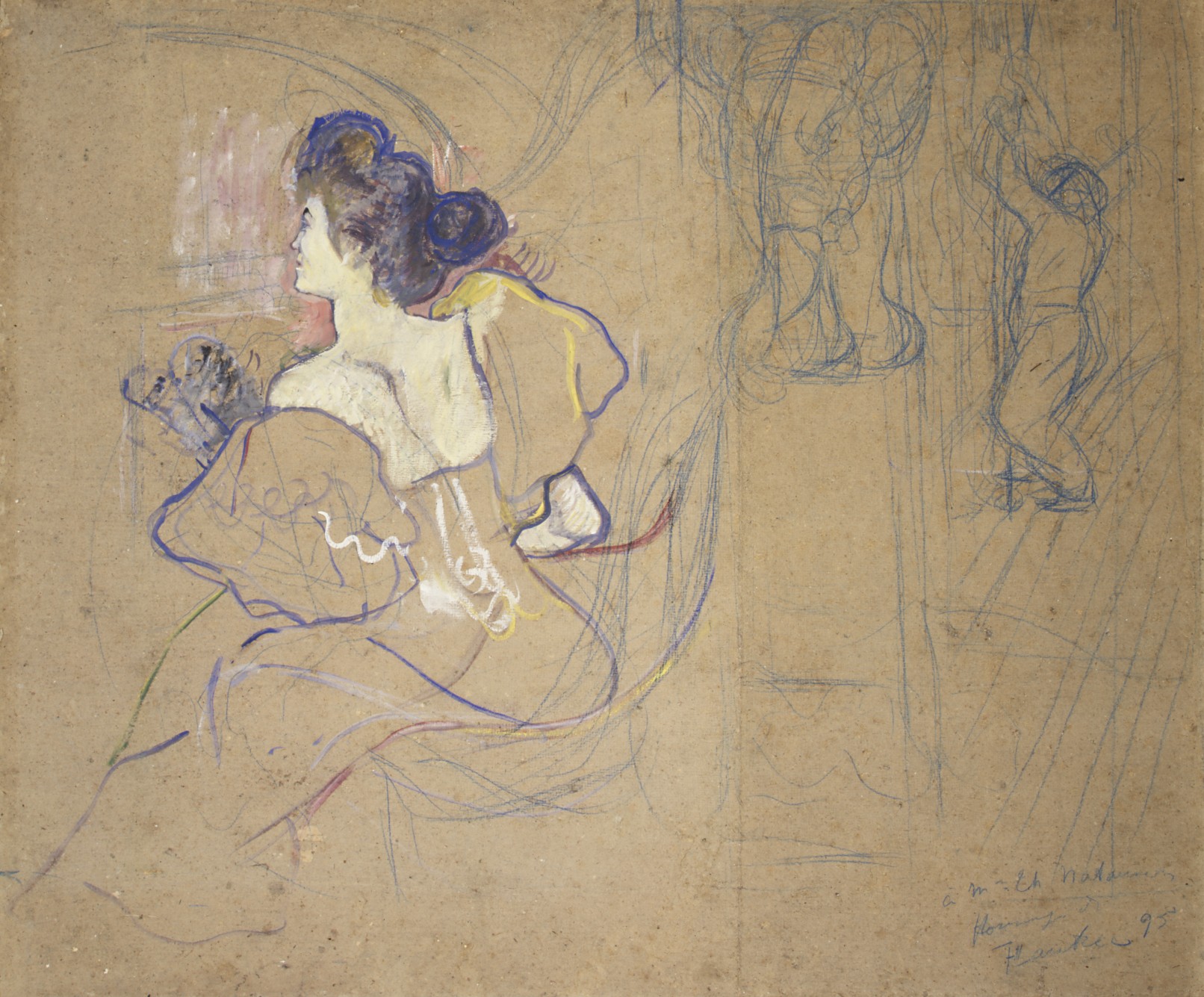
Lautrec made this study for the cover of the final issue of L'Estampe Originale (1893–95), a quarterly album of original prints by young French artists. Fittingly, it shows stagehands bringing down the curtain on a performance. In the middle, a plaster elephant stands guard atop a cartouche for the table of contents. Seated at left is Misia Natanson, the glamorous patroness of poets Paul Verlaine and Stéphane Mallarmé, and of artists including Lautrec, Bonnard, and Vuillard. Now restored, this work was once sliced into two pieces and framed so as to reveal only Misia in her loge.
This image cannot be enlarged, viewed at full screen, or downloaded.
Open Access
As part of the Met's Open Access policy, you can freely copy, modify and distribute this image, even for commercial purposes.
API
Public domain data for this object can also be accessed using the Met's Open Access API.
Use your arrow keys to navigate the tabs below, and your tab key to choose an item
Title:Madame Thadée Natanson (Misia Godebska, 1872–1950) at the Theater
Artist:Henri de Toulouse-Lautrec (French, Albi 1864–1901 Saint-André-du-Bois)
Date:1895
Medium:Oil on cardboard
Dimensions:24 1/2 x 29 1/2 in. (62.2 x 74.9 cm)
Classification:Drawings
Credit Line:Gift of Mr. and Mrs. Richard Rodgers, 1964
Object Number:64.153
Inscription: Signed, dated, and inscribed (lower right): à Meth, Natanson / Hommages de / HTLautrec [HTL in monogram] 95 (to Madame Thadée Natanson / With the compliments of / HTLautrec 95)
Misia Natanson, Paris (from 1895); [Ambroise Vollard, Paris]; Marcel Guérin, Paris (by 1926–at least 1939); [Jacques Lindon, New York, until 1950; sold December 9 for $8,000 to Rodgers]; Mr. and Mrs. Richard Rodgers, New York (1950–64; his life interest, 1964–d. 1972; her life interest, 1964–d. 1992)
Paris. Musée des Arts Décoratifs. "Exposition H. de Toulouse-Lautrec," April 9–May 17, 1931, no. 138 (as "Madame Th. Natanson," lent by M. Marcel Guérin).
Paris. M. Knoedler & Co. "Toulouse-Lautrec, 1864–1901," March 1938, no. 26 (lent by M. Marcel Guérin).
Hartford. Wadsworth Atheneum. "Music Makers," July 9–August 9, 1959, no. 18 (lent by Mr. and Mrs. Richard Rodgers).
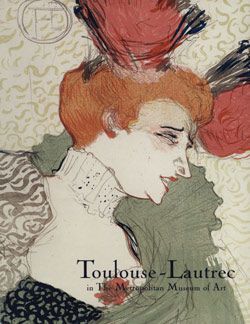
New York. The Metropolitan Museum of Art. "Toulouse-Lautrec in The Metropolitan Museum of Art," July 2–September 29, 1996, unnumbered cat. (fig. 45).
Roslyn Harbor, N.Y. Nassau County Museum of Art. "Art and Entertainment," November 18, 2007–February 3, 2008, no catalogue.
Paris. Musée d'Orsay. "Misia, Reine de Paris," June 12–September 9, 2012, unnumbered cat. (fig. 17).
LOAN OF THIS WORK IS RESTRICTED.
Maurice Joyant. Henri de Toulouse-Lautrec, 1864–1901. Vol. 1, Peintre. Paris, 1926, p. 292, as in the collection of Marcel Guérin.
Jacques Lassaigne. Toulouse-Lautrec. London, 1939, p. 167, ill. p. 117, as Madame Missia [sic] Natanson, in the collection of Marcel Guérin.
Gerstle Mack. Letter to Mrs. Richard Rodgers. December 20, 1950, discusses this work, as well as a lithograph for which it is a study.
Misia Sert. Two or Three Muses: The Memoirs of Misia Sert. London, 1953, p. 62, remarks that she prefered it to all other portraits of herself Toulouse-Lautrec painted.
Lawrence Hanson and Elisabeth Hanson. The Tragic Life of Toulouse-Lautrec, 1864–1901. London, 1956, p. 158, remark that the subject was one of the few women of his own class with whom Lautrec could interact, and thus he expressed his devotion with this and numerous other portraits.
Henri Perruchot. T-Lautrec. [Paris], 1958, p. 243 [English ed., 1960, p. 203].
Charles Sterling and Margaretta M. Salinger. French Paintings: A Catalogue of the Collection of The Metropolitan Museum of Art. Vol. 3, XIX–XX Centuries. New York, 1967, pp. 205–6, ill. (detail).
James Laver. "Fashion, Art, and Beauty." Metropolitan Museum of Art Bulletin 26 (November 1967), p. 127, ill. (detail).
M. G. Dortu. Toulouse-Lautrec et son œuvre. New York, 1971, vol. 3, pp. 368–69, no. P.599, ill., adds the sitter and Vollard to the provenance of this picture.
G. M. Sugana inThe Complete Paintings of Toulouse-Lautrec. London, 1973, p. 113, no. 413.
Götz Adriani. Toulouse-Lautrec: Das gesamte graphische Werk. Cologne, 1976, p. 263.
Arthur Gold and Robert Fizdale. Misia: The Life of Misia Sert. New York, 1980, p. 41, ill. opp. p. 114 (color detail).
Tom Prideaux. "Misia, a free spirit, knew (and loved) just about everyone." Smithsonian 10 (February 1980), p. 94, ill. on cover (color detail).
Götz Adriani. Toulouse-Lautrec: Das gesamte graphische Werk. Cologne, 1986, p. 181.
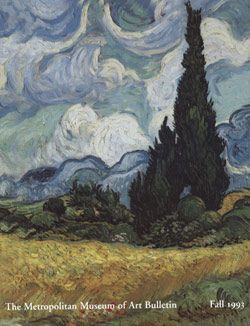
Gary Tinterow in "Recent Acquisitions, A Selection: 1992–1993." Metropolitan Museum of Art Bulletin 51 (Fall 1993), p. 52, ill. (color), remarks that this is a study for the cover of the final issue of "L'estampe originale," for which Lautrec had also provided the first cover illustration, noting the appropriateness of the curtain being rung down; identifies the plaster elephant as one used previously as an illustration for a Hindustani play, "The Terracotta Chariot"; states that although the work had been sliced into two pieces, it has recently been skillfully pieced together.
Katharine Baetjer. European Paintings in The Metropolitan Museum of Art by Artists Born Before 1865: A Summary Catalogue. New York, 1995, p. 505, ill. p. 504.
Colta Ives. Toulouse-Lautrec in The Metropolitan Museum of Art. Exh. cat., The Metropolitan Museum of Art. New York, 1996, pp. 45, 61, fig. 45, suggests that the ornamental elephant may have been inspired by the animal rides of the Bois de Boulogne or the papier-maché model at the Moulin Rouge.
Claude Arnaud inMisia, reine de Paris. Ed. Isabelle Cahn, Guy Cogeval, and Marie Robert. Exh. cat., Musée d'Orsay. Paris, 2012, p. 27.
Misia, reine de Paris. Ed. Isabelle Cahn, Guy Cogeval, and Marie Robert. Exh. cat., Musée d'Orsay. Paris, 2012, p. 182, fig. 17 (color), note that Misia is depicted watching "Chariot de terre cuite," which was presented by the Théâtre de l'Oeuvre on January 22, 1895, and that Toulouse-Lautrec had done the set design and illustrated program for the lyric drama.
Martine Kaufmann inMisia, reine de Paris. Ed. Isabelle Cahn, Guy Cogeval, and Marie Robert. Exh. cat., Musée d'Orsay. Paris, 2012, pp. 142, 165 n. 19, mistakenly identifies the medium as gouache.
Abigail Yoder inDegas, Impressionism, and the Paris Millinery Trade. Exh. cat., Saint Louis Art Museum. San Francisco, 2017, p. 176 n. 1, under no. 45.
Stéphane Guégan inToulouse-Lautrec: Résolument moderne. Ed. Stéphane Guégan. Exh. cat., Galeries nationales du Grand Palais. Paris, 2019, fig. 21 (color).
Misia Natanson was one of Lautrec's favorite models. At the time of this portrait, she was the wife of Thadée Natanson, who in 1891 founded La revue blanche, a magazine devoted to contemporary arts and letters. She later married the financier Alfred Edwards and, finally, the Spanish artist José-Maria Sert.
Gerstle Mack (1950) describes Lautrec's portraits of Mme Natanson in the 1952 edition of Toulouse-Lautrec, including a poster for La revue blanche in 1935 (Delteil 355), the cover for L'estampe originale in 1895, a poster in 1896 for the Ault Wiborg Co., a head in pastel and gouache in 1896, two portraits in 1897, and two pencil drawings in 1898.
This painting is a study for a lithograph which served as the last issue of L'estampe originale in March 1895 (Delteil 127; The Met 22.82.1–81).
In a letter to Mrs. Rodgers in December 1950, Mack states that the figure of Madame Natanson was to appear on the back of the cover, while the elephant and the stagehand were on the front. The painting was folded under and framed to show only its left hand side, but has since been straightened out, conserved, and reframed to show the entire sheet.
The performance depicted has been identified as Victor Barrucand's adaptation of the Sanskrit "Chariot de terre cuite" (The Little Clay Cart) by Shudraka, which was presented by the Théâtre de l'Oeuvre on January 22, 1895. Toulouse-Lautrec created both the set design and the illustrated program for the lyric drama (see Cahn, Cogeval, and Robert 2012).
Henri de Toulouse-Lautrec (French, Albi 1864–1901 Saint-André-du-Bois)
1898
Resources for Research
The Met's Libraries and Research Centers provide unparalleled resources for research and welcome an international community of students and scholars.
The Met Collection API is where all makers, creators, researchers, and dreamers can connect to the most up-to-date data and public domain images for The Met collection. Open Access data and public domain images are available for unrestricted commercial and noncommercial use without permission or fee.
Feedback
We continue to research and examine historical and cultural context for objects in The Met collection. If you have comments or questions about this object record, please complete and submit this form. The Museum looks forward to receiving your comments.