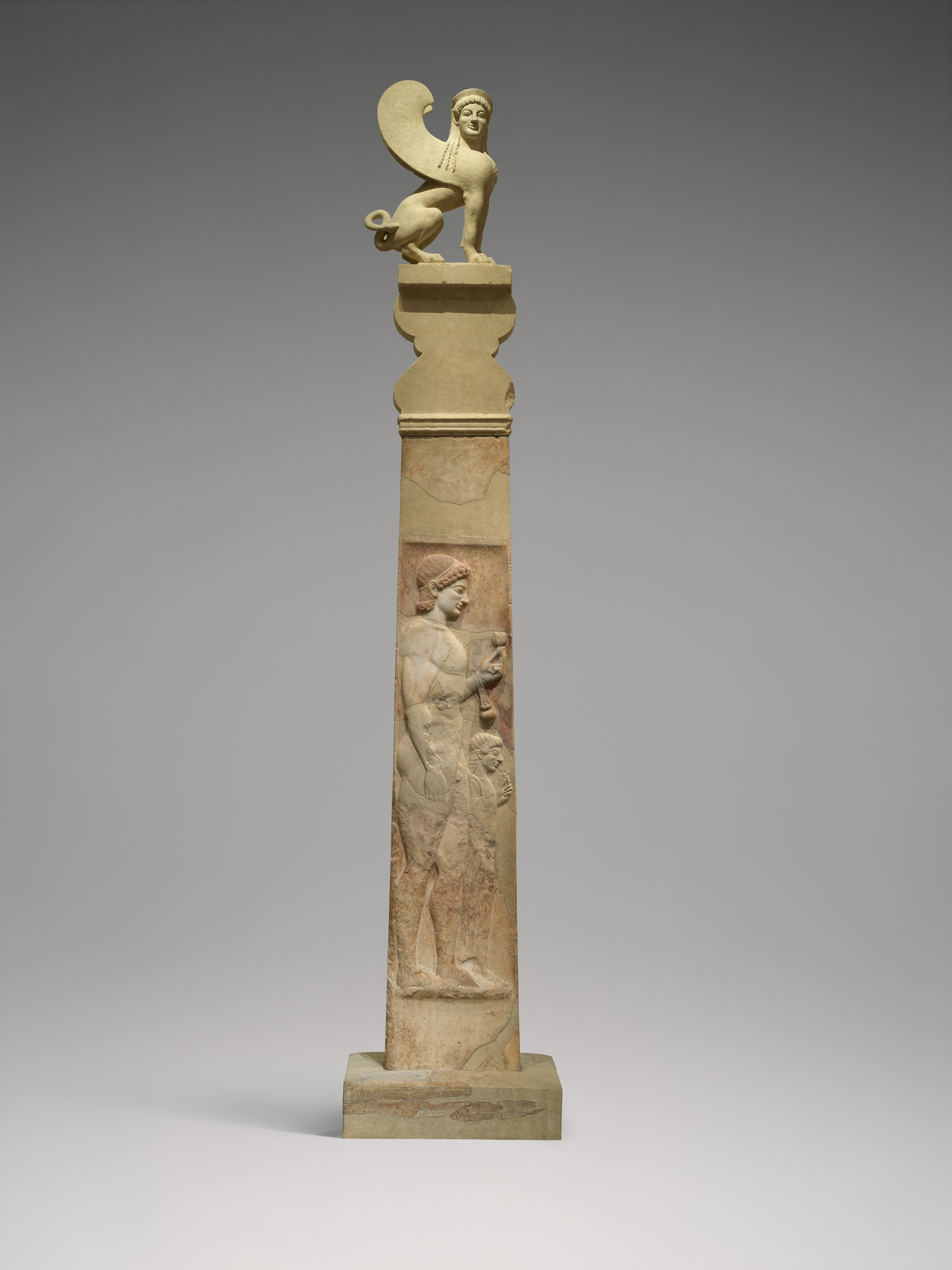
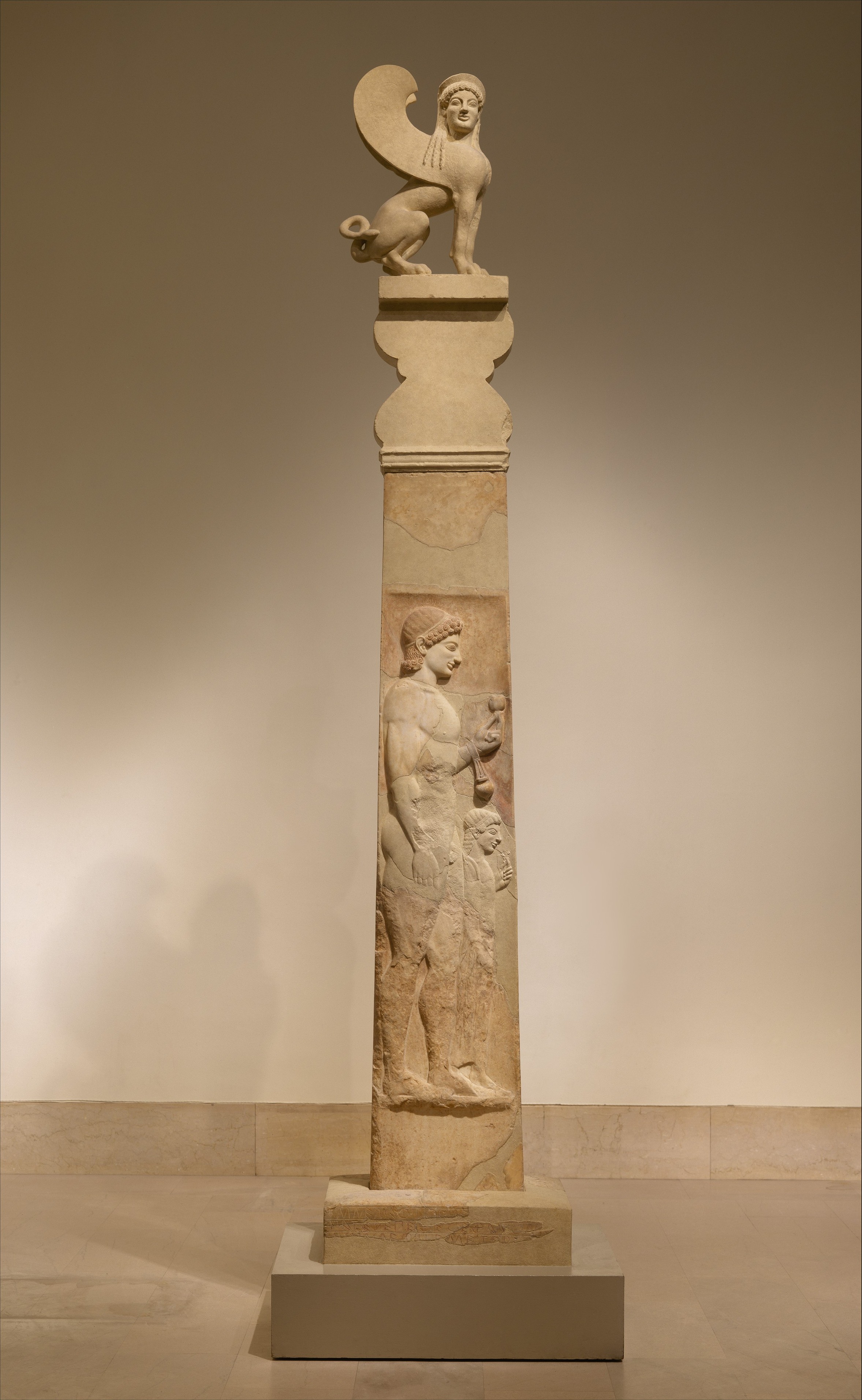
Inscribed on the base: to dear Me[gakles], on his death, his father with his dear mother set [me] up as a monument
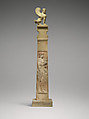
This is the most complete grave monument of its type to have survived from the Archaic period. Fragments were acquired by The Metropolitan Museum of Art in 1911, 1921, 1936, 1938, and 1951. The fragment with the girl's head, here a plaster copy, was acquired in 1903 by the Berlin Museums; the fragment with the youth's right forearm, also a plaster cast here, is in the National Museum in Athens. The capital and crowning sphinx are casts of the originals, displayed in a case nearby.
The youth on the shaft is shown as an athlete, with an aryballos (oil flask) suspended from his wrist. Athletics were an important part of every boy's education, and oil was used as a cleanser after exercise. He holds a pomegranate—a fruit associated with both fecundity and death in Greek myths—perhaps indicating that he had reached puberty before his death. The little girl, presumably a younger sister, holds a flower.
This exceptionally lavish monument, which stands over thirteen feet high, must have been erected by one of the wealthiest aristocratic families. Some scholars have restored the name of the youth in the inscription as Megakles, a name associated with the powerful clan of the Alkmeonidai, who opposed the tyrant Peisistratos during most of the second half of the sixth century B.C. The tombs of aristocratic families were sometimes desecrated and destroyed as a result of that conflict, and this stele may well have been among them.
#1012. Marble stele (grave marker) of a youth and a little girl, Part 1
0:00
0:00
Playlist
1012. Marble stele (grave marker) of a youth and a little girl, Part 1
1012. Marble stele (grave marker) of a youth and a little girl, Part 2
1444. Marble stele (grave marker) of a youth and a little girl, Part 3
This artwork is meant to be viewed from right to left. Scroll left to view more.
This image cannot be enlarged, viewed at full screen, or downloaded.
Infrared-reflected image of aryballos showing traces of painted decoration
Artwork Details
Use your arrow keys to navigate the tabs below, and your tab key to choose an item
Title:Marble stele (grave marker) of a youth and a little girl
Period:Archaic
Date:ca. 530 BCE
Culture:Greek, Attic
Medium:Marble
Dimensions:total H. 166 11/16 in. (423.4cm)
Classification:Stone Sculpture
Credit Line:Frederick C. Hewitt Fund, 1911; Rogers Fund, 1921; and Anonymous Gift, 1951
Object Number:11.185a–c, f, g
Inscription: On the base: "To dear Me[gakles], on his death, his father with his dear mother set (me) up as a monument."
Said to have come from Kataphygi, Attica
Fragmentary shaft (a); base (b); acroterion (c): [Until 1903, Edward Perry Warren, Lewes House, England]; [1903-1909, owned joined by Edward P. Warren and John Marshall, Lewes House, England]; [1909-1911, with John Marshall, Lewes House, England]; acquired in 1911, purchased from John Marshall.
Fragment of youth’s shoulder and arm: [Until 1922, with M.L. Kambanis, Athens and Paris]; acquired in 1922, purchased from M.L. Kambanis.
Fragments of the inscription at base (f, g): [Until 1951, with Theodore Zoumboulakis, Paris]; 1951, purchased from Th. Zoumboulakis by Walter Cummings Baker; acquired in 1951, gift of Walter C. Baker.
Robinson, Edward. 1913. "An Archaic Greek Grave Monument." Bulletin of the Metropolitan Museum of Art, 8(5): pp. 94–99.
Langlotz, Ernst. 1920. Zur zeitbestimmung der strengrotfigurigen Vasenmalerei und der gleichzeitigen Plastik. p. 17, Leipzig: E. A. Seemann.
Metropolitan Museum of Art. 1922. "Accessions and Notes: A New Fragment of the Archaic Stele." Bulletin of the Metropolitan Museum of Art, 17(3): p. 68.
Chase, George H. 1924. Greek and Roman Sculpture in American Collections. pp. 25–28, figs. 27, 28, Cambridge, MA: Harvard University Press.
Richter, Gisela M. A. 1927. Handbook of the Classical Collection. pp. 232–35, 283, figs. 158, 159, New York: The Metropolitan Museum of Art.
Lawrence, Arnold Walter. 1929. Classical Sculpture. pp. 131–32, pl. 12b, London: J. Cape.
Richter, Gisela M. A. 1940. "An Archaic Greek Sphinx." Bulletin of the Metropolitan Museum of Art, 35(9): pp. 178–80, figs. 1–4.
Hall, Lindsley F. 1944. "Notes on the Colors Preserved on the Archaic Attic Gravestones in the Metropolitan Museum." American Journal of Archaeology, 48(4): p. 334–35, pl. VII.
Hill, Dorothy Kent. 1944. "Hera, the Sphinx?." Hesperia, 13(4): pp. 357–58, fig. 5, pl. XIII.
Richter, Gisela M. A. 1944. "Polychromy in Greek Sculpture." Bulletin of the Metropolitan Museum of Art, 2(8): p. 324, pl. VII.
Richter, Gisela Marie Augusta. 1944. "Polychromy in Greek Sculpture with Special Reference to the Archaic Attic Gravestones in the Metropolitan Museum." American Journal of Archaeology, 48(4): pp. 233–40, pls. 1–4.
Richter, Gisela M. A. 1944. Archaic Attic Gravestones. pp. 64–74, figs. 73–79, Cambridge, MA: Oberlin College.
Richter, Gisela M. A. 1950. The Sculpture and Sculptors of the Greeks, 3rd edn. pp. 132, 158, 491, 502, figs. 423, 458, New Haven: Yale University Press.
Richter, Gisela M. A. 1953. Handbook of the Greek Collection. no. 1, p. 134, pl. 113, Cambridge, Mass.: Harvard University Press.
Dohrn, Tobias. 1957. Attische Plastik vom Tode des Phidias bis zum Wirken der grossen Meister des iv. Jahrhunderts v. Chr. no. 46
, pp. 94, 234, Krefeld: Scherpe.
Richter, Gisela M. A. 1961. The Archaic Gravestones of Attica. no. 37, p. 27, figs. 96–109, 19, London: Phaidon Press.
Pfohl, Gerhard. 1964. Monument und Epigramm: Studien zu den metrischen Inschriften der Griechen. p. 60, fig. 4, Nuremburg: Universität Erlangen-Nürnberg.
Cole, Nancy. 1968. Greek Athletic Games. no. 17, New York: The Metropolitan Museum of Art.
Richter, Gisela M. A. 1970. "The Department of Greek and Roman Art: Triumphs and Tribulations." Metropolitan Museum Journal, 3: pp. 75–77, 82–83, 89–90, figs. 4, 18, 34.
Hoving, Thomas. 1970. "Director's Choice." Bulletin of the Metropolitan Museum of Art, 28(5): p. 203.
Richter, Gisela M. A. 1974. "The Story of the Megakles' Stele in New York." Mélanges Mansel, 1, Arif Müfid Mansel, ed. pp. 1–5, Ankara: Turk Tarih Kurumu Basimeri.
Robertson, Martin and Cambridge University Press. 1975. A History of Greek Art, Vols. 1 and 2. pp. 108ff., pl. 29a, Cambridge, England.
Karouzou, Semni Papaspyridi. 1976. "On the Brother and Sister Stele in the Museums of New York, Athens, and Berlin." Archaiologikon Deltion, 31: pp. 9–22, 353–58, pls. 1, 2.
Reuterswärd, Patrik. 1980. Studien zur Polychromie der Plastik. p. 78, Stockholm: Bokförlaget Svenska.
Martelli, Marina Cristofani. 1983. "Il 'Marte' di Ravenna." Xenia Antiqua, 6: p. 10, fig. 15.
Metropolitan Museum of Art. 1987. Greece and Rome. no. 16, pp. 30–31, New York: The Metropolitan Museum of Art.
Ridgway, B.S. 1990. "Metal Attachments in Greek Marble Sculpture." Marble: Art Historical and Scientific Perspectives on Ancient Sculpture, Dr. Marion True and Mr. Jerry Podany, eds. p. 201, Malibu, C.A.: J. Paul Getty Museum.
Bodel, John P. and Stephen Tracy. 1997. Greek and Latin Inscriptions in the USA : A Checklist. p. 184, Rome: American Academy in Rome.
Brinkmann, Vinzenz. 1998. Frisuren in Stein: Arbeitsweisen frühgriechischer Bildhauer. pp. 28, 44, n. 119, München: Biering und Brinkmann.
Manchester, Karen. 1999. "The New Greek and Roman Galleries at the Metropolitan Museum of Art." Apollo, 150: p. 10, fig. 15.
Oakley, John H., Lesley A. Beaumont, H. Alan Shapiro, and Jenifer Neils. 2003. "Death and the Child." Coming of Age in Ancient Greece: Images of Childhood from the Classical Past, Jenifer Neils, John H. Oakley, and Katherine Hart, eds. p. 180, fig. 19, New Haven: Hood Museum of Art, Dartmouth College.
Picón, Carlos A. 2007. Art of the Classical World in the Metropolitan Museum of Art: Greece, Cyprus, Etruria, Rome no. 71, pp. 74–75, 420, New York: The Metropolitan Museum of Art.
Stylianou, Andreas and Patrick Schollmeyer. 2007. "Der Sarkophag aus Golgoi." Dynastensarkophage mit szenischen Reliefs aus Byblos und Zypern: Der Sarkophag aus Amathous als Beispiel kontaktinduzierten Wandels, 2. pp. 37 n. 192, 154 n. 1276, 174, Mainz am Rhein: Philipp von Zabern.
Oakley, John H., Olga Palagia, and H. Alan Shapiro. 2009. "Children in Athenian Funerary Art During the Peloponnesian War." Art in Athens During the Peloponnesian War, Olga Palagia, ed. p. 213, Cambridge: Cambridge University Press.
Mertens, Joan R. 2010. How to Read Greek Vases. pp. 46, 59, 62, fig. 26, New York: The Metropolitan Museum of Art.
Schwarzmaier, Agnes. 2012. Die Antikensammlung: Altes Museum, Neues Museum, Pergamonmuseum no. 23, pp. 59–60, fig. 15, Darmstadt: Verlag Philipp von Zabern.
Lazzarini, Lorenzo and Clemente Marconi. 2014. "A New Analysis of Major Greek Sculptures in the Metropolitan Museum: Petrological and Stylistic." Metropolitan Museum Journal, 49: pp. 125–26, 130, fig. 24.
Zanker, Paul. 2022. Afterlives : Ancient Greek Funerary Monuments in the Metropolitan Museum of Art. no. 5, pp. 34–37, New York: Scala Publishers.
Williams, Dyfri, Kenneth Lapatin, Nicholaus Dietrich, Judith M. Barringer, Francois Lissarrague, and Edinburgh University Press. 2022. Images at the Crossroads : Media and Meaning in Greek Art, Judith M. Barringer and Francois Lissarrague, eds. pp. 311, 312, 421, 433–36, fig. 14.1, Edinburgh.
Estrin, Seth. 2023. "Archaic Sculpture and Archaisms of Gender:
Rethinking the “Brother and Sister Stele”." The Art Bulletin, 105(3): pp. 33–60, figs. 3–4, 9–10, 12–14, 17.
Basso, Elena, Federico Caro, and De Abramitis. 2023. "Polychromy in Ancient Greek Sculpture: New Scientific
Research on an Attic Funerary Stele at the Metropolitan
Museum of Art." Applied Sciences, 15(5): pp. 1–16, figs. 1–10.
Hemingway, Seán and Sarah Lepinski. 2025. "Chroma : Ancient Sculpture in Color and Anceint Polychromy at The Met." Chroma : Sculpture in Color from Antiquity to Today, The Metropolitan Museum of Art Symposia, Seán Hemingway, Sarah Lepinski, and Vinzenz Brinkmann, eds. p. 14, fig. 1, New York: The Metropolitan Museum of Art.
Geffert, Scott and Jessica Ng. 2025. "3D Imaging the Sphinx : Challenges, solutions and opportunities." Chroma : Sculpture in Color from Antiquity to Today, The Metropolitan Museum of Art Symposia, Seán Hemingway, Sarah Lepinski, and Vinzenz Brinkmann, eds. p. 83, fig. 1, New York: The Metropolitan Museum of Art.
The Met's Libraries and Research Centers provide unparalleled resources for research and welcome an international community of students and scholars.
The Met Collection API is where all makers, creators, researchers, and dreamers can connect to the most up-to-date data and public domain images for The Met collection. Open Access data and public domain images are available for unrestricted commercial and noncommercial use without permission or fee.
Feedback
We continue to research and examine historical and cultural context for objects in The Met collection. If you have comments or questions about this object record, please complete and submit this form. The Museum looks forward to receiving your comments.
The Museum's collection of Greek and Roman art comprises more than 30,000 works ranging in date from the Neolithic period to the time of the Roman emperor Constantine's conversion to Christianity in A.D. 312.