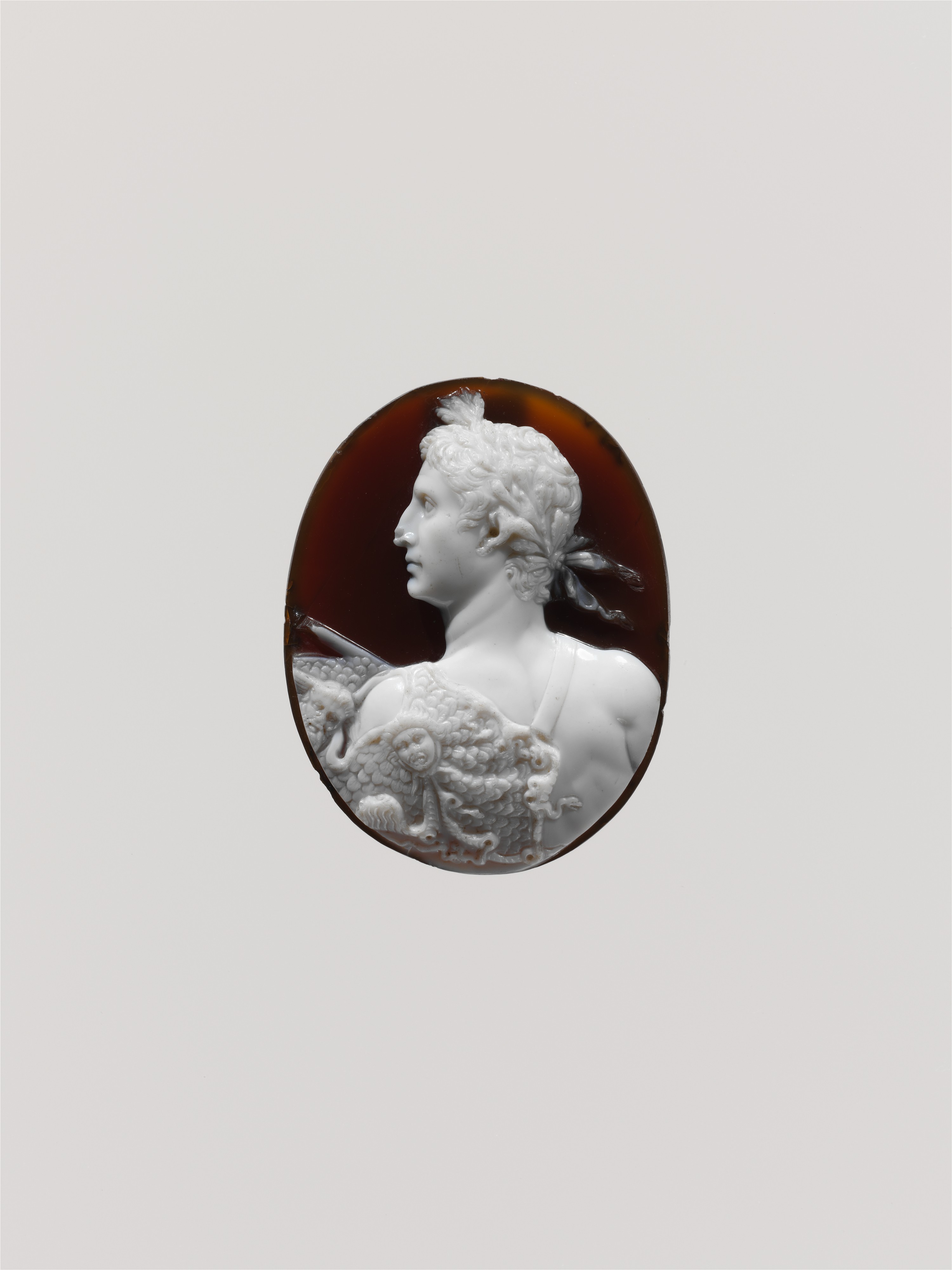
The cameo depicts Augustus as a triumphant demigod wearing the aegis, a cape usually associated with Jupiter and Minerva. Here, it is decorated with the head of a wind god, perhaps intended as a personification of the summer winds that brought the corn fleet from Egypt to Rome and so an oblique reference to Augustus’s annexation of Egypt after the defeat of Mark Antony and Cleopatra at Actium in 31 B.C.
#1074. Sardonyx cameo portrait of the Emperor Augustus
Credit Line:Purchase, Joseph Pulitzer Bequest, 1942
Object Number:42.11.30
Collection of Thomas Howard, Earl of Arundel (1585-1646); until 1875, collection of the Dukes of Marlborough; by 1900, collection of Sir Arthur Evans; acquired in 1941, purchased from the estate of Sir Arthur Evans.
Story-Maskelyne Collection. 1870. The Marlborough Gems; being a collection of works in cameo and intaglio, formed by George, third duke of Marlborough. no. 481, p. 80, London: Printed for Private Distribution.
Fürtwangler, Adolf. 1900. Die antiken Gemmen: Geschichte der Steinschneidekunst im klassischen Altertum. pl. LXV, 49, Leipzig, Berlin: Giesecke & Devrient.
1904. Exhibition of Ancient Greek Art M137, pl. CXII, London: Burlington Fine Arts Club.
Evans, Arthur J. 1938. An Illustrative Selection of Greek and Greco-Roman Gems to which is Added a Minoan and Proto-Hellenic Series. no. 140
, Oxford: Oxford University Press.
Richter, Gisela M. A. 1942. "Multum in Parvo: An Exhibition of Newly Acquired Engraved Ancient Gems." American Journal of Archaeology, 46(4): pp. 488–89, fig. 1.
Richter, Gisela M. A. 1942. Ancient Gems from the Evans and Beatty Collection. no. 52, New York: The Metropolitan Museum of Art.
Richter, Gisela M. A. 1948. Roman Portraits, 2nd edn. p. 24, p. ii, New York: The Metropolitan Museum of Art.
Richter, Gisela M. A. 1949. "Glyptic Portraits of the late Republic and early Empire in the Metropolitan Museum." Hommages à Joseph Bidez et à Franz Cumont. p. 299, pl. XXII, 10, Brussels: Latomus, revue d'études latines.
Richter, Gisela M. A. 1956. Catalogue of Engraved Gems of the Classical Style: Greek, Etruscan, and Roman. no. 648, p. 130, pl. 73, Rome: L'Erma di Bretschneider.
Vollenweider, Marie-Louise. 1966. Die Steinschneidekunst und ihre Künstler in spätrepublikanischer und augusteischer Zeit. pp. 67, n. 10, 68, n. 17, 79, n. 78, pl. 72.3, Baden-Baden: Grimm.
Hafner, G. 1969. "Der Adlerkameo und die Auffindung des Telephos." Aachener Kunstblätter, : pp. 215–17, fig. 7.
Kyrieleis, Helmut. 1971. "Der Kameo Gonzaga." Bonner Jahrbücher des Rheinisehen Landesmuseum in Bonn, 171: p. 169–70, fig. 6.
Guépin, Jan Pieter. 1976. "Alexander Promachos." Festoen : opgedragen aan A.N. Zadoks-Josephus Jitta bij haar zeventigste verjaardag, Annie N. Zadoks-Josephus Jitta, ed. p. 313, fig. 5, Bussum: H.D. Tjeenk Willink.
Giard, Jean-Baptiste. 1978. "L'illusion du portrait." Bulletin de la Bibliothèque Nationale, 3 (1): pp. 30, 32, fig. 5.
Zwierlein-Diehl, Erika. 1980. "Der Divus-Augustus-Kameo in Köln." Kölner Jahrbuch Für Vor-und-Frühgeschichte, 17: p. 30.
Bastien, Pierre. 1980. "Egide, Gorgonéion et Buste Impérial dans le Monnayage Romain." Numismatica e Antichità Classiche, 9: p. 254.
Metropolitan Museum of Art. 1987. Greece and Rome. no. 71, pp. 11, 98, New York: The Metropolitan Museum of Art.
Megow, Wolf-Rüdiger. 1987. Kameen von Augustus bis Alexander Severus, Antike Münzen und geschnittene Steine, XI, Deutsches Archaologisches Institut, ed. no. A 29, pp. 170–71, pl. 28.3, Berlin: Walter de Gruyter & Co.
Thomas, Renate. 1995. "Hellenistische Wurzeln Romischer Herrscherikonographie." Jahrbuch des Deutschen Archäologischen Instituts, 110: no. VI.8.1, pp. 368–69, 402, fig. 2.
Milleker, Elizabeth J. 2000. The Year One: Art of the Ancient World East and West, Elizabeth J. Milleker, ed. no. 47, pp. 59–61, 206, New York: The Metropolitan Museum of Art.
Antikensammlung, Pergamonmuseum, Staatliche Museen zu Berlin. 2002. Die Griechische Klassik: Idee oder Wirklichkeit. no. 506, pp. 646–47, Mainz: Verlag Philipp von Zabern.
Richter, Gisela M. A. 2006[1956]. Catalogue of Engraved Gems of the Classical Style: Greek, Etruscan, and Roman, 2nd edn. no. 648, p. 130, pl. 73, color pl. 20, Rome: L'Erma di Bretschneider.
Picón, Carlos A. 2007. Art of the Classical World in the Metropolitan Museum of Art: Greece, Cyprus, Etruria, Rome no. 384, pp. 333, 481–82, New York: The Metropolitan Museum of Art.
Zwierlein-Diehl, Erika. 2007. Antike Gemmen und ihr Nachleben. p. 436, fig. 622
, Berlin: Walter de Gruyter & Co.
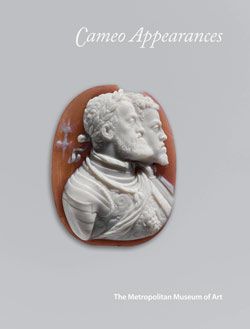
Draper, James David. 2008. "Cameo Appearances." Bulletin of the Metropolitan Museum of Art, 65(4): p. 14, fig. 18.
Boardman, John. 2009. The Marlborough Gems : formerly at Blenheim Palace, Oxfordshire. no. 52, p. 54, Oxford: Oxford University Press.
Metropolitan Museum of Art. 2012. The Metropolitan Museum of Art Guide. p. 79, New York: The Metropolitan Museum of Art.
Zanker, Paul and Matteo Cadario. 2013. Augusto, Eugenio La Rocca, ed. IV.1.7, pp. 158–59, 216–17, fig. 6, Milan: Electa.
Cadario, Matteo. 2014. Auguste, Eugenio La Rocca, ed. pp. 116–17, fig. 79, Paris: Grand Palais.
Zanker, Paul, Seán Hemingway, Christopher S. Lightfoot, and Joan R. Mertens. 2019. Roman Art : A Guide through the Metropolitan Museum of Art's Collection. no. 96, pp. 182, 191, 210, 382–83, fig. 157, New York: Scala Publishers.
Metropolitan Museum of Art. 2020. ART = Discovering Infinite Connections in Art History. p. 072, New York: Phaidon Press.
The Met's Libraries and Research Centers provide unparalleled resources for research and welcome an international community of students and scholars.
The Met Collection API is where all makers, creators, researchers, and dreamers can connect to the most up-to-date data and public domain images for The Met collection. Open Access data and public domain images are available for unrestricted commercial and noncommercial use without permission or fee.
Feedback
We continue to research and examine historical and cultural context for objects in The Met collection. If you have comments or questions about this object record, please complete and submit this form. The Museum looks forward to receiving your comments.
The Museum's collection of Greek and Roman art comprises more than 30,000 works ranging in date from the Neolithic period to the time of the Roman emperor Constantine's conversion to Christianity in A.D. 312.