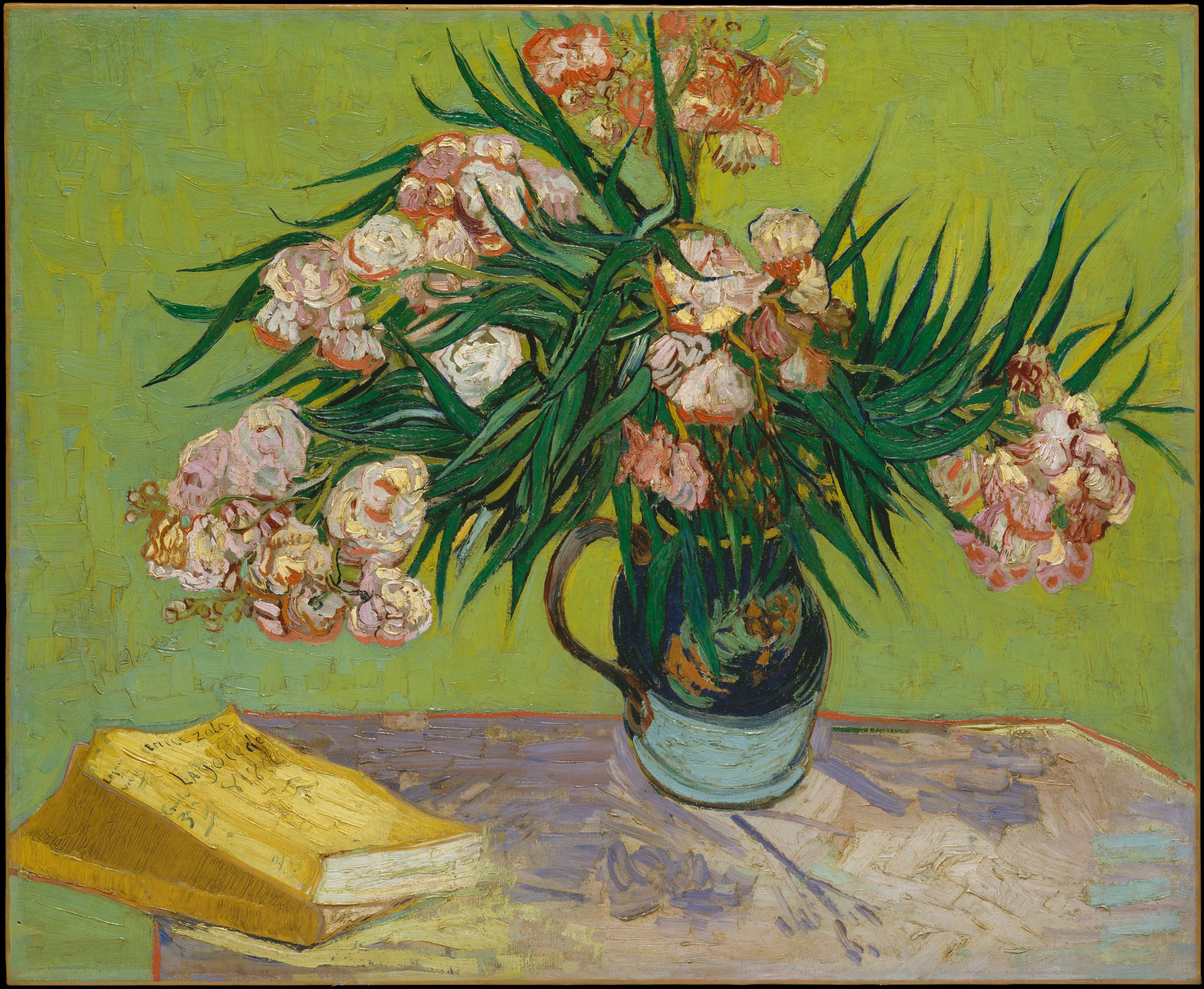
For Van Gogh, oleanders were joyous, life-affirming flowers that bloomed "inexhaustibly" and were always "putting out strong new shoots." In this painting of August 1888 the flowers fill a majolica jug that the artist used for other still lifes made in Arles. They are symbolically juxtaposed with Émile Zola's La joie de vivre, a novel that Van Gogh had placed in contrast to an open Bible in a Nuenen still life of 1885.
Use your arrow keys to navigate the tabs below, and your tab key to choose an item
Title:Oleanders
Artist:Vincent van Gogh (Dutch, Zundert 1853–1890 Auvers-sur-Oise)
Date:1888
Medium:Oil on canvas
Dimensions:23 3/4 x 29 in. (60.3 x 73.7 cm)
Classification:Paintings
Credit Line:Gift of Mr. and Mrs. John L. Loeb, 1962
Object Number:62.24
Inscription: Inscribed: (on cover of book) EMILE ZOLA / LA joie de / vivre; (on spine of book) La joie / de / vivre / Emile / Zola
the artist's sister-in-law, Johanna van Gogh-Bonger, Amsterdam (at least 1896–September 1905; sold for 2,000 Reichsmark through Cassirer [stock book no. 6808] to Reininghaus); Carl Reininghaus, Vienna (from 1905); Josef and Gertrud Redlich, Vienna (until ca. 1920); [Barbazanges, Paris]; [Alexander Reid in collaboration with Lefevre Gallery, London, until 1923; sold in November 1923 to Sadler]; Sir Michael E. Sadler, Oxford (1923–25; returned in April 1925 to Reid and Lefevre); [Alexander Reid in collaboration with Lefevre Gallery, London, 1925; sold for £2, 500 to Workman]; Mrs. R. A. Workman, London (1925–28; sold to Reid & Lefevre); [Alex. Reid & Lefevre, London, 1928]; [Knoedler, New York, and Alex. Reid & Lefevre, London, jointly owned in half-shares, 1928; Knoedler stock no. A279, as "Les Laurier [sic] roses"; sold on December 11 for $47,500 to Clark]; Mrs. William Andrews (Anna Eugenia La Chapelle) Clark, New York (1928–47); [Knoedler, New York, 1947]; Mrs. Charles Suydam Cutting, New York (1947–61); [Knoedler, New York, until 1962]
Groningen. Museum van Oudheden. "Vincent van Gogh," February 21–26, 1896, no. 52 (as "Oleanders") [see Feilchenfeldt 2013].
Rotterdam. Kunstzalen Oldenzeel. "Vincent van Gogh," March 1896, no. 47 (as "Oleanders") [see Feilchenfeldt 2013].
Paris. Galerie Vollard. December 1896–February 1897, no catalogue (exhibition checklist no. 28/215, as "Oleandre [Laurier roses]") [see Pratt 2007 and Feilchenfeldt 2013].
Amsterdam. Stedelijk Museum. "Tentoonstelling van Schilderijen en Teekeningen door Vincent van Gogh," July–August 1905, no. 122 (as "Oleanders," lent by Johanna van Gogh-Bonger) [see Feilchenfeldt 1988 and Sterling and Salinger 1967].
Dresden. Ernst Arnold. "II. Ausstellung: Vincent van Gogh, Constantin Guys," October 26–November 11, 1905, no. 25 (as "Oleander [Arles]") [see Feilchenfeldt 2013].
Berlin. Paul Cassirer. "Collectiv-Ausstellung," December 10–28, 1905, no catalogue [see Feilchenfeldt 1988].
Vienna. H. O. Miethke. "Die Neue Kunst," January–February 1913, no. 26 (as "Blumenstilleben") [see Feilchenfeldt 1988].
London. Lefevre Galleries. "Exhibition of the Post-Impressionist Masters: Gauguin, Van Gogh, Toulouse-Lautrec, Renoir"," October 25–November 24, 1923, no. 20 (as "Les Lauriers Roses").
Oxford Arts Club. "Loan Collection of Pictures and Drawings by Vincent van Gogh, 1853–1890," May 7–June 2, 1924, no. 1 (as "Les lauriers roses," lent by a member of the Club [Sadler]).
Paris. Galerie Marcel Bernheim. "Exposition rétrospective d'oeuvres de Vincent van Gogh (1853–1890)," January 5–24, 1925, no. 25 (as "Le vase aux lauriers-roses," lent by Sir M. E. Sadler).
London. National Gallery, Millbank [Tate Gallery]. "Opening Exhibition of the Modern Foreign Gallery," June–October 1926, unnum. checklist (p. 7, as "Les Lauriers roses," lent by Mrs. R. A. Workman).
New York. M. Knoedler & Co. "A Century of French Painting," November 12–December 8, 1928, no. 31 (as "Les Lauriers roses").
Washington. Corcoran Gallery of Art. May 1929, no catalogue [see Mechlin 1929].
San Francisco. California Palace of the Legion of Honor. "French Painting from the Fifteenth Century to the Present Day," June 8–July 8, 1934, no. 157 (as "The Rose-Laurel," lent by Mrs. William A. Clark, New York).
New York. M. Knoedler & Co. "Fourteen Masterpieces: Van Gogh," March 30–April 17, 1948, no. 9 (as "Les Lauriers roses").
New York. Paul Rosenberg. "Loan Exhibition of 21 Masterpieces by 7 Great Masters," November 15–December 18, 1948, no. 11 (as "Les Lauriers-Roses," lent by Mrs. C. Suydam Cutting).
New York. The Metropolitan Museum of Art. "Van Gogh: Paintings and Drawings," October 21, 1949–January 15, 1950, no. 90 (as "Oleanders," lent by Mrs. Charles Suydam Cutting, New York).
Art Institute of Chicago. "Van Gogh: Paintings and Drawings," February 1–April 15, 1950, no. 90 (as "Oleanders," lent by Mrs. Charles Suydam Cutting, New York).
Newark Museum. "Flower Paintings by European Masters of the 19th and 20th Centuries," May 16–June 25, 1950, no. 12 (lent by Mrs. C. Suydam Cutting).
Newark Museum. "From the Collection of Mrs. C. Suydam Cutting: Paintings, Drawings, Prints," February 8–April 25, 1954, no. 12 (as "Les Lauriers roses").
New York. The Metropolitan Museum of Art. "Van Gogh as Critic and Self-Critic," October 30, 1973–January 6, 1974, no. 2.
New York. The Metropolitan Museum of Art. "Van Gogh in Arles," October 18–December 30, 1984, no. 93.
Art Institute of Chicago. "Van Gogh and Gauguin: The Studio of the South," September 22, 2001–January 13, 2002, no. 60 (as "Oleanders and Zola's 'Joie de vivre'").
Amsterdam. Van Gogh Museum. "Van Gogh and Gauguin: The Studio of the South," February 9–June 2, 2002, no. 60.
Compton Verney, Warwickshire. Compton Verney House Trust. "Van Gogh and Britain: Pioneer Collectors," March 31–June 18, 2006, no. 18.
Edinburgh. Dean Gallery. "Van Gogh and Britain: Pioneer Collectors," July 7–September 24, 2006, no. 18.
New York. The Metropolitan Museum of Art. "Cézanne to Picasso: Ambroise Vollard, Patron of the Avant-Garde," September 14, 2006–January 7, 2007, no. 120.
Art Institute of Chicago. "Cézanne to Picasso: Ambroise Vollard, Patron of the Avant-Garde," February 17–May 13, 2007, no. 120.
Paris. Musée d'Orsay. "De Cézanne à Picasso: Chefs d'oeuvre de la galerie Vollard," June 19–September 16, 2007, no. 153.
Paris. Musée d'Orsay. "Van Gogh/Artaud: Le suicidé de la société," March 11–July 6, 2014, no. 36 (as "Les Lauriers roses").
Sapporo. Hokkaido Museum of Modern Art. "Van Gogh & Japan," August 26–October 15, 2017, no. 125.
Tokyo Metropolitan Art Museum. "Van Gogh & Japan," October 24, 2017–January 8, 2018, no. 125.
National Museum of Modern Art, Kyoto. "Van Gogh & Japan," January 20–March 4, 2018, no. 125.
London. National Gallery. "Van Gogh: Poets & Lovers," September 14, 2024–January 19, 2025, unnumbered cat. (colorpl. 77).
Vincent van Gogh. Letter to his brother Theo. [on or about August 13, 1888] [Van Gogh Museum, Amsterdam, inv. nos. b565 a-b V/1962; pub. in Van Gogh Letters 1958, letter no. 524; Van Gogh Letters 2009, letter no. 660], mentions that he hopes "to do a study of oleanders in the next few days".
Vincent van Gogh. Letter to his brother Theo. [August 29 or 30, 1888] [Van Gogh Museum, Amsterdam, inv. no. b571 V/1962; pub. in Van Gogh Letters 1958, letter no. 529; Van Gogh Letters 2009, letter no. 671], mentions that he has "a bouquet on the go," possibly this picture.
Ernst Schur. "Vincent van Gogh." Unterhaltungsblatt des Vorwärts 22 (December 19, 1905), p. 983 [reprinted in Echte and Feilchenfeldt 2011–16, vol. 3, p. 101], refers to it as “die kräftig roten Rosen in einer Vase zusammen mit grünem Lorbeer” [the bold red roses in a vase together with green laurels] and calls it “ein reifes und sicheres Werk, dem beides eigen ist, eine feste plastische Form und eine lebendige Farbe” [a mature and confident work, which possesses both a firm plastic form and a vivid color].
J. B. Manson. "The Workman Collection: Modern Foreign Art." Apollo 3 (March 1926), p. 143, ill. opp. p. 156 (color).
"London [exhibition notes]." Studio 93 (January 15, 1927), p. 38, ill. (color, frontispiece).
J.-B. de La Faille. L'Oeuvre de Vincent van Gogh: Catalogue Raisonné. Paris, 1928, vol. 1, p. 167, no. 593; vol. 2, pl. 164, as "Les lauriers-roses".
J. B. Manson. "A Century of French Painting." Apollo 8 (November 1928), p. 280.
Hanfstaengl-Drucke: Grosse Farbige Wiedergaben nach Meisterwerken der Malerei. Munich, [1929–30], pp. XXI, 33, ill., advertises large color reproductions of this painting, calling it "Laurier Roses" and dating it 1888.
Leila Mechlin. "Notes of Art and Artists: Negro Artists Show Their Work in Interesting Exhibition at National Gallery—Loan Collection at Corcoran—Other Exhibitions." The Sunday Star (May 19, 1929), p. 4, mentions that Van Gogh's "Roses" is on view in a small loan exhibition from the Clark collection but identifies the flowers actually depicted as pink oleanders, presumably those in this picture.
Wilhelm Uhde and Ludwig Goldscheider. Vincent van Gogh. Vienna, 1936, pl. 28, p. 3 of back matter, states incorrectly that the work was then still in the collection of Mrs. R. A. Workman.
W. Scherjon and Jos. De Gruyter. Vincent van Gogh's Great Period: Arles, St. Rémy and Auvers sur Oise (complete catalogue). Amsterdam, 1937, p. 106, Arles no. 80, ill.
Alexander Dorner. Vincent van Gogh: Blumen und Landschaften. Berlin, 1937, p. 16, colorpl. 4.
J.-B. de La Faille. Vincent van Gogh. London, [1939], pp. 411, 561, 577, 588, no. 594, ill.
W[ilhelm]. Uhde and Ludwig Goldscheider. Vincent van Gogh. New York, 1941, pl. 22 [German ed., Vienna, 1936], as in the collection of Mrs. R. A. Workman, London.
Judith Kaye Reed. "Seven Titans of Modern French Art." Art Digest 23 (December 1, 1948), ill. p. 12, as lent by Mrs. C. Suydam Cutting to the Rosenberg exhibition.
Philip James. Van Gogh. London, 1949, p. 16, colorpl. 5 [repub. in revised form in Philip James and T.W. Earp, "Van Gogh," vol. 2, London, 1950, p. 8, colorpl. 4], as in a private collection, U.S.A.; dates it August–September 1888.
Meyer Schapiro. Vincent van Gogh. New York, 1950, pp. 66–67, ill. (color).
"Flowers and Flower Paintings on View at Museum in Mid-May." Newark Museum News Notes 7 (May 1950), p. 2, ill.
Jean Seznec. "Literary Inspiration in Van Gogh." Magazine of Art 43 (December 1950), p. 284, ill. p. 282.
Jean Leymarie. Van Gogh. [Paris], 1951, pp. 27, 98, mentions it in connection with Zola's novel "La Joie de vivre," which Van Gogh also depicted in "Still Life with Open Bible" (F117; Van Gogh Museum, Amsterdam) of 1885.
"Collector's Choice at Newark." Art News 53 (March 1954), p. 57, ill., as lent by Mrs. Suydam Cutting to the Newark Museum; dates it 1888–89.
Frank Elgar. Van Gogh: A Study of His Life and Work. New York, 1958, no. 130, ill., as in the collection of Mrs. Charles Suydam Cutting, New York; dates it August 1888.
Vincent van Gogh. The Complete Letters of Vincent van Gogh with Reproductions of All the Drawings in the Correspondence. Greenwich, Conn., 1958, under letter nos. 524, 529 (possibly this work).
Catalogue of Colour Reproductions of Paintings—1860 to 1961. Paris, 1961, p. 174, no. 446, ill., as in a private collection, London.
John Rewald. Letter to A. M. Hammacher. April 29, 1962, writes that he showed Ref. La Faille 1939 to Joseph Roulin's daughter at Arles, from which she picked out the works that had once belonged to her parents, and which were sold to Vollard around 1895, including this picture [see Ref. La Faille 1970, p. 204].
Charles Sterling and Margaretta M. Salinger. French Paintings: A Catalogue of the Collection of The Metropolitan Museum of Art. Vol. 3, XIX–XX Centuries. New York, 1967, pp. 183–85, ill.
Margaretta M. Salinger. "Windows Open to Nature." Metropolitan Museum of Art Bulletin 27 (Summer 1968), unpaginated, ill.
J.-B. de La Faille. The Works of Vincent van Gogh: His Paintings and Drawings. Amsterdam, 1970, pp. 193, 204, 242–43, 634, no. 593, ill., as "Still Life: One-Eared Vase with Oleanders and Books"; dates it August 1888; does not include the 1905 Amsterdam exhibition because he does not believe this work ever belonged to Van Gogh-Bonger [but see Ref. Feichenfeldt 1988]; mentions that Van Gogh included the same vase in several other still lifes.
Claus Virch. "European Paintings." Metropolitan Museum of Art Bulletin 29 (October 1970), pp. 76, 78, ill.
Paolo Lecaldano. L'opera pittorica completa di Van Gogh e i suoi nessi grafici. Vol. 2, Da Arles a Auvers. repr. [1st ed., 1966]. Milan, 1971–77, pp. 210–11, no. 554, ill., as "Natura morta (due libri, vaso con oleandri)"; dates it August 1888.
Matthias Arnold. "Duktus und Bildform bei Vincent van Gogh." PhD diss., Ruprecht-Karl University, Heidelberg, 1973, pp. 121, 188 n. 218, p. 192 n. 335.
Anthony M. Clark inThe Metropolitan Museum of Art: Notable Acquisitions, 1965–1975. New York, 1975, p. 79, ill., dates it August–September 1888.
Pierre Descargues. Vincent van Gogh. Paris, 1975, p. 82, ill. p. 83 (color), dates it August 1888.
Douglas Cooper. Alex Reid & Lefevre 1926–1976. [London], 1976, p. 18, states that this picture was bought from Lefevre by Michael Sadler in November 1923, returned by him within a week, and then bought the following week by Mrs. Workman [but see Exh. Paris 1925, to which this painting was lent by Sadler].
Jan Hulsker. The Complete Van Gogh: Paintings, Drawings, Sketches. [1st ed., Amsterdam, 1977]. New York, 1980, pp. 356, 358, no. 1566, ill. p. 359, as "Majolica Jar with Branches of Oleander"; dates it August 1888.
Hope B. Werness. "Some Observations on Van Gogh and the 'Vanitas' Tradition." Studies in Iconography 6 (1980), p. 128 n. 20.
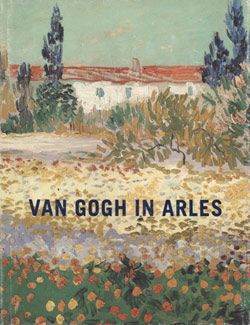
Ronald Pickvance. Van Gogh in Arles. Exh. cat., The Metropolitan Museum of Art. New York, 1984, pp. 159, 162–63, 166, no. 93, ill. (color), believes that this must be the "bunch of flowers" the artist referred to in a letter to his brother of late August 1888 (letter no. 529); states that it once belonged to Joseph Roulin.
A[braham]. M. Hammacher. Vincent van Gogh: Genius and Disaster. 2nd ed. [1st ed., New York, 1968]. New York, 1985, pp. 74–75, ill. (color).
Walter Feilchenfeldt. Vincent van Gogh & Paul Cassirer, Berlin: The Reception of Van Gogh in Germany from 1901 to 1914. Zwolle, The Netherlands, 1988, pp. 22, 106, 141, 145, 147, 149, 155, 158, ill., gives early provenance and exhibition history, and lists it in the 1905 Amsterdam exhibition.
Shuji Takashina. "Vincent van Gogh and French Literature." Vincent van Gogh: International Symposium. Ed. Shuji Takashina et al. Tokyo, 1988, p. 406.
Judith Bumpus. Van Gogh's Flowers. Oxford, 1989, pp. 70–71, colorpl. 37.
Almut Krapf-Weiler inVincent van Gogh and the Modern Movement: 1890–1914. Exh. cat., Museum Folkwang, Essen. Freren, Germany, 1990, p. 416.
Tsukasa Kodera. Vincent van Gogh: Christianity versus Nature. Amsterdam, 1990, pp. 46, 55, 144, pl. 71.
Judy Sund. True to Temperament: Van Gogh and French Naturalist Literature. Cambridge, 1992, pp. 187, 204–6, colorpl. 9.
Matthias Arnold. Vincent van Gogh: Werk und Wirkung. Munich, 1995, pp. 275, 279, colorpl. 136.
Katharine Baetjer. European Paintings in The Metropolitan Museum of Art by Artists Born Before 1865: A Summary Catalogue. New York, 1995, p. 495, ill.
Jan Hulsker. The New Complete Van Gogh: Paintings, Drawings, Sketches. rev. ed. Amsterdam, 1996, pp. 354, 358, no. 1566, ill. p. 359 (color), calls it "Majolica Jar with Branches of Oleanders," and dates it to the second half of August 1888; notes that it is the largest of three still lifes with flowers in the same vase, including no. 1567 (F594; location unknown) and no. 1568 (F592; private collection, Lausanne).
Georg Klusmann. Vincent van Gogh: Still Life with Peonies. Mainburg, Germany, 1996, p. 58.
Susan Alyson Stein in "Recent Acquisitions, A Selection: 1996–1997." Metropolitan Museum of Art Bulletin 55 (Fall 1997), pp. 5, 54, ill. (color), notes the analogy between the title of Zola's novel and the vitality of the flowers; contrasts the painting's format with those of his sunflowers, and compares it instead to his later flower paintings, such as "Irises" (MMA 58.187) and "Vase of Roses" (MMA 1993.400.5).
Naomi Margolis Maurer. The Pursuit of Spiritual Wisdom: The Thought and Art of Vincent van Gogh and Paul Gauguin. Madison, N.J., 1998, p. 75, fig. 129 (color), as "Vase with oleanders and books"; dates it August 1888.
Bogomila Welsh-Ovcharov. Van Gogh in Provence and Auvers. [New York], 1999, p. 141, ill. pp. 134–35 in color (overall and detail).
Douglas Druick and Peter Kort Zegers et al. Van Gogh and Gauguin: The Studio of the South. Exh. cat., Art Institute of Chicago. New York, 2001, pp. 128, 132, 381 n. 146, p. 406, no. 60, fig. 52 (color), as "Oleanders and Zola's 'Joie de vivre'".
Chris Stolwijk and Han Veenenbos. The Account Book of Theo van Gogh and Jo van Gogh-Bonger. Amsterdam, 2002, pp. 51, 125, 146–47, 180, ill., note that this is one of four paintings that Paul Cassirer sold for Van Gogh-Bonger for which she recorded payment on February 17, 1906; add that all four works went to different buyers, this one being purchased by Carl Reininghaus, Vienna, for 2,000 Reichsmark.
Madeleine Korn. "Collecting Paintings by Van Gogh in Britain Before the Second World War." Van Gogh Museum Journal (2002), pp. 131, 136, as "Still life: one–eared vase with oleanders and books"; notes that the archives of Reid & Lefevre show that the work was returned to the gallery by Michael Sadler in April 1925 and bought by Elizabeth Workman "within the week".
Hollis Clayson. "'Some Things Bear Fruit'? Witnessing the Bonds between Van Gogh and Gauguin." Art Bulletin 84 (December 2002), p. 673.
Martin Bailey inVan Gogh and Britain: Pioneer Collectors. Exh. cat., Compton Verney, Warwickshire. Edinburgh, 2006, pp. 24–25, 27, 30, 84, 126, 129, 137 n. 36, p. 141 n. 18, no. 18, ill. in color pp. 12 (detail) and 85, gives detailed provenance information.
Frances Fowle in "Van Gogh in Scotland." Van Gogh and Britain: Pioneer Collectors. Exh. cat., Compton Verney, Warwickshire. Edinburgh, 2006, pp. 40, 140 n. 15, 17, states that Reid & Lefevre sold it to Elizabeth Workman in March 1925 for £2,500.
Ronald Pickvance. "Exhibition Reviews, Van Gogh." Burlington Magazine 148 (July 2006), p. 501, ill. on cover (color).
Walter Feilchenfeldt. By Appointment Only: Cézanne, Van Gogh and Some Secrets of Art Dealing. English ed. London, 2006, p. 59, states that Cassirer sold it to Reininghaus out of the Hamburg exhibition of 1905.
Jonathan Pascoe Pratt inCézanne to Picasso: Ambroise Vollard, Patron of the Avant-Garde. Ed. Rebecca A. Rabinow. Exh. cat., The Metropolitan Museum of Art. New York, 2006, p. 54 [French ed., "De Cézanne à Picasso: Chefs-d'oeuvre de la galerie Vollard," Paris, 2007, p. 63], mentions it as one of fifty-six paintings included in the second Van Gogh exhibition at the Galerie Vollard, 6, rue Laffitte, around December 1896–February 1897.
Ann Dumas and Jonathan Pascoe Pratt inCézanne to Picasso: Ambroise Vollard, Patron of the Avant-Garde. Ed. Rebecca A. Rabinow. Exh. cat., The Metropolitan Museum of Art. New York, 2006, pp. 377, 379 n. 5 (under no. 124), no. 120, ill., give a critical review of the early provenance; argue that Johanna van Gogh-Bonger owned the painting rather than the Roulins, and contend that she lent it to an 1896 exhibition at the Galerie Vollard, from which it was returned to her unsold.
Anne Roquebert inCézanne to Picasso: Ambroise Vollard, Patron of the Avant-Garde. Ed. Rebecca A. Rabinow. Exh. cat., The Metropolitan Museum of Art. New York, 2006, p. 227, fig. 238 (color) [French ed., "De Cézanne à Picasso: Chefs-d'oeuvre de la galerie Vollard," Paris, 2007, p. 335, ill. p. 236 (color)].
Martin Gayford. "Voluptuous — and Venomous." Art News 105 (September 2006), pp. 130–31, ill. (color).
Martin Gayford. "Ploughed Fields of Paint." Apollo 169 (July 2006), p. 71, fig. 2 (color).
Belinda Thomson. Van Gogh Painter: The Masterpieces. Amsterdam, 2007, p. 97, fig. 83 (color).
Laura Ann Coyle. "The Still-Life Paintings of Vincent van Gogh and Their Context." PhD diss., Princeton University, September 2007, pp. 412–14, 477, fig. 6.23.
Gary Tinterow inThe Masterpieces of French Painting from The Metropolitan Museum of Art: 1800–1920. Exh. cat., Museum of Fine Arts, Houston. New York, 2007, p. 11.
Frances Fowle. Impressionism and Scotland. Exh. cat., National Gallery Complex. Edinburgh, 2008, pp. 88, 136.
Wouter van der Veen. Van Gogh: A Literary Mind. Literature in the Correspondence of Vincent van Gogh. Zwolle, The Netherlands, 2009, fig. 15 (color).
Susan Alyson Stein inMasterpieces of Impressionism and Post-Impressionism: The Annenberg Collection. Ed. Susan Alyson Stein and Asher Ethan Miller. 4th rev. ed. [1st ed., 1989]. New York, 2009, p. 192.
Vincent van Gogh. Vincent van Gogh—The Letters. Ed. Leo Jansen, Hans Luijten, and Nienke Bakker. London, 2009, vol. 4, pp. 232, 233 n. 4, under letter no. 660, p. 250, under letter no. 671, identify this picture as possibly the "bouquet on the go" referred to in letter no. 671.
Frances Fowle. Van Gogh's Twin: The Scottish Art Dealer Alexander Reid 1854-1928. Edinburgh, 2010, p. 142.
Steven Naifeh and Gregory White Smith. Van Gogh: The Life. New York, 2011, p. 647, ill. between pp. 270 and 271 (color), see it as the artist's celebration of his own madness.
Ella Hendriks et al. Vincent van Gogh: Paintings. Vol. 2, Antwerp & Paris, 1885–1888: Van Gogh Museum. Amsterdam, 2011, p. 291.
Martin Bailey. The Sunflowers Are Mine: The Story of Van Gogh's Masterpiece. London, 2013, p. 212 n. 6 to chapter 3.
Walter Feilchenfeldt. Vincent van Gogh: The Years in France. Complete Paintings 1886–1890. London, 2013, p. 32 n. 40, pp. 126, 293, 299, 312–13, 315, 321–22, 324, 343, 346, ill. (color) [1st German ed., 2009], as "One Eared Vase with Oleanders and Books".
Kunstsalon Paul Cassirer. Ed. Bernhard Echte and Walter Feilchenfeldt. Vol. 3, Die Ausstellungen 1905–1908. Wädenswil, Zürich, 2013, pp. 101, 120–21, 123, 784, ill. p. 100 (color), as “Oleander [Rosen in einer Vase]” and “Rosen mit grünem Lorbeer in einer Vase”; republish Schur 1905; reproduce a list dated September 1905 of paintings lent by Johanna van Gogh to Cassirer, Hamburg branch, including this one as no. 122, “oleanders (niet te koop), verkocht, 2000 Mark”.
Van Gogh/Artaud: Le suicidé de la société. Exh. cat., Musée d'Orsay. Paris, 2014, p. 198, no. 36, ill. p. 125 (color).
Griselda Pollock inVan Gogh. London, 2015, p. 39, colorpl. 22, notes that the Zola novel included here is the same one in his "Still Life with Bible" (Van Gogh Museum, Amsterdam) of three years earlier.
Sjraar van Heugten inVan Gogh and Nature. Exh. cat., Clark Art Institute. Williamstown, Mass., 2015, p. 157, fig. 129 (color).
Cornelia Homburg inVan Gogh & Japan. Ed. Tsukasa Kodera, Cornelia Homburg, and Yukihiro Sato. Exh. cat., Hokkaido Museum of Modern Art, Sapporo. Kyoto, 2017, pp. 123, 126, 149 n. 46, p. 150 n. 49, fig. 125 (color), compares the composition to the earlier "Still Life with Bible" (1885, Van Gogh Museum, Amsterdam) and the later "Still Life of Oranges and Lemons with Blue Gloves" (1889, National Gallery of Art, Washington); notes that Susan Stein and Charlotte Hale stated in conversation that the intense hues of the picture have paled over time, resulting in the more subdued color contrasts of pink and green; discusses the oleander's connections to Japan and the popular Pierre Loti novel, "Madame Chrysanthème" (1888), which the artist had enjoyed.
Louis van Tilborgh inVan Gogh & Japan. Ed. Tsukasa Kodera, Cornelia Homburg, and Yukihiro Sato. Exh. cat., Hokkaido Museum of Modern Art, Sapporo. Kyoto, 2017, p. 59.
Van Gogh & Japan. Ed. Tsukasa Kodera, Cornelia Homburg, and Yukihiro Sato. Exh. cat., Hokkaido Museum of Modern Art, Sapporo. Kyoto, 2017, p. 277, no. 125, ill. front and back dustjackets (color detail).
Louis van Tilborgh inVan Gogh & Japan. Exh. cat., Van Gogh Museum, Amsterdam. Brussels, 2018, p. 59, fig. 68 (color).
Cornelia Homburg inVan Gogh & Japan. Exh. cat., Van Gogh Museum, Amsterdam. Brussels, 2018, pp. 112, 181 nn. 47, 50.
Mariella Guzzoni. Vincent's Books: Van Gogh and the Writers Who Inspired Him. Chicago, 2020, pp. 134, 216 n. 10, discusses the artist's contrast of his adored flower that he related to the theme of love with his appreciation for Zola's "bitter worldview," found in the top book depicted.
Chris Stolwijk and Julia Krikke inVan Gogh in America. Ed. Jill Shaw. Exh. cat., Detroit Institute of Arts. Detroit, 2022, pp. 54, 55 n. 57.
Dorota Chudzicka inVan Gogh in America. Ed. Jill Shaw. Exh. cat., Detroit Institute of Arts. Detroit, 2022, pp. 214, 222, 228 n. 108.
Hans Luijten. Jo van Gogh-Bonger: The Woman Who Made Vincent Famous. London, 2023, plate 27 [Jo van Gogh-Bonger's list of Van Gogh paintings and asking prices for Ambroise Vollard in Paris, November 1896], reproduces a list of paintings in Jo van Gogh-Bonger's possession, dated November 1896, with asking prices for Ambroise Vollard, that includes "Oleandres/laurier roses" with an asking price of four hundred [francs?].
Van Gogh painted this still life at Arles in August 1888. He painted a second, smaller, vertical vase of oleanders (F594; current whereabouts unknown) at about the same time.
Between 1850 and 1950, when art collecting in France stalled due to the devastating effects of two world wars, revolution, and economic uncertainty, it accelerated internationally, gaining interest from foreign collectors. In this discussion, curators, scholars, and experts in provenance research consider the historical market for modern art as the root of the globalized art world of today.
Near the end of his life, Vincent van Gogh moved from Paris to the city of Arles in southeastern France, where he experienced the most productive period of his artistic career.
Vincent van Gogh (Dutch, Zundert 1853–1890 Auvers-sur-Oise)
1890
Resources for Research
The Met's Libraries and Research Centers provide unparalleled resources for research and welcome an international community of students and scholars.
The Met Collection API is where all makers, creators, researchers, and dreamers can connect to the most up-to-date data and public domain images for The Met collection. Open Access data and public domain images are available for unrestricted commercial and noncommercial use without permission or fee.
Feedback
We continue to research and examine historical and cultural context for objects in The Met collection. If you have comments or questions about this object record, please complete and submit this form. The Museum looks forward to receiving your comments.