This artwork is meant to be viewed from right to left. Scroll left to view more.
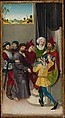
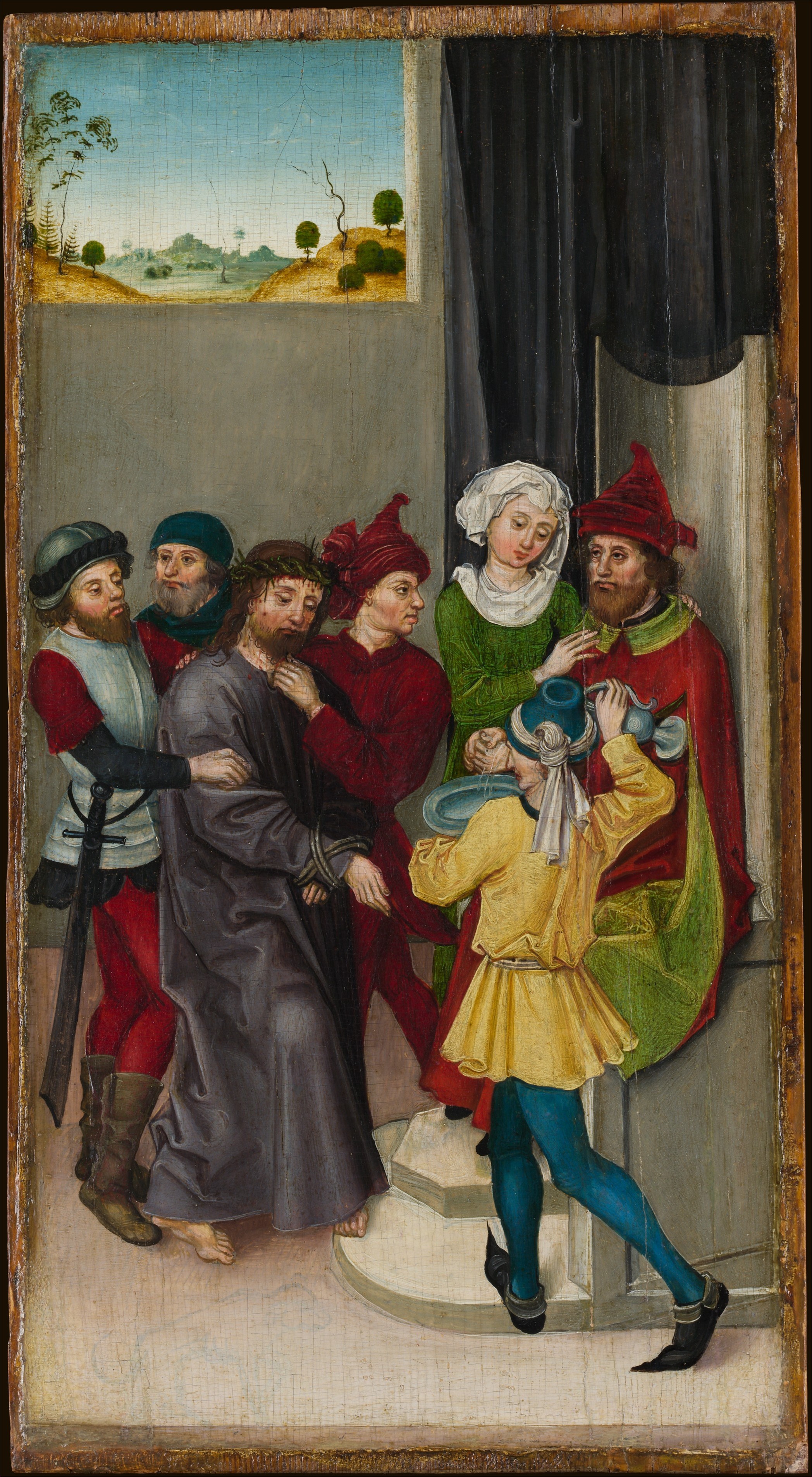
Christ before Pilate (1982.60.34a)
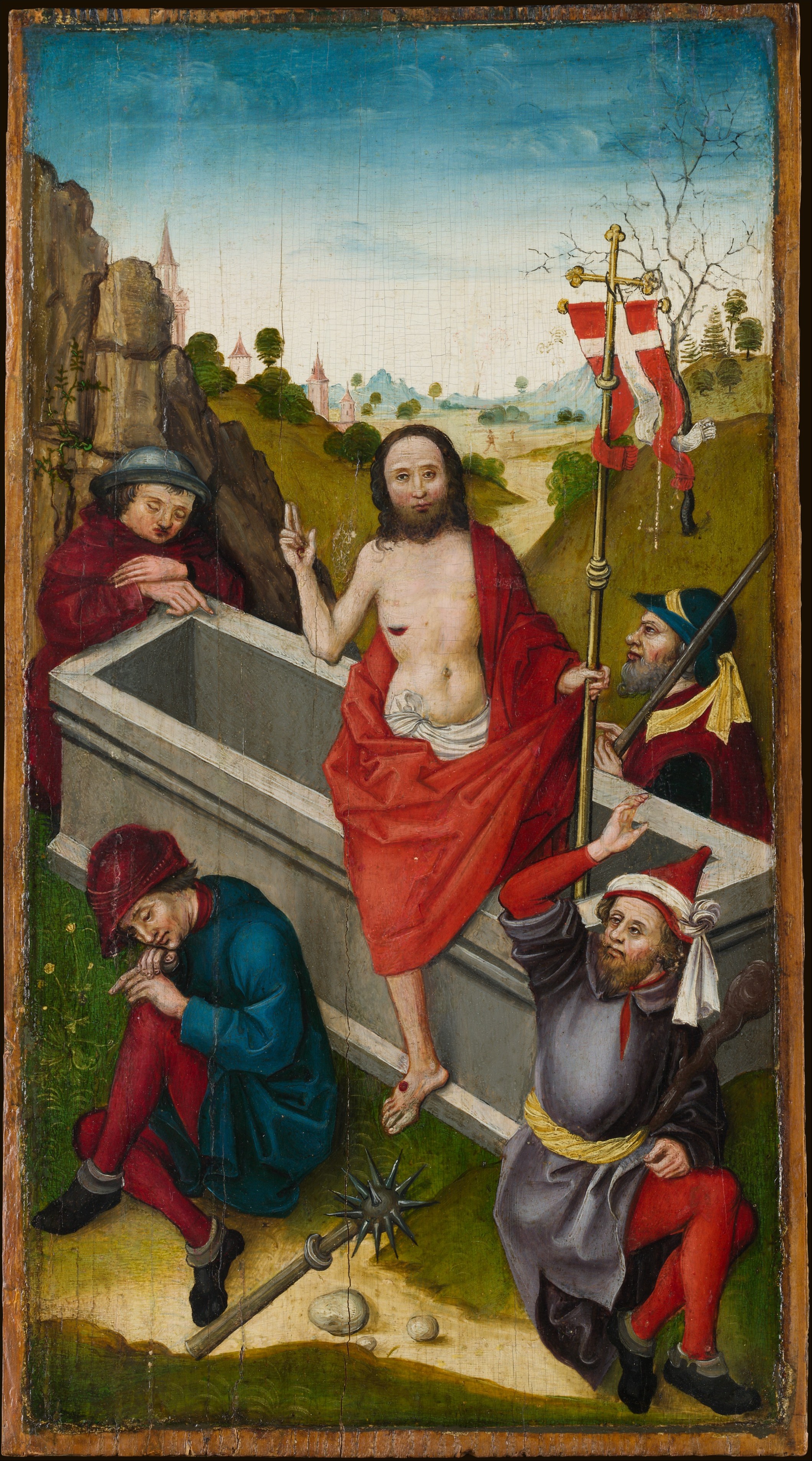
The Resurrection (1982.60.34b)
Fig. 1. Infrared Reflectogram
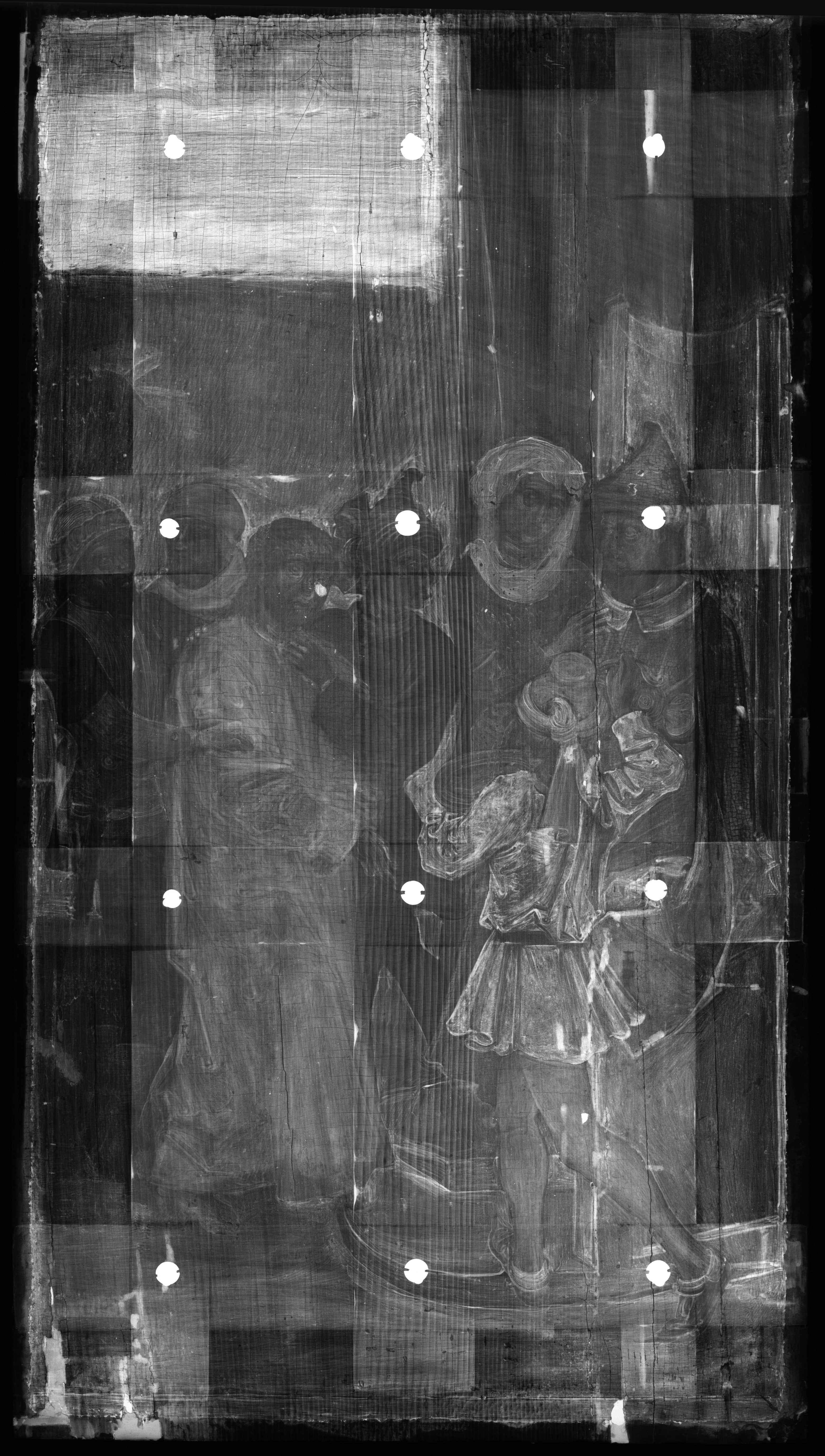
Fig. 2. X-radiograph, Christ Before Pilate
Fig. 3. Infrared reflectogram
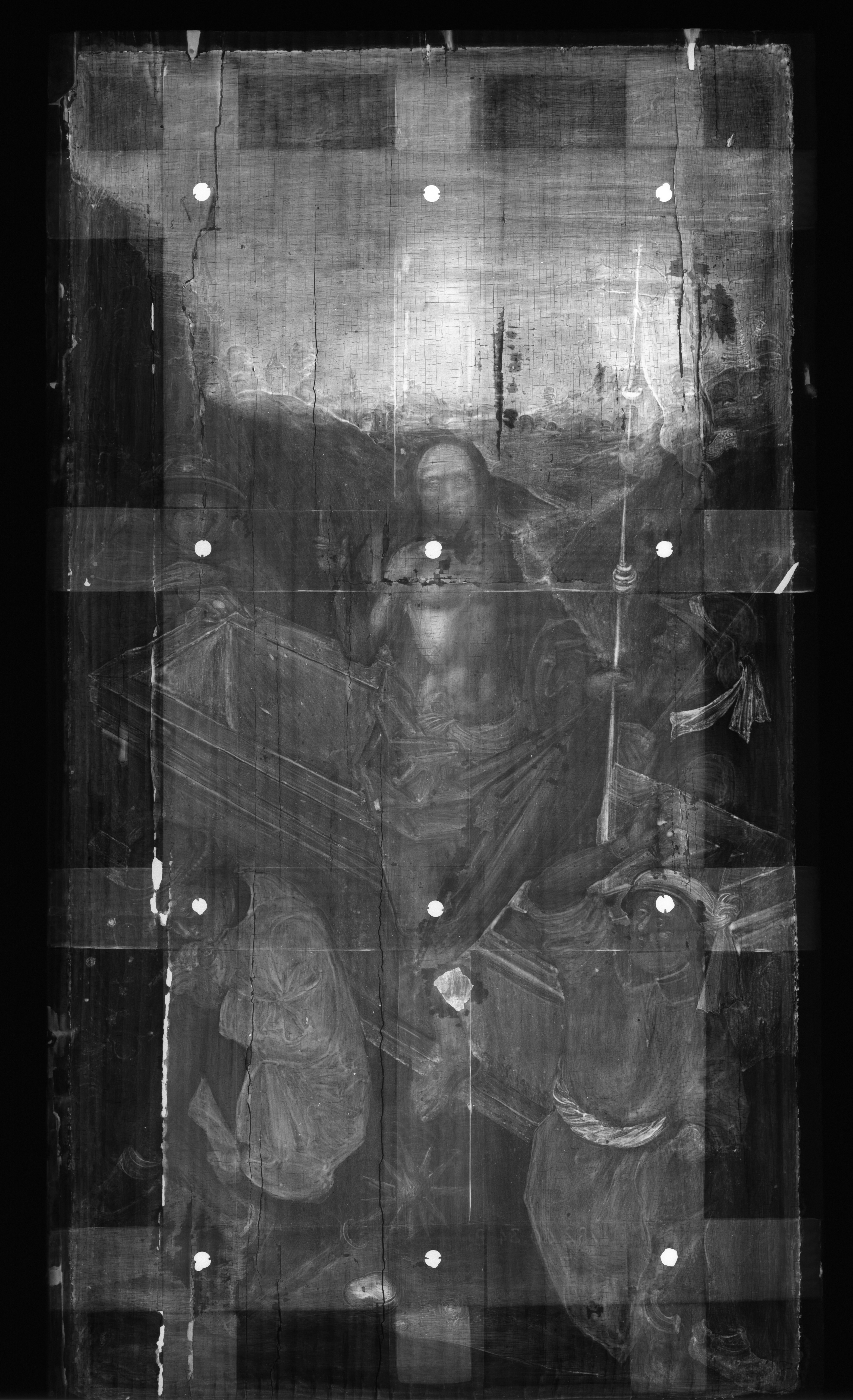
Fig. 4. X-radiograph, The Resurrection
Artwork Details
Use your arrow keys to navigate the tabs below, and your tab key to choose an item
Title:Christ before Pilate; The Resurrection
Artist:Ludwig Schongauer (German, Colmar ca. 1440/55–1493/94 Colmar)
Medium:Oil on fir
Dimensions:(a) overall 15 1/8 x 8 1/4 in. (38.4 x 21 cm), painted surface 14 3/8 x 7 3/4 in. (36.5 x 19.7 cm); (b) overall 15 1/8 x 8 1/4 in. (38.4 x 21 cm), painted surface 14 1/2 x 7 3/4 in. (36.8 x 19.7 cm)
Classification:Paintings
Credit Line:The Jack and Belle Linsky Collection, 1982
Object Number:1982.60.34ab
In the first of these two scenes from a Passion series, Christ, crowned with thorns and with hands bound, is presented to Pilate by a soldier and two additional captors. This treatment of the subject derives from the account in Matthew (27:19–24), the only Gospel that mentions both Pilate washing his hands and the presence of Pilate’s wife, who urges her husband to extricate himself from the situation. In The Resurrection, the triumphant Christ, wearing a loincloth and red shroud, steps out of the sarcophagus, blessing with his right hand and carrying a cruciform staff with a red banner emblazoned with a white cross. Beyond the cross is a leafless tree, recalling the prophecy of Ezekiel (17:24), "I the Lord . . . have made the dry tree to flourish," a possible metaphor for the renewal of humanity through Christ.
Although it cannot be confirmed by technical evidence, these two paintings most likely once formed the obverse and reverse of the same panel, as Bauman first proposed in 1984. They probably belonged to a house altar of the Passion of Christ that consisted of a central sculpture depicting the Crucifixion flanked by wings of four panels each, painted on both sides. Two other associated scenes, a Flagellation (exterior) and a Christ Carrying the Cross (interior) formerly belonging to Kloster Salem, near Ulm, were first connected to The Met's paintings by Bushart (1959). Another panel of the group represents the Taking of Christ (exterior) and the Entombment (interior) (De Coster Collection, Brussels). Although a fourth double-sided panel with the missing scenes of Christ in the Garden of Gethsemane and the Ecce Homo has not yet surfaced, the extant paintings allow for a reconstruction of the altarpiece. Meyer (2003) proposed a reconstruction that takes into account the currently known panels and suggests a Crucifixion sculpture as the centerpiece. In his convincing arrangement, The Met's panel would have appeared at the lower right on the exterior (Christ before Pilate) and interior (The Resurrection). A closely comparable house altar, dated 1484, in the sacristy of the Münster in Ulm has painted scenes of the Passion after engravings by Martin Schongauer and a sculpture of the Crucifixion in the center.
Like his older and more well-known brother Martin, Ludwig Schongauer was a painter, printmaker, and draftsman. Since no extant painting carries Ludwig’s signature, those attributed to him have been identified on the basis of stylistic similarities with his monogrammed prints the most relevant of which is an engraving of the Deposition from the Cross (Graphische Sammlung Albertina, Vienna). The compositions of the Passion scenes in the altarpiece to which The Met's paintings belonged derive generally from Martin Schongauer’s widely distributed engravings and from the Retable of the Dominicans (Musée Unterlinden, Colmar) by Martin and his associates, one of whom was probably Ludwig. The Museum’s paintings are not exact copies, however, and it is quite likely that Ludwig made freely adapted drawings after Martin’s engravings and workshop drawings as a starting point for his own paintings. Eight such drawings convincingly attributed to him are in the Kupferstich-Kabinett Dresden, and four additional ones are in the Museum der bildenden Künste Leipzig. These scenes reduce Martin’s elaborate narrative compositions to the essential figures placed in sparser settings. The underdrawings in the present paintings are distinctly similar in handling and execution to the Passion drawings attributed to Ludwig.
Ludwig Schongauer’s presence in Ulm from 1479 to 1486 and the dendrochronology, which indicates an earliest possible fabrication date of 1477, together suggest that the artist most probably painted these panels for a small house altar in that city during his time there.
[2014; adapted from Ainsworth in Ainsworth and Waterman 2013]
The support of each painting is a single fir board, with the grain oriented vertically. Dendrochronology provided an earliest possible fabrication date of 1477 for Christ before Pilate. The borders of unpainted wood and a barbe around the perimeters indicate that an engaged frame was in place when the white ground preparation was applied. The panels were thinned, and fixed cradles attached. Each panel displays a corrugated surface, many vertical splits, depressions, and a very slight concave lateral warp. X-radiography (see figs. 2, 4 above) showed two narrow, tapering holes along the top edge of Christ before Pilate and two holes along the bottom edge of The Resurrection, which may indicate the location of original pegs or nails.
Infrared reflectography (figs. 1, 3) of both panels revealed extensive underdrawing in a liquid medium. The black underdrawing is on top of the ground and beneath an uneven, thin, translucent white priming layer that contains a small number of red particles. Various discrepancies between the drawn and final painted images can be seen with infrared reflectography, including numerous minor shifts in perspective and placement. More significant variances from underdrawing to painting include, in The Resurrection, Christ’s head and shoulders moved significantly lower, the figure in the lower right corner, originally clean-shaven, given a full beard, and the angle of the sarcophagus shifted slightly. In Christ before Pilate, an arched doorway in the back wall was drawn opening onto a view of a hilly landscape, and the soldier urging Christ forward from behind was originally drawn—and painted—with slipperlike footwear rather than high boots. In The Resurrection, some forms seen in the underdrawing were not painted, including a waving pennant to the left of Christ’s staff and a tree and some rocks in the upper left. A dog drawn in the bottom left corner of Christ before Pilate was not included in the painting. The underdrawing appears to have been used to create shadow and form in some of the red passages, for example, the tunic of the man with the pointed hat behind Christ in Christ before Pilate, where the transparent lake pigment allows the black underdrawing to show through. The belt of the man pouring water into the basin at the lower right was never painted. When this passage was examined with the stereomicroscope, a thin, translucent pink priming, consisting of white with a tiny amount of red pigment, applied over the underdrawing was apparent. The artist modeled the flesh with strokes of pink and white, allowing portions of the priming to remain visible.
Overall, the paintings are very well preserved, despite tiny paint losses along the edges of the splits. In The Resurrection, losses are found in the beard and upper chest of Christ; in a series that extends down from the midpoint of his red robe and terminates in a larger loss in his calf; in the ground between the feet of the figure in the foreground at the left; and along the split in the panel that extends from the shoulder of the figure on the right side, kneeling behind the sarcophagus, into the hat of the figure below him. In Christ before Pilate, there is a series of losses along a split in the panel that extends through the figure holding the basin, from his shoulder to the back of his left knee.
[2013; adapted from German Paintings catalogue]
Paul Ackermann, Stuttgart (by 1958–65; sale, Sotheby's, London, March 24, 1965, no. 113 [the pair], as by Ludwig Schongauer, for £4,000 to Linsky); Mr. and Mrs. Jack Linsky, New York (1965–his d. 1980); The Jack and Belle Linsky Foundation, New York (1980–82)
Staatsgalerie Stuttgart. "Meisterwerke aus baden-württembergischem Privatbesitz," October 9, 1958–January 10, 1959, nos. 182, 183 (as by a follower of Martin Schongauer, lent by a private collection).
THIS WORK MAY NOT BE LENT, BY TERMS OF ITS ACQUISITION BY THE METROPOLITAN MUSEUM OF ART.
J[ohann]. E[ckart]. v[on]. Borries, ed. Meisterwerke aus baden-württembergischem Privatbesitz. Exh. cat., Staatsgalerie Stuttgart. [Stuttgart], [1958?], p. 78, nos. 182 (a), 183 (b), attributes them to a follower of Martin Schongauer; calls them panels from a small winged altarpiece; notes that E. Buchner assigns them to a Swabian artist probably from Ulm and dates them to the end of the fifteenth century.
Bruno Bushart. "Studien zur altschwabischen Malerei: Ergänzungen und Berichtigungen zu Alfred Stanges 'Deutsche Malerei der Gotik,' VIII. Band, 'Schwaben in der Zeit von 1450 bis 1500'." Zeitschrift für Kunstgeschichte 22, no. 2 (1959), pp. 140–41, figs. 10 (a), 11 (b), attributes them to Ludwig Schongauer or an assistant; associates them with a panel in Schloss Salem depicting the Flagellation on one side and Christ Carrying the Cross on the other, stating that the four scenes formed a small Passion altarpiece which he dates several years after the "Schongaueraltärchen" in the Ulm cathedral, supposedly given in 1484 [see also Ref. Moraht-Fromm 2001].
Alfred Stange. Kritisches Verzeichnis der deutschen Tafelbilder vor Dürer. Ed. Norbert Lieb. Vol. 2, Oberrhein, Bodensee, Schweiz, Mittelrhein, Ulm, Augsburg, Allgäu, Nördlingen, von der Donau zum Neckar. Munich, 1970, p. 131, no. 603, lists them as by Ludwig Schongauer; erroneously as still in a private collection, Stuttgart.
Karl-Heinz Mehnert inKataloge der Graphischen Sammlung. Vol. 1, Altdeutsche Zeichnungen. Leipzig, [1972?], p. 107, relates them to eight drawings by Ludwig Schongauer depicting the Passion of Christ (four in the Graphische Sammlung, Museum der bildenden Künste, Leipzig, and four in the Dresdener Kupferstichkabinett), noting that some of the motifs in the drawings are borrowed from Martin Schongauer's Passion series.
Martha Wolff. Letter to Guy Bauman. July 19, 1983, sees several similarities between these two paintings and engravings by Master B+R [see Max Lehrs, "Geschichte und kritischer Katalog des deutschen, niederländischen und französischen Kupferstichs im XV. Jahrhundert," vol. 6, Vienna, 1927, nos. 1, 9, and 16, under Master B+R].
Guy C. Bauman inThe Jack and Belle Linsky Collection in The Metropolitan Museum of Art. New York, 1984, pp. 98–100, nos. 34 (a), 35 (b), ill. (a and b, color), states that the two works originally formed the obverse and reverse of a single panel that was sawed in half; supports an attribution to Ludwig Schongauer, noting correspondences to three of Ludwig's signed engravings; agrees that the MMA and Schloss Salem [see Ref. Bushart 1959] panels formed the wings of a small Passion triptych and suggests that they flanked a painted or carved Crucifixion, with the Flagellation and Christ before Pilate on the outside and Christ Carrying the Cross and the Resurrection on the inside.
Katharine Baetjer. European Paintings in The Metropolitan Museum of Art by Artists Born Before 1865: A Summary Catalogue. New York, 1995, p. 214, ill.
Fritz Koreny. "Martin Schongauer as a Draftsman: A Reassessment." Master Drawings 34 (Summer 1996), p. 145, figs. 39 (a), 40 (b), favors an attribution to Ludwig Schongauer, mentioning similarities to drawings and prints attributed to him.
Christian Heck inThe Dictionary of Art. Ed. Jane Turner. Vol. 28, New York, 1996, p. 154, rejects the attribution to Ludwig Schongauer, stating that they are probably by a follower of Martin Schongauer.
Anna Moraht-Fromm inSpätmittelalter am Oberrhein: Maler und Werkstätten: 1450–1525. Exh. cat., Staatliche Kunsthalle Karlsruhe. Stuttgart, 2001, pp. 36, 39 n. 45, figs. 9 (a), 10 (b), states that the altarpiece comprising the MMA and Salem panels comes from a monastery in Salem; calls this altarpiece similar in type and function to one in the Historisches Museum Basel, Barfüsserkirche (no. 201; Upper Rhine [?] Workshop, 1484) and to the "Schongaueraltärchen" in the Ulm cathedral (no. 199; Follower of Martin Schongauer, about 1480–1500).
Old Master Pictures. Christie's, London. December 10, 2003, p. 83, under no. 41, mentions them under the entry for the recently discovered panel depicting the Arrest of Christ on one side and the Entombment of Christ on the other; follows Ludwig Meyer's [see Ref. 2003] attribution, dating, and reconstruction.
Ludwig Meyer. Reconstruction. July 29, 2003, pp. 1–3, proposes a reconstruction of the altarpiece to which the MMA pictures belonged, calling it a small domestic altarpiece that he attributes to Ludwig Schongauer; believes that the centerpiece was a carved Crucifixion and that it was flanked by four double-sided panels [see Notes]; dates it 1479–86, when the artist was in Ulm, relating it to the "Schongaueraltärchen" in the Ulm cathedral.
Peter Klein. Letter to The Metropolitan Museum of Art. April 28, 2006, identifies the wood from which the panel is made as fir; writes that dendrochronological analysis reveals that the earliest felling date for the tree from which this panel is made is 1475, adding that a minimum of two years for seasoning means that the earliest possible execution date for the painting is 1477.
Maryan W. Ainsworth in Maryan W. Ainsworth and Joshua P. Waterman. German Paintings in The Metropolitan Museum of Art, 1350–1600. New Haven, 2013, pp. 219–23, 316–17, nos. 51A (Christ Before Pilate), 51B (Resurrection), ill. (color) and figs. 180–82 (altarpiece reconstruction and infrared reflectogram details).
These two pictures originally formed the obverse and reverse of a single panel, which was sawed in half. This panel formed part of the wing of a small domestic altarpiece. Two other double-sided panels from this altarpiece are known: Christ Carrying the Cross and the Flagellation of Christ (formerly in the collection of the Markgrafen und Grossherzöge von Baden, Schloss Salem; sold Sotheby's, Baden-Baden, October 10, 1995, no. 2278) and the Arrest of Christ and the Entombment of Christ (sold Christie's, London, December 10, 2003, no. 41). A fourth panel is lost.
Ludwig Meyer (2003) proposes the following reconstruction of the altarpiece. A carved Crucifixion was the centerpiece and was flanked by four double-sided panels. The lost panel was at the upper left and depicted Christ on the Mount of Olives (wings closed) and Ecce Homo (wings open). Below this panel was the Flagellation (closed) and Christ Carrying the Cross (open). At upper right was the Arrest of Christ (closed) and the Entombment (open). Below this was Christ before Pilate (closed) and the Resurrection (open).
This work may not be lent, by terms of its acquisition by The Metropolitan Museum of Art.
Lucas Cranach the Younger and Workshop (German, Wittenberg 1515–1586 Wittenberg)
ca. 1545–50
Resources for Research
The Met's Libraries and Research Centers provide unparalleled resources for research and welcome an international community of students and scholars.
The Met Collection API is where all makers, creators, researchers, and dreamers can connect to the most up-to-date data and public domain images for The Met collection. Open Access data and public domain images are available for unrestricted commercial and noncommercial use without permission or fee.
Feedback
We continue to research and examine historical and cultural context for objects in The Met collection. If you have comments or questions about this object record, please complete and submit this form. The Museum looks forward to receiving your comments.