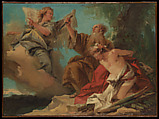
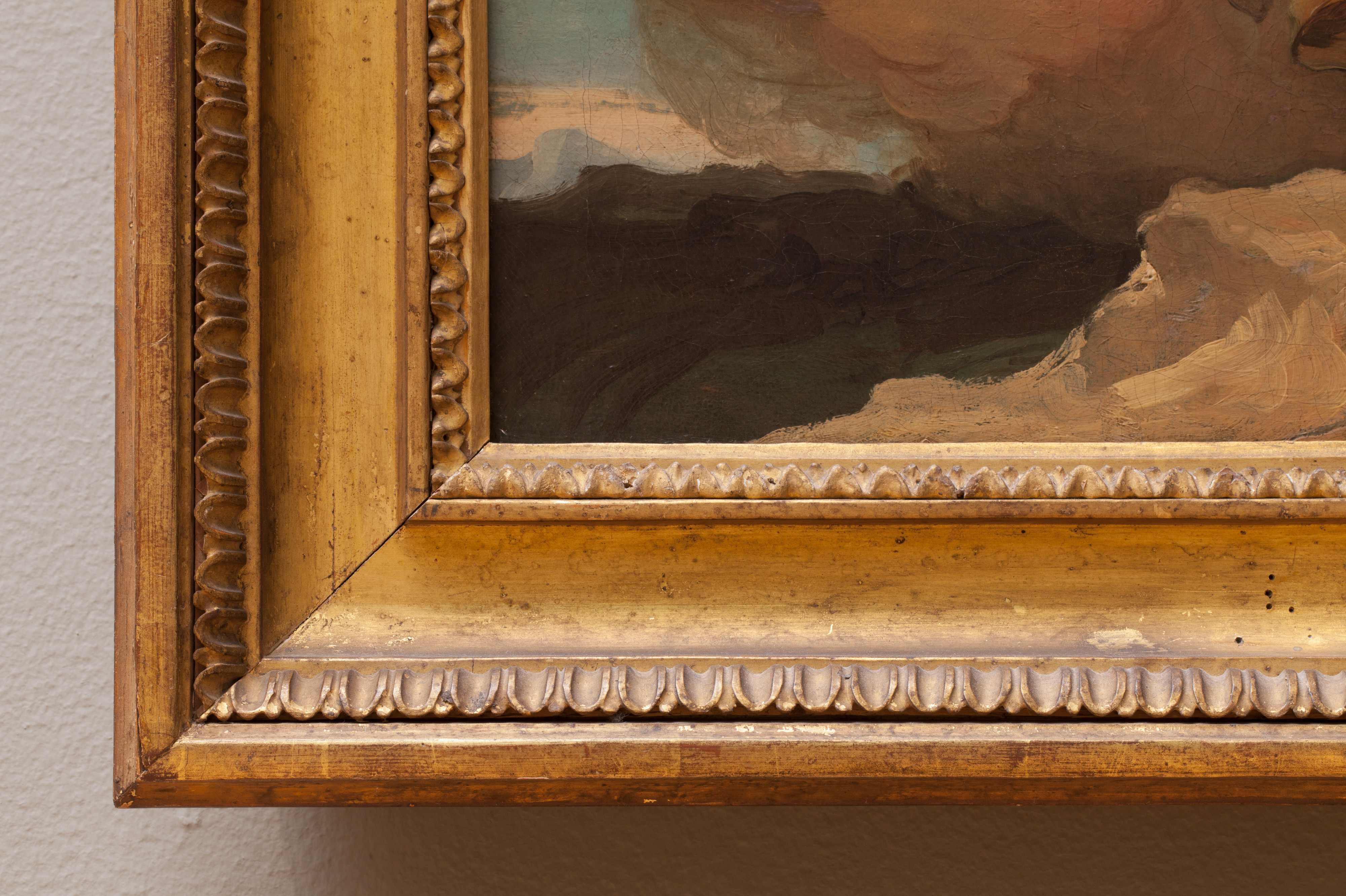
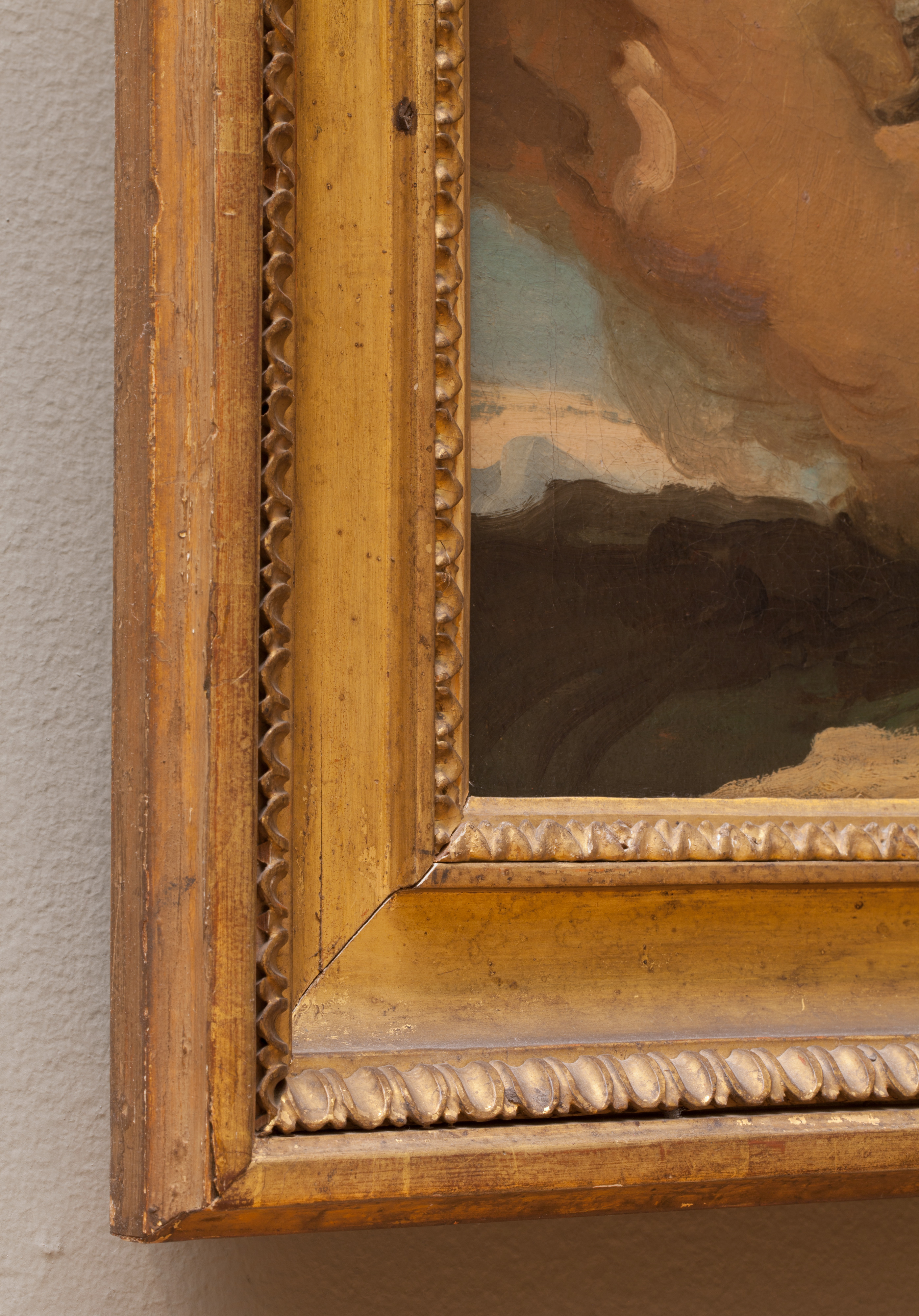
An angel keeps Abraham from sacrificing his son Issac, as God had commanded him to do as a test of his faithfulness. The loose paint handling and daring composition of this painting are very similar to works by his father Giovanni Battista Tiepolo. It was probably painted when both artists worked together on the decoration of the Residenz at Würzburg.
This image cannot be enlarged, viewed at full screen, or downloaded.
Open Access
As part of the Met's Open Access policy, you can freely copy, modify and distribute this image, even for commercial purposes.
API
Public domain data for this object can also be accessed using the Met's Open Access API.
?Caroline Ferdinande Louise, duchesse de Berry, Palazzo Vendramin-Calergi, Venice; [Léon Gauchez, Paris, and Alexis Febvre, Paris, until 1870, as by Giovanni Battista Tiepolo; sold to Blodgett]; William T. Blodgett, Paris and New York (1870–71; sold half share to Johnston); William T. Blodgett, New York, and John Taylor Johnston, New York (1871; sold to The Met)
New York. The Metropolitan Museum of Art. "Tiepolo and his Contemporaries," March 14–April 24, 1938, no. 31 (as "The Sacrifice of Abraham," by Giovanni Domenico Tiepolo).
New York. The Metropolitan Museum of Art. "The Taste of the Seventies," April 2–September 10, 1946, no. 54 (as "The Sacrifice of Abraham").
New York. Union League Club. "Exhibition from The Metropolitan Museum of Art," November 23, 1969–January 2, 1970, checklist no. 17 (as "The Sacrifice of Abraham").
Allentown, Pa. Allentown Art Museum. "The Circle of Canaletto," February 21–March 21, 1971, no. 42 (as "The Sacrifice of Abraham").
New York. The Metropolitan Museum of Art. "Venetian Paintings in the Metropolitan Museum," May 1–September 2, 1974, no catalogue.
Residenz Würzburg. "Der Himmel auf Erden: Tiepolo in Würzburg," February 15–May 19, 1996, no. 144.
New York. The Metropolitan Museum of Art. "Domenico Tiepolo: Drawings, Prints, and Paintings in The Metropolitan Museum of Art," January 23–April 27, 1997, no catalogue.
[Henry James]. "Art: The Dutch and Flemish Pictures in New York." Atlantic Monthly 29 (June 1872), p. 759 [reprinted in John L. Sweeney, ed., "The Painter's Eye," London, 1956, p. 58], as by Giovanni Battista Tiepolo.
Paul Leroi [Léon Gauchez]. "Italia fara da se." L'art 7 (1876), p. 320, mentions it as by Tiepolo's son [Giovanni Domenico].
F[ritz von]. Harck. "Berichte und Mittheilungen aus Sammlungen und Museen, über staatliche Kunstpflege und Restaurationen, neue Funde: Aus amerikanischen Galerien." Repertorium für Kunstwissenschaft 11 (1888), p. 73.
Bernhard Berenson. The Venetian Painters of the Renaissance. 3rd ed. New York, 1894, p. 133 [3rd, illustrated ed., 1897, p. 128], lists it as by Giovanni Battista.
Eduard Sack. Giambattista und Domenico Tiepolo: Ihr Leben und Ihre Werke. Hamburg, 1910, vol. 2, p. 308, no. 65, attributes it to Giovanni Domenico and dates it 1753.
Morton H. Bernath. New York und Boston. Leipzig, 1912, p. 85.
Joseph Breck. "Paintings and Drawings by Tiepolo in the Metropolitan Museum." Art in America 1 (January 1913), pp. 8, 11–12, fig. 5, attributes it to Giovanni Battista.
Lionello Venturi. Italian Paintings in America. Vol. 3, Sixteenth to Eighteenth Century. New York, 1933, unpaginated, pl. 599, attributes it to Giovanni Domenico and calls it a late work.
Arthur McComb. The Baroque Painters of Italy: An Introductory Historical Survey. Cambridge, Mass., 1934, p. 127, lists it as by Giovanni Battista.
Hermann Voss. Letter. December 1935, attributes it to Giovanni Domenico, imitating his father's style; suggests that it may date from the Würzburg period, when father and son were working closely together.
Max Goering. Letter. 1938, considers it close to Giovanni Domenico, but not by him.
M[ax]. Goering inAllgemeines Lexikon der bildenden Künstler. Ed. Hans Vollmer. Vol. 33, Leipzig, 1939, p. 160, includes it, with a question mark, among works by Giovanni Domenico.
Harry B. Wehle. The Metropolitan Museum of Art: A Catalogue of Italian, Spanish, and Byzantine Paintings. New York, 1940, p. 288, ill., attributes it to Giovanni Domenico.
Josephine L. Allen and Elizabeth E. Gardner. A Concise Catalogue of the European Paintings in The Metropolitan Museum of Art. New York, 1954, p. 95.
Rodolfo Pallucchini. La pittura veneziana del Settecento. Venice, 1960, p. 260, fig. 686, attributes it to Giovanni Domenico and suggests that it may date from shortly before his departure for Spain in 1762.
Adriano Mariuz. Giandomenico Tiepolo. Venice, [1971], pp. 33, 128, 151, pl. 53, attributes it to Giovanni Domenico and agrees with Sack's [see Ref. 1910] dating of 1753; calls it probably a pendant to "The Sacrifice of Iphigenia" (Schlossmuseum, Weimar).
Burton B. Fredericksen and Federico Zeri. Census of Pre-Nineteenth-Century Italian Paintings in North American Public Collections. Cambridge, Mass., 1972, pp. 198, 256, 605.
Federico Zeri with the assistance of Elizabeth E. Gardner. Italian Paintings: A Catalogue of the Collection of The Metropolitan Museum of Art, Venetian School. New York, 1973, p. 66, pl. 80, date it to the late 1750s; disagree with Mariuz's [see Ref. 1971] suggestion that it is a pendant to the Weimar "Sacrifice of Iphigenia".
George Knox. Giambattista and Domenico Tiepolo: A Study and Catalogue Raisonné of the Chalk Drawings. Oxford, 1980, vol. 1, p. 309, no. P.168, includes it in a checklist of paintings by Giovanni Domenico.
Katharine Baetjer. European Paintings in The Metropolitan Museum of Art by Artists Born Before 1865: A Summary Catalogue. New York, 1995, p. 97, ill.
Linda Wolk-Simon. "Domenico Tiepolo: Drawings, Prints, and Paintings in The Metropolitan Museum of Art." Metropolitan Museum of Art Bulletin 54 (Winter 1996/97), pp. 14–16, fig. 17 (color).
Cornelia Syre inDer Himmel auf Erden: Tiepolo in Würzburg. Ed. Peter O. Krückmann. Exh. cat., Residenz Würzburg. Munich, 1996, vol. 1, pp. 194–95, no. 144, ill. (color), attributes it to Giovanni Domenico and dates it about 1753.
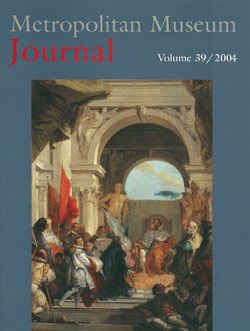
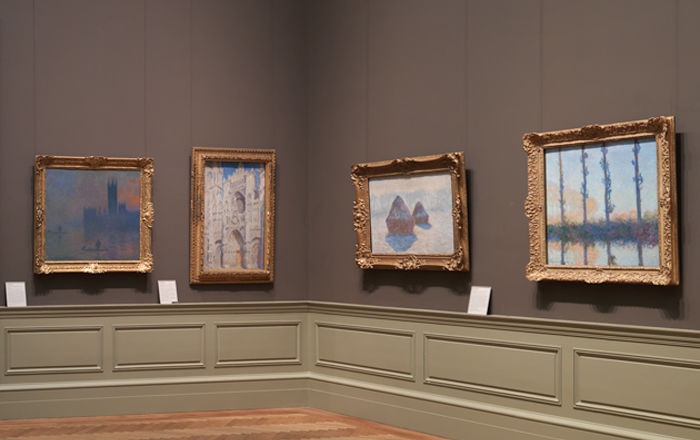
Katharine Baetjer. "Buying Pictures for New York: The Founding Purchase of 1871." Metropolitan Museum Journal 39 (2004), pp. 217, 245, appendix 1A no. 140, ill. p. 217 and fig. 35 (installation photograph).
Giovanni Domenico Tiepolo (Italian, Venice 1727–1804 Venice)
Resources for Research
The Met's Libraries and Research Centers provide unparalleled resources for research and welcome an international community of students and scholars.
The Met Collection API is where all makers, creators, researchers, and dreamers can connect to the most up-to-date data and public domain images for The Met collection. Open Access data and public domain images are available for unrestricted commercial and noncommercial use without permission or fee.
Feedback
We continue to research and examine historical and cultural context for objects in The Met collection. If you have comments or questions about this object record, please complete and submit this form. The Museum looks forward to receiving your comments.