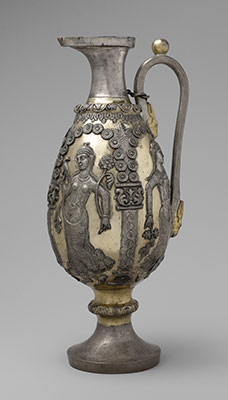
Encompasses present-day Iraq and northeastern Syria
From 138 B.C. until the coming of Islam in 636/7 A.D., Mesopotamia is dominated first by the Parthian and then Sasanian empires from Iran. Their strength and wealth is based on control of the trade routes through the region, which connect the cultures of East and West. This often brings the rulers of Mesopotamia into conflict with the expansionist aims of Rome and, later, Byzantium . By the second century A.D., the archetypal Mesopotamian writing system, cuneiform, is almost extinct and has been replaced by alphabetic scripts.

- 1224 A.D.The Parthians
develop the iwan, an open-fronted vaulted hall. Iwans are often
covered with carved stucco reliefs, some of the finest examples of which
are found at Uruk and Ashur. The palace at Ashur has the earliest example
of four iwans opening onto a central square. This form of architecture
supplants Hellenistic styles in Iraq and Iran, and will play an important
role in the religious architecture of the later Islamic period. A new
fashion, frontality, arises in relief sculpture where the head and body
are shown frontally.
- 224636/37 A.D.From southwest
Iran, Ardashir I (r. 22440) founds the Sasanian dynasty and ends
Parthian rule. His successors establish their administrative and economic
center at Ctesiphon. Buildings continue to be embellished with stucco,
now largely molded rather than carved. The moldings, applied like tiles
to walls, create repetitive friezes that depict figural, animal, geometric,
and floral motifs. Despite constant aggression between the Sasanians and
Byzantium, there are parallels in the arts, especially motifs on textiles
that reflect mutual differences. The use of frontality, introduced in
the Parthian period, continues in Sasanian art, and becomes a hallmark
of the Romano-Byzantine West.
Citation
"Mesopotamia, 1500 A.D.". In Heilbrunn Timeline of Art History. New York: The Metropolitan Museum of Art, 2000–. http://www.metmuseum.org/toah/ht/?period=05®ion=wam (October 2000)