Sideboard
Artwork Details
- Title: Sideboard
- Maker: Alexander Roux (1813–1886)
- Date: ca. 1853
- Geography: Made in New York, New York, United States
- Culture: American
- Medium: Black walnut, pine (secondary wood)
- Dimensions: 92 3/4 x 71 3/4 x 25 5/8 in. (235.6 x 182.2 x 65.1 cm)
- Credit Line: Purchase, Friends of the American Wing Fund and David Schwartz Foundation Inc. Gift, 1993
- Object Number: 1993.168
- Curatorial Department: The American Wing
Audio
3875. Sideboard
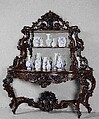
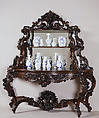
ALICE COONEY FRELINGHUYSEN: Étagères consist of a table surmounted by open shelves, or étages. The form of étagère sideboards was invented in France in the 1840s. Elaborate pieces such as this one gained popularity in America by the early 1850s to display curiosities and objets d’art, symbols of travel or good taste. Conceived for use in dining rooms, the sideboard, sometimes called “the altar of gastronomy,” became a domestic shrine to prosperity and good living—and one of the most important pieces of furniture in the American home. This extremely heavy piece is solidly constructed of American black walnut. Naturalism is key to the ornament. Carving is the hallmark of fine cabinetmaking in the 1850s. The deeply carved realistic images are sculpted with extraordinary skill. At the top of the crest, a three-dimensional stag’s head is flanked by two menacing dogs. Look at the four doors on the base, with exquisitely carved, high relief depictions of game animals, fish, fruits, vegetables, nuts, and berries. The imagery evokes the plentiful bounties of the hunt and the untamed natural world. The sideboard was made by Alexander Roux, one of the leading New York cabinetmakers of his day. Roux was a French emigré who worked in New York from 1836 until his death fifty years later.
More Artwork
Related Content

 Free to download
Research Resources
The Met provides unparalleled resources for research and welcomes an international community of students and scholars. The Met's Open Access API is where creators and researchers can connect to the The Met collection. Open Access data and public domain images are available for unrestricted commercial and noncommercial use without permission or fee.
To request images under copyright and other restrictions, please use this Image Request form.
Feedback
We continue to research and examine historical and cultural context for objects in The Met collection. If you have comments or questions about this object record, please contact us using the form below. The Museum looks forward to receiving your comments.
Content Notice
The Metropolitan Museum of Art presents over 5,000 years of art from around the world, and our online collection reflects ongoing work conducted over the course of our more than 150-year history. You may encounter objects or images that may be inappropriate for some viewers or information that may be outdated.