Eagle
Artwork Details
- Title: Eagle
- Artist: William Rush (1756–1833)
- Date: 1809–11
- Culture: American
- Medium: Carved wood (probably Eastern white pine), gessoed and gilded, and cast iron, painted
- Dimensions: 36 x 68 x 61 in. (91.4 x 172.7 x 154.9 cm)
- Credit Line: Purchase, Sansbury-Mills Fund, and Anthony W. and Lulu C. Wang, Mr. and Mrs. Robert G. Goelet, Annette de la Renta, and Vira Hladun-Goldmann Gifts, 2002
- Object Number: 2002.21.1
- Curatorial Department: The American Wing
Audio
3802. Eagle
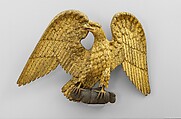
NARRATOR— In the early 1800s, a congregation of Protestants gazed up at this soaring gold eagle in a church in Philadelphia. As you look at it today, you may want to move away from the doors as many visitors pass through them. Artist William Rush carved the commanding bird from pine for the church, which was dedicated to St. John the Evangelist. There, the eagle hovered over the pulpit—a symbol of John, the church’s patron saint. Like many of the first sculptors in America, Rush came out of an artisan, or craftsman tradition. He began his career as a carver of ship figureheads, working primarily with wood. But using wood for this massive eagle required additional structural support. An iron rod runs through the bird’s body, extending from the tail to the tip of the painted red tongue. Another supports the bird’s extraordinary 6-foot wingspan. With its multiple layers of gilding, or gold, one can imagine what a commanding presence it must have had as it gleamed in the dark, candle-lit church. But after a few decades, Rush’s eagle was relocated to Philadelphia’s Independence Hall…placed in the very room where the Declaration of Independence was signed. This new home and context transformed the eagle’s symbolic connotations. The religious icon suddenly became a national symbol—the bird chosen by our Founding Fathers to be an emblem of the nation and a proud assertion of American strength and freedom.
More Artwork
Related Content

Research Resources
The Met provides unparalleled resources for research and welcomes an international community of students and scholars. The Met's Open Access API is where creators and researchers can connect to the The Met collection. Open Access data and public domain images are available for unrestricted commercial and noncommercial use without permission or fee.
To request images under copyright and other restrictions, please use this Image Request form.
Feedback
We continue to research and examine historical and cultural context for objects in The Met collection. If you have comments or questions about this object record, please contact us using the form below. The Museum looks forward to receiving your comments.
Content Notice
The Metropolitan Museum of Art presents over 5,000 years of art from around the world, and our online collection reflects ongoing work conducted over the course of our more than 150-year history. You may encounter objects or images that may be inappropriate for some viewers or information that may be outdated.