Rattle, Whistle, and Bells
Artwork Details
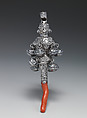
- Title: Rattle, Whistle, and Bells
- Maker: Nicholas Roosevelt (1715–1769)
- Date: 1755–68
- Geography: Made in New York, New York, United States
- Culture: American
- Medium: Gold, coral
- Dimensions: L. 6 1/8 in. (15.6 cm); 2 oz. 13 dwt. (82.3 g)
- Credit Line: Rogers Fund, 1947
- Object Number: 47.70
- Curatorial Department: The American Wing
Audio
1134. Rattle, Whistle, and Bells
BARBARA DRAKE BOEHM: Look carefully at this object made of gold and red coral. What would you guess it was used for? It’s actually a luxurious baby toy. Children born into the wealthiest families in colonial America sometimes played with toys like this one, called a rattle, whistle, and bells. Babies could blow the whistle at the gold end of the toy. Or they could shake the toy to jingle the bells. Teething babies chewed the polished coral at the other end of the toy. Coral looks like a rock, but it’s actually formed by sea organisms called polyps. Colonies, or groups, of polyps form this hard substance as a kind of skeleton. People once believed that coral could protect against disease and evil spells. This teething toy was meant to protect the baby. Look for a gold loop under the whistle end of the toy. The baby’s mother or a nursemaid put a ribbon through this loop, and hung the toy from the baby’s waist or neck. Why do you think they did this? You probably know if you’ve ever taken care of an active toddler. The bells jingled whenever the baby moved. This made it easier to keep track of where your baby was at all times.
More Artwork
Related Content

 Free to download
Research Resources
The Met provides unparalleled resources for research and welcomes an international community of students and scholars. The Met's Open Access API is where creators and researchers can connect to the The Met collection. Open Access data and public domain images are available for unrestricted commercial and noncommercial use without permission or fee.
To request images under copyright and other restrictions, please use this Image Request form.
Feedback
We continue to research and examine historical and cultural context for objects in The Met collection. If you have comments or questions about this object record, please contact us using the form below. The Museum looks forward to receiving your comments.
Content Notice
The Metropolitan Museum of Art presents over 5,000 years of art from around the world, and our online collection reflects ongoing work conducted over the course of our more than 150-year history. You may encounter objects or images that may be inappropriate for some viewers or information that may be outdated.