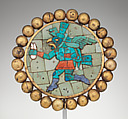
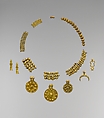
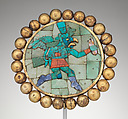
Necklace beads with frogs and snakes
Moche necklace beads were generally between 3 and 8 cm in diameter, although other beads as large as 12 cm have been described (Alva and Donnan; 1993; Bourget, 2014; Donnan, 2022). High ranking individuals were usually buried with multiple necklaces composed of beads of various dimensions, the outer strand having larger size beads. Beads with images of warriors, spiders, snails, frogs, felines, peanuts, owl and monkey heads, as well as geometrical forms have been found in both gold and silver, and sometimes with combinations of the two metals. The large beads in Moche necklaces usually did not extend to the nape, as depicted on their ceramics and inferred by the numbers of necklace beads excavated in burials.
The Moche (also known as the Mochicas) flourished on Peru’s North Coast from 200-850 CE, centuries before the rise of the Incas (Castillo, 2017). Over the course of some seven centuries, the Moche built thriving regional centers from the Nepeña River Valley in the south to perhaps as far north as the Piura River, near the modern border with Ecuador, developing coastal deserts into rich farmlands and drawing upon the abundant maritime resources of the Pacific Ocean’s Humboldt Current. Although it is not certain whether the Moche formed a single centralized state, they shared unifying cultural traits such as religious practices (Donnan, 2010).
References and Further Reading
Alva, Walter, and Christopher B. Donnan. Royal Tombs of Sipán. Los Angels: Fowler Museum of Cultural History, University of California, 1993.
Bourget, Steve. Les rois mochica: Divinité et pouvoir dans le Pérou ancien. Paris: Somogy éditions d'art; Geneva: MEG, Musée d'ethnographie de Genève, 2014.
Castillo, Luis Jaime. "Masters of the Universe: Moche Artists and Their Patrons." In Golden Kingdoms: Luxury Arts in the Ancient Americas, edited by Joanne Pillsbury, Timothy Potts, and Kim N. Richter, pp. 24-31. Los Angeles: J. Paul Getty Museum, 2017.
Donnan, Christopher B. "Moche State Religion." In New Perspectives on Moche Political Organization, edited by Jeffrey Quilter and Luis Jaime Castillo, pp. 47-69. Washington D.C.: Dumbarton Oaks Research Library and Collection, 2010.
Donnan, Christopher A. La Mina: A Royal Moche Tomb. Albuquerque: University of New Mexico Press, 2022.
Artwork Details
- Title: Necklace beads with frogs and snakes
- Artist: Moche artist(s)
- Date: 500-800 CE
- Geography: Peru
- Culture: Moche
- Medium: Gold, inlay
- Dimensions: Diameter 1-3/4 in.
- Classification: Metal-Ornaments
- Credit Line: Gift and Bequest of Alice K. Bache, 1974, 1977
- Object Number: 1974.271.32a-i
- Curatorial Department: The Michael C. Rockefeller Wing
More Artwork
Related Content
 Free to download
Research Resources
The Met provides unparalleled resources for research and welcomes an international community of students and scholars. The Met's Open Access API is where creators and researchers can connect to the The Met collection. Open Access data and public domain images are available for unrestricted commercial and noncommercial use without permission or fee.
To request images under copyright and other restrictions, please use this Image Request form.
Feedback
We continue to research and examine historical and cultural context for objects in The Met collection. If you have comments or questions about this object record, please contact us using the form below. The Museum looks forward to receiving your comments.
Content Notice
The Metropolitan Museum of Art presents over 5,000 years of art from around the world, and our online collection reflects ongoing work conducted over the course of our more than 150-year history. You may encounter objects or images that may be inappropriate for some viewers or information that may be outdated.