Ci wara headdress
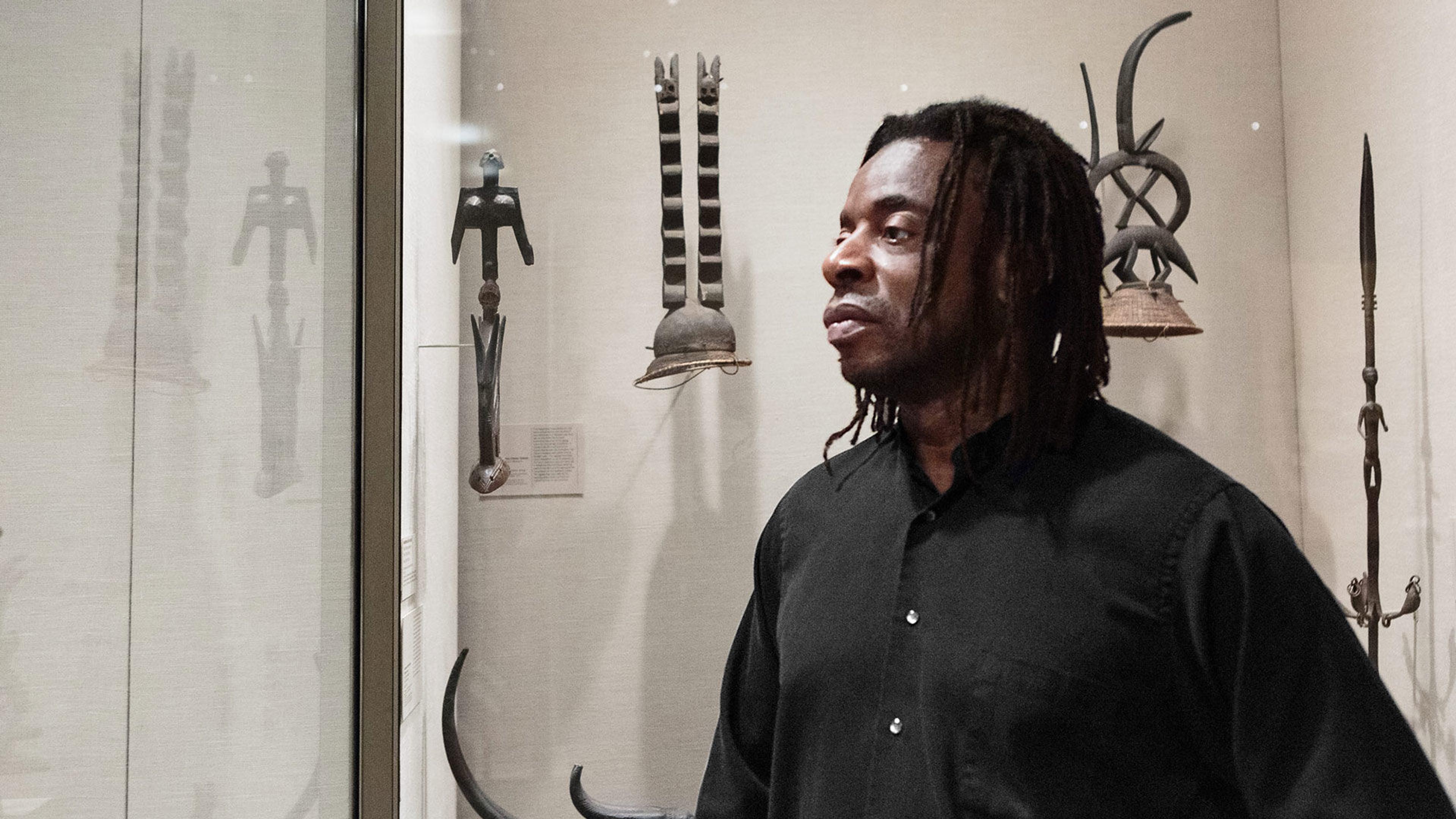
Ci wara performances encourage Bamana farmers as they work in the fields and praise their efforts after they have returned to the village when the work is complete. The performances always feature a pair of headdresses, one male and one female, worn by two skilled young male dancers. The male and female ci wara serve as multifaceted metaphors for the elemental forces upon which all humanity depends. The infant on the female's back has been interpreted as the embodiment of humanity and as a visual treatise on the relationship between the powerful Sun (the male) and the gentle, nurturing Earth (the female). It has also been suggested that the openwork zigzag carving of the male figure's neck and mane invokes the sun's corona and its radiance. The performers' costumes are made of long raffia fibers that stretch from the base of the headdress to the ground and have been darkly dyed. The raffia fibers sway and bounce as the skilled performer executes his choreographed movements, which are intended to mimic those of the antelope. The undulations of the raffia costume are also a subtle reference to water and add to the overall metaphor of the performance as a convergence of the elemental forces of sun, earth, and water. The masquerade performances begin outside the village in the fields and gradually travel to the village center. Women also play an integral part during the masquerading ceremonies by singing songs of praise for Ci Wara and the hard-working farmers.
The ci wara tradition remains one of the most widely recognized forms in all of African art. Throughout the years, the sculptures, costumes, songs, and all the other elements that compose this living art form have grown and changed along with Bamana culture itself. Different regions within Bamana society display unique sculptural variations of ci wara iconography—the vertically dominated form seen here is prevalent in the east. These elegant sculptures have not only served as inspiration in their region of origin, but also in the West for early twentieth-century artists such as Constantin Brancusi and Ferdinand Léger, who were impressed by their juxtaposition of negative and positive space and two-dimensional sculptural design.
Artwork Details
- Title: Ci wara headdress
- Artist: Bamana numu (blacksmith)
- Date: 19th–early 20th century
- Geography: South-central Mali
- Culture: Bamana peoples
- Medium: Wood, metal, fiber
- Dimensions: H. 35 11/16 x W. 15 3/4 x D. 3 3/8 in. (90.7 x 40 x 8.5 cm)
- Classification: Wood-Sculpture
- Credit Line: The Michael C. Rockefeller Memorial Collection, Gift of Nelson A. Rockefeller, 1964
- Object Number: 1978.412.435
- Curatorial Department: The Michael C. Rockefeller Wing
Audio
982. Kids: Headdress: Male Antelope (Ci Wara), Part 1
Listen to more about this artwork
More Artwork
Related Content
 Free to download
Research Resources
The Met provides unparalleled resources for research and welcomes an international community of students and scholars. The Met's Open Access API is where creators and researchers can connect to the The Met collection. Open Access data and public domain images are available for unrestricted commercial and noncommercial use without permission or fee.
To request images under copyright and other restrictions, please use this Image Request form.
Feedback
We continue to research and examine historical and cultural context for objects in The Met collection. If you have comments or questions about this object record, please contact us using the form below. The Museum looks forward to receiving your comments.
Content Notice
The Metropolitan Museum of Art presents over 5,000 years of art from around the world, and our online collection reflects ongoing work conducted over the course of our more than 150-year history. You may encounter objects or images that may be inappropriate for some viewers or information that may be outdated.