Violoncello
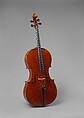
Description: Spruce top in 2 pieces with medium grain widening toward the sides; 2-pieces maple back with figure descending toward the sides; matching maple ribs; neck possibly not original; pegbox grafted to neck; orange-brown varnish.
Artwork Details
- Title: Violoncello
- Maker: Jean Baptiste Vuillaume (French, Mirecourt 1798–1875 Paris)
- Date: mid-19th century
- Geography: Paris, France
- Culture: French
- Medium: Spruce and maple
- Dimensions: Body L.: 75.5 cm (29-1/2 in.); Upper bouts: 34.2 cm (13-1/2 in.) Middle bouts; 23.6 cm (9-1/2 in.; Lower bouts: 43.9 cm (17-1/2 in.)
- Classification: Chordophone-Lute-bowed-unfretted
- Credit Line: Gift of Dr. Peter Blos, 1984
- Object Number: 1984.114.1
- Curatorial Department: Musical Instruments
Audio
Allegro ma non troppo from String Quartet No. 10 in E-flat Major, Op. 51 by Antonín Dvořák performed by the American String Quartet: Peter Winograd ("Antonius" violin 34.86.1), Laurie Carney ("Francesca" violin 34.86.2), Daniel Avshalomov, viola, and Wolfram Koessel (cello 1984.114.1) May 17, 2012 for the American Musical Instrument Society
Listen to more about this artwork
More Artwork
Related Content
Perspectives
Articles, audio, and video from The Met's online magazine.
Publications
Books, guides, and catalogues published by The Met.
 Free to download
Research Resources
The Met provides unparalleled resources for research and welcomes an international community of students and scholars. The Met's Open Access API is where creators and researchers can connect to the The Met collection. Open Access data and public domain images are available for unrestricted commercial and noncommercial use without permission or fee.
To request images under copyright and other restrictions, please use this Image Request form.
Feedback
We continue to research and examine historical and cultural context for objects in The Met collection. If you have comments or questions about this object record, please contact us using the form below. The Museum looks forward to receiving your comments.
Content Notice
The Metropolitan Museum of Art presents over 5,000 years of art from around the world, and our online collection reflects ongoing work conducted over the course of our more than 150-year history. You may encounter objects or images that may be inappropriate for some viewers or information that may be outdated.