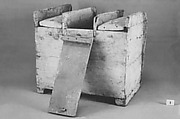
Shabti Box and Shabtis of Djedmutesankh
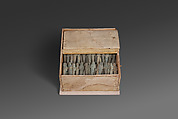
This box (Box I in the excavation records) was found right-side up and half full of shabtis, with the cords that had once held the box closed still present but the seals gone. The other (25.3.18, Box III in the excavation records) was found fallen on its side, with a number of shabtis spilled out onto the ground next to it.
Artwork Details
- Title: Shabti Box and Shabtis of Djedmutesankh
- Period: Third Intermediate Period
- Dynasty: Dynasty 21
- Date: ca. 1000–945 BCE
- Geography: From Egypt, Upper Egypt, Thebes, Deir el-Bahri, Tomb MMA 60, Chamber, Burial of Djedmutesankh (Ch5), MMA excavations, 1923–24
- Medium: Wood, faience
- Dimensions: 48.5 x 63 cm (19 1/8 x 24 13/16 in.)
- Credit Line: Rogers Fund, 1925
- Object Number: 25.3.17
- Curatorial Department: Egyptian Art
Audio
1149. Kids: Shabti box with shabtis, Part 1
Gallery 126
JO LOH: Hi, I’m Jo. I’m here with our Egyptologist, and our Egyptian Gallery Explorers. They’re going to help us figure out what’s in these boxes on the floor. Look at the open box. What do you see inside?
EXPLORER ONE: I see blue dolls that kind of look like pharaohs?
ISABEL STUENKEL: These small figures are called shabtis...
EXPLORER TWO: …and they represent the person who is dead, the mummy.
ISABEL STUENKEL: And they are actually substitute figurines. … And they hold in their hands little hoes for agricultural work.
EXPLORER TWO: … agriculture means the growing of crops …
ISABEL STUENKEL: So, they were meant to actually work in the afterlife. The Egyptians believed that they would be called upon to do agricultural work, so the figures could do this work for them. But it was not that they did not want to do this work, they wanted to make sure that this work is done.
JO LOH: How many do you think there are?
EVERYONE SHOUTS: 365!
JO LOH: Why do you think there are 365 in the boxes? What do you think it signifies?
EXPLORER THREE: That's how many days are in a year, and they thought one would go for each day.
JO LOH: Exactly. Ideally, there were 365 shabtis, one for each day of the year. There were so many shabtis altogether that they couldn’t fit in one box—the closed box here also has shabtis. The shabtis would magically come alive and work in place of the dead person. And, to be extra sure, there were even additional supervisor shabtis to make that everything was done right! But how did the shabtis work?
ISABEL STUENKEL: Often the shabtis had a magical spell written on them, parts of which sounded like this “O, this shabti! If I am called to grow food in the fields, to water to the crops, to carry sand from east to west—Here I am! you shall say.”
JO LOH: Even the color of the shabtis is important. To hear why, press PLAY, now.
Listen to more about this artwork
More Artwork
Research Resources
The Met provides unparalleled resources for research and welcomes an international community of students and scholars. The Met's Open Access API is where creators and researchers can connect to the The Met collection. Open Access data and public domain images are available for unrestricted commercial and noncommercial use without permission or fee.
To request images under copyright and other restrictions, please use this Image Request form.
Feedback
We continue to research and examine historical and cultural context for objects in The Met collection. If you have comments or questions about this object record, please contact us using the form below. The Museum looks forward to receiving your comments.
Content Notice
The Metropolitan Museum of Art presents over 5,000 years of art from around the world, and our online collection reflects ongoing work conducted over the course of our more than 150-year history. You may encounter objects or images that may be inappropriate for some viewers or information that may be outdated.