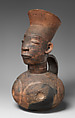
Domu (harp)
In more elaborately carved harps, the entire neck may be figurative. There is also considerable variation in the curvature of the bow and the angle of the neck's attachment to the resonator. The resonators come in two forms, the hourglass shape seen here or an oval shape, and usually feature two small sounding holes on the top surface. A variety of animal skins were used to cover the resonator, including pangolin scales, okapi and leopard pelts, and snake and lizard skins. In ethnic groups related to the Mangbetu, the anthropomorphic convention is carried further and legs are carved below the resonator so that the body of the harp is also the body of the figure.
Mangbetu harps have been studied in depth as art objects; their musical use, however, remains largely unexplored. Although they appear in historical photographs from the region, these rarely show the harp being played. As the Mangbetu enthusiasm for carving continued and harps became increasingly figurative, the ability to appropriately string and tune the instruments became increasingly difficult. Before long, the importance of the harp as a musical instrument was replaced by its importance as an art object. This evolution led to instruments that were completely unplayable—with strings too close together, unusable tuning pegs, flattened sound boxes, etc.—but undoubtedly visually striking.
The harp first appeared in Mangbetu culture some time in the late nineteenth century, and reached its peak during the colonial period of the early twentieth century. Many believe that the initial practice of carving representations of human heads was adopted from the neighboring Azande peoples to the north. As cultural and musical traditions have changed over the years in Mangbetu culture, musical instruments have appeared and disappeared. Some Mangbetu elders claim that the heads of the harp represented Queen Nenzima and King Yangala, and that after their deaths the practice of that particular style gradually declined. Today, harps are no longer found in Mangbetu society.
Artwork Details
- Title: Domu (harp)
- Artist: Mangbetu artist
- Date: 19th–first half of 20th century
- Geography: Democratic Republic of the Congo
- Culture: Mangbetu peoples
- Medium: Wood, hide, plant fiber, twine, brass
- Dimensions: H. 26 1/2 × W. 8 1/2 × D. 13 3/8 in. (67.3 × 21.6 × 34 cm)
- Classification: Wood-Musical Instruments
- Credit Line: The Michael C. Rockefeller Memorial Collection, Purchase, Nelson A. Rockefeller Gift, 1960
- Object Number: 1978.412.412
- Curatorial Department: The Michael C. Rockefeller Wing
More Artwork
Related Content

Research Resources
The Met provides unparalleled resources for research and welcomes an international community of students and scholars. The Met's Open Access API is where creators and researchers can connect to the The Met collection. Open Access data and public domain images are available for unrestricted commercial and noncommercial use without permission or fee.
To request images under copyright and other restrictions, please use this Image Request form.
Feedback
We continue to research and examine historical and cultural context for objects in The Met collection. If you have comments or questions about this object record, please contact us using the form below. The Museum looks forward to receiving your comments.
Content Notice
The Metropolitan Museum of Art presents over 5,000 years of art from around the world, and our online collection reflects ongoing work conducted over the course of our more than 150-year history. You may encounter objects or images that may be inappropriate for some viewers or information that may be outdated.