Ehrenthron mit Karyatide
Artwork Details
- Titel: Ehrenthron mit Karyatide
- Künstler: Der Buli-Meister, möglicherweise Ngongo ya Chintu
- Datum: 19. Jhd.
- Geografie: Hemba, Demokratische Republik Kongo
- Medium: Holz, Metallbolzen
- Dimensionen: H: 61 cm
- Anerkennung: Neuerwerb, Schenkung vom Buckeye Trust und Charles B. Benenson, Rogers Fund und Funds verschiedener Spender, 1979
- Akzession Nr.: 1979.29
- Curatorial Department: The Michael C. Rockefeller Wing
Audio
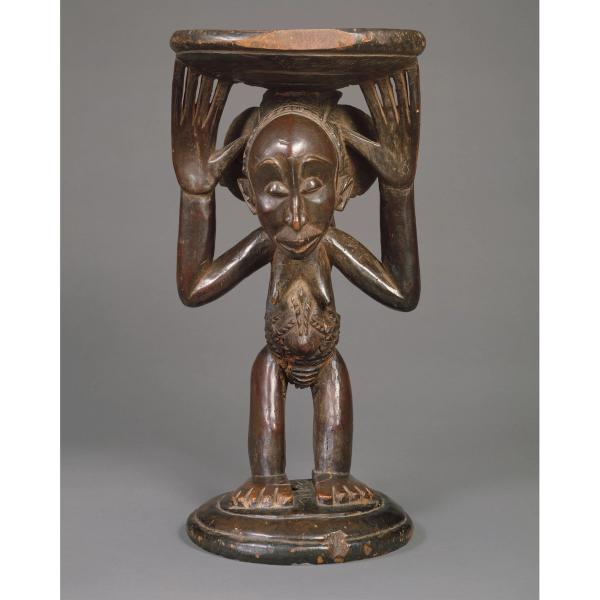
1595. Lupona (royal seat), Ngongo ya Chintu
Alison Saar
ANGELIQUE KIDJO (NARRATOR): The royal seat is held by a woman with powerful, exaggerated hands. Her eyes are downturned, her face a picture of melancholic reflection and resilience.
ALISON SAAR: What’s really beautiful about this piece is how she’s supporting upon her head and shoulders the weight of the chief. It feels that without her support, it would all sort of crumble and cease to exist.
My name is Alison Saar. I’m an artist working in sculpture that is influenced and informed by the African diaspora.
It’s always really incredible for me to see these works as a sculptor working in wood primarily myself. It’s truly a collaboration between the artist and the material, in terms of how far you can push it and what the wood will allow itself to be formed into.
ANGELIQUE KIDJO: When viewed in profile, you can see one of the most ornate and important aspects of the sculpture: the woman’s elaborate hairstyle.
ALISON SAAR: You know, for me, hair kind of tells the story. I think being biracial and looking very white and having curly hair, I felt like that was one of the things that really connected me to my African American ancestry through my mother’s family.
And to see how prominent hair and hairstyles were in the work of the Luba was really fascinating. Hairstyles will tell how many children a woman has or whom she’s married to or what her class is and what her ancestry is—these hairstyles tell stories and have really significant meaning in the community.
More Artwork
Related Content


 Free to download
Research Resources
The Met provides unparalleled resources for research and welcomes an international community of students and scholars. The Met's Open Access API is where creators and researchers can connect to the The Met collection. Open Access data and public domain images are available for unrestricted commercial and noncommercial use without permission or fee.
To request images under copyright and other restrictions, please use this Image Request form.
Feedback
We continue to research and examine historical and cultural context for objects in The Met collection. If you have comments or questions about this object record, please contact us using the form below. The Museum looks forward to receiving your comments.
Content Notice
The Metropolitan Museum of Art presents over 5,000 years of art from around the world, and our online collection reflects ongoing work conducted over the course of our more than 150-year history. You may encounter objects or images that may be inappropriate for some viewers or information that may be outdated.