Lupona (royal seat)
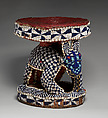
This ornate and impressive seat of leadership belonged to a Luba chief. Luba leaders trace their ancestry to a dynasty of sacred kings, and Luba royal seats are intended to replicate an original seat of office owned by the progenitor of this divine lineage. Such works associate their owner with the source of his legitimacy.
Despite their functional form, royal stools are never used for sitting but, rather, are sacred insignia preserved within a king's palace. They serve as metaphorical, not literal, seats of kingship. The design of Luba seats of leadership may either be abstract or figurative. Those incorporating female caryatids give expression to the Luba conception of the female body as a spiritual receptacle that supports divine kingship. The aesthetic refinement of the female body through elaborate skin ornamentation and coiffure serves as a metaphor for the civilization and refinement that Luba rulers disseminate within society. This particular caryatid displays filed teeth, a practice of beautification thought to render spoken language more "sweet" by weaving words and sentences into utterances of admirable clarity and beauty.
Blue and white beads such as those that embellish this caryatid are worn by important members of the court and provide spiritual protection for their owners. Here, the beads emphasize the caryatid's high social status and shield both the king and the stool itself from supernatural harm.
Artwork Details
- Title: Lupona (royal seat)
- Artist: Luba artist
- Date: Late 19th century–early 20th century
- Geography: southeastern Democratic Republic of the Congo, Shankadi region, Lovoi River region
- Culture: Luba
- Medium: Wood, glass beads, cotton fiber(?)
- Dimensions: H. 23 1/4 x W. 11 x D. 10 7/8 in. (59.1 x 27.9 x 27.6 cm)
- Classification: Wood-Furniture
- Credit Line: The Michael C. Rockefeller Memorial Collection, Gift of Nelson A. Rockefeller, 1969
- Object Number: 1978.412.317
- Curatorial Department: The Michael C. Rockefeller Wing
More Artwork


Related Content
Timeline of Art History
Entries and chronologies from The Met's art encyclopedia.

Publications
Books, guides, and catalogues published by The Met.
 Free to download
- Free to download
- Free to download
Research Resources
The Met provides unparalleled resources for research and welcomes an international community of students and scholars. The Met's Open Access API is where creators and researchers can connect to the The Met collection. Open Access data and public domain images are available for unrestricted commercial and noncommercial use without permission or fee.
To request images under copyright and other restrictions, please use this Image Request form.
Feedback
We continue to research and examine historical and cultural context for objects in The Met collection. If you have comments or questions about this object record, please contact us using the form below. The Museum looks forward to receiving your comments.
Content Notice
The Metropolitan Museum of Art presents over 5,000 years of art from around the world, and our online collection reflects ongoing work conducted over the course of our more than 150-year history. You may encounter objects or images that may be inappropriate for some viewers or information that may be outdated.