The Fall of the Giants
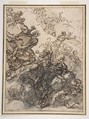
Salvator Rosa was inspired by Giulio Romano's famous fresco of the Fall of the Giants in the Palazzo del Te in Mantua when he created this unusually large print. There are more than a dozen surviving preparatory drawings for the etching, indicating the effort that Rosa put into its production. Although Rosa signed the work 'Salvator Rosa Inv. pinx', the etching is not derived from a painting. In a letter to his friend Ricciardi, Rosa lamented that 'even a fantasia like the Giants hasn't been sufficient to create the desire in anyone to see it painted.' Obtaining few of the painting commissions that he coveted, Rosa used etching to explore the grand philosophical and mythological themes that fascinated him, yet was disappointed that prospective patrons who saw this dramatic episode in print did not request a painting of the subject.
The inscription attached to Rosa's dedication, 'he is raised aloft that he may be hurled down in more headlong ruin,' is from The First Book Against Rufinus by Claudian Claudianus, often called the last poet of classical Rome. This quotation links the downfall of the presumptuous Giants to the fate of the cruel and greedy tyrant Rufinus, whose reign was also portrayed as the end of a Golden Age.
Artwork Details
- Title: The Fall of the Giants
- Artist: Salvator Rosa (Italian, Arenella (Naples) 1615–1673 Rome)
- Date: 1663
- Medium: Etching with drypoint
- Dimensions: Plate: 28 3/8 × 18 9/16 in. (72 × 47.1 cm)
Sheet: 29 15/16 × 20 3/8 in. (76 × 51.7 cm) - Classification: Prints
- Credit Line: Gift of Georgiana W. Sargent, in memory of John Osborne Sargent, 1924
- Object Number: 24.63.1829
- Curatorial Department: Drawings and Prints
More Artwork
Related Content
 Free to download
Research Resources
The Met provides unparalleled resources for research and welcomes an international community of students and scholars. The Met's Open Access API is where creators and researchers can connect to the The Met collection. Open Access data and public domain images are available for unrestricted commercial and noncommercial use without permission or fee.
To request images under copyright and other restrictions, please use this Image Request form.
Feedback
We continue to research and examine historical and cultural context for objects in The Met collection. If you have comments or questions about this object record, please contact us using the form below. The Museum looks forward to receiving your comments.
Content Notice
The Metropolitan Museum of Art presents over 5,000 years of art from around the world, and our online collection reflects ongoing work conducted over the course of our more than 150-year history. You may encounter objects or images that may be inappropriate for some viewers or information that may be outdated.