English
DonateMembershipTickets

Writing Box (Suzuribako) with Praying Mantis

Attributed to Ogawa Haritsu (Ritsuō) Japanese
first half 18th century
On view at The Met Fifth Avenue in Gallery 226
The Edo period witnessed a flowering of innovative design, fueled by the rise of a wealthy urban merchant class. Eager to distinguish themselves, merchants commissioned highly original objects that displayed both their prosperity and cultural sophistication. Among these were the lacquerwares of Ritsuō, to whom this dazzling writing box is attributed. In addition to using traditional gold and silver powders, he enriched the cedar surface with inlays of ceramic, glass, shell, carved bone, and pewter (or imitations using lacquer), creating a visually complex, colorful composition. The design’s Chinese aesthetic reflects the contemporaneous fascination with literati culture. Originally aspiring to become a haiku poet, Ritsuō did not begin his career as a lacquer artist until his mid-fifties. Beginning in 1721, he worked under the patronage of the daimyo Tsugaru Nobuhisa (1669–1746).

Artwork Details

Object Information
  • 伝小川破笠作 蟷螂蒔絵螺鈿象嵌硯箱
  • Title: Writing Box (Suzuribako) with Praying Mantis
  • Artist: Attributed to Ogawa Haritsu (Ritsuō) (Japanese, 1663–1747)
  • Period: Edo period (1615–1868)
  • Date: first half 18th century
  • Culture: Japan
  • Medium: Cedar wood, lacquer, gold and silver maki-e, mother-of-pearl, ceramic, bone
  • Dimensions: H. 1 7/8 in. (4.8 cm); W. 8 3/4 in. (22.2 cm); L. 9 1/2 in. (21.6 cm)
  • Classification: Lacquer
  • Credit Line: Gift of Florence and Herbert Irving, 2019
  • Object Number: 2019.193.32a–f
  • Curatorial Department: Asian Art
More Artwork
Panel, Ogawa Haritsu (Ritsuō)  Japanese, Lacquered wood, Japan
Attributed to Ogawa Haritsu (Ritsuō)
18th century
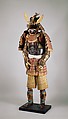
Armor (<i>Gusoku</i>), Saotome Ietada  Japanese, Iron, lacquer, silk, gilt copper, Japanese
Armorer Helmet bowl signed Saotome Ietada
Armorer Breastplate inscribed inside, Myōchin Munesuke
16th and 18th centuries
Case (Inrō) with Design of Grasshopper on Stalk of Flowering Lily, Nomura Chōkei (dates unknown)  Japanese, Case: Powdered gold (maki-e) on black lacquer with mother-of-pearl, pewter, and ceramic inlays; floral decoration on risers in incised gold; Fastener (ojime): carved red lacquer with design of Chinese sage and pine; Toggle (netsuke): stained ivory carved in the shape of a farm woman and child (signed: Homin), Japan
Nomura Chōkei (dates unknown)
18th–19th century
Greenrock Bench, George Nakashima  American, American walnut, Japan
George Nakashima
1986–87
Inrō Imitating an Old Chinese Ink Cake, Ogawa Haritsu (Ritsuō)  Japanese, Two-part (sheath-type); lacquered wood, metal, leather, with black and brown togidashimaki-e, takamaki-e on black ground<br/>Netsuke: manjū type with maki-e Daruma<br/>Ojime: ceramic bead with incense and ash design, Japan
Ogawa Haritsu (Ritsuō)
18th century

Research Resources

The Met provides unparalleled resources for research and welcomes an international community of students and scholars. The Met's Open Access API is where creators and researchers can connect to the The Met collection. Open Access data and public domain images are available for unrestricted commercial and noncommercial use without permission or fee.

To request images under copyright and other restrictions, please use this Image Request form.

Feedback

We continue to research and examine historical and cultural context for objects in The Met collection. If you have comments or questions about this object record, please contact us using the form below. The Museum looks forward to receiving your comments.

Send feedback

Content Notice

The Metropolitan Museum of Art presents over 5,000 years of art from around the world, and our online collection reflects ongoing work conducted over the course of our more than 150-year history. You may encounter objects or images that may be inappropriate for some viewers or information that may be outdated.