Division Viol
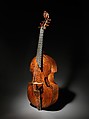
Slightly smaller than the bass viola da gamba, the division viol is an instrument ideal for playing improvised variations (or "divisions") upon a repeated bassline, or ground. Division viols grew in popularity in England in the seventeenth century alongside publications of methodical treatises, such as Christopher Simpson's The Division Viol of 1665 and The Division-Violist of 1669, as well as John Playford's A Brief Introduction of 1667. Because of its large compass and range of over three octaves, the instrument allowed accomplished performers to play polyphonic compositions and rapid passagework, but was also ideal for informal consort playing. (Elizabeth Weinfield, 2014)
As with many seventeenth century viols, this instrument was modified in the nineteenth century to be used as a cello. A restoration in southern Germany or Austria returned the instrument as a viol before it came to the Museum.
Technical description: intact except for neck; body of classical English viol proportions; opaque reddish-brown varnish; table of spruce in five pieces; back of maple in two pieces; ribs of similar maple to the back; table richly ornamented with double purfling, with an inlaid rosette of maple with figured parchment backing and a single purfling surround beneath the fingerboard; the back with double purfling extending inwards toward the center joint in a cross-over pattern at the top and bottom block areas; tuning: D, G, c, e, a, d'. (William Monical, 1977)
Artwork Details
- Title: Division Viol
- Maker: Henry Smith (British, London active 1623–ca. 1637)
- Date: 1629
- Geography: London, England, United Kingdom
- Culture: British
- Medium: Maple, spruce
- Dimensions: Body Length 65 cm
- Classification: Chordophone-Lute-bowed-fretted
- Credit Line: The Crosby Brown Collection of Musical Instruments, 1889
- Object Number: 10.30.2
- Curatorial Department: Musical Instruments
More Artwork
Research Resources
The Met provides unparalleled resources for research and welcomes an international community of students and scholars. The Met's Open Access API is where creators and researchers can connect to the The Met collection. Open Access data and public domain images are available for unrestricted commercial and noncommercial use without permission or fee.
To request images under copyright and other restrictions, please use this Image Request form.
Feedback
We continue to research and examine historical and cultural context for objects in The Met collection. If you have comments or questions about this object record, please contact us using the form below. The Museum looks forward to receiving your comments.
Content Notice
The Metropolitan Museum of Art presents over 5,000 years of art from around the world, and our online collection reflects ongoing work conducted over the course of our more than 150-year history. You may encounter objects or images that may be inappropriate for some viewers or information that may be outdated.