Two Views from the Eight Views of the Xiao and Xiang Rivers
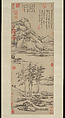
Little is known about Kantei, the artist of these two paintings, save that he may have been a monk of the Ritsu sect of Buddhism, in Nara. It is apparent that both compositions, with their strong horizontal and vertical lines, were influenced by works of the master ink painter Sesshū Tōyō (1420–1506).
Artwork Details
- 鑑貞筆 瀟湘八景中の二景図
- Title: Two Views from the Eight Views of the Xiao and Xiang Rivers
- Artist: Kantei (Japanese, active second half of 15th century)
- Period: Muromachi period (1392–1573)
- Date: early 16th century
- Culture: Japan
- Medium: Pair of hanging scrolls; ink and color on paper
- Dimensions: Image (a): 18 1/16 × 11 3/4 in. (45.8 × 29.9 cm)
Overall with mounting (a): 51 15/16 × 16 3/8 in. (132 × 41.6 cm)
Overall with knobs (a): 51 15/16 × 18 1/8 in. (132 × 46 cm)
Image (b): 18 1/8 × 11 3/4 in. (46 × 29.9 cm)
Overall with mounting (b): 52 1/16 × 16 5/16 in. (132.2 × 41.5 cm)
Overall with knobs (b): 52 1/16 × 18 1/8 in. (132.2 × 46 cm) - Classification: Paintings
- Credit Line: Mary Griggs Burke Collection, Gift of the Mary and Jackson Burke Foundation, 2015
- Object Number: 2015.300.52a, b
- Curatorial Department: Asian Art
More Artwork
Research Resources
The Met provides unparalleled resources for research and welcomes an international community of students and scholars. The Met's Open Access API is where creators and researchers can connect to the The Met collection. Open Access data and public domain images are available for unrestricted commercial and noncommercial use without permission or fee.
To request images under copyright and other restrictions, please use this Image Request form.
Feedback
We continue to research and examine historical and cultural context for objects in The Met collection. If you have comments or questions about this object record, please contact us using the form below. The Museum looks forward to receiving your comments.
Content Notice
The Metropolitan Museum of Art presents over 5,000 years of art from around the world, and our online collection reflects ongoing work conducted over the course of our more than 150-year history. You may encounter objects or images that may be inappropriate for some viewers or information that may be outdated.