Group Portrait of Three Ōbaku Zen Masters: Yinyuan (Ingen), Mu’an (Mokuan), and Jifei (Sokuhi)
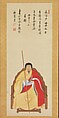
Also distinctive in this portrait is how the monks that flank Yinyuan are represented in three-quarters profile—a rarity in Ōbaku portraiture, which usually features full frontal poses (as demonstrated by three individual portraits in The Met’s collection: Yinyuan (2015.3); Mu’an (2015.500.9.7); and Jifei (1975.268.78). Numerous portraits of Yinyuan and his Dharma descendants were commissioned, keeping in mind that by 1745 there were over 1000 Ōbaku branch temples throughout Japan, and naturally local supporters would have commissioned portraits of the founders as well as the monks in charge of a particular branch temple. Approximately 250 Ōbaku monk portraits are known to survive; about 65 of these depict Yinyuan. At least seventeen triptychs are recorded, although many more may have been commissioned but later dispersed.
Commemorative portraits (chinzō 頂相) of the most prominent abbots have always been important in the East Asian Chan/Zen tradition, and hundreds of examples from Muromachi-period Japan survive. In the mid- to late seventeenth century, Chinese monks who emigrated to Japan and established Ōbaku as a “third sect” of Zen continued and reinvigorated this tradition. According to monastic codes, the portraits were used in ritual settings and for memorial services after the death of an abbot. In the Chan/Zen tradition, the practice of displaying the likeness of a deceased monk was known as “hanging the portrait” (keshin 挂真). Portraits of living monks, referred to as juzō 壽像, literally, “portraits of longevity,” were also commissioned, though further research is required to identify on what type of ritual occasions portraits of living monks were used, since many portraits, including the present example, were completed during the sitters’ lifetimes.
The artist Kita Genki is known to have created numerous portraits of these three masters, but this work stands out as one of very few created by the artist depicting the trio together in a single composition. It serves as a visual testament to the abbots who were crucial in establishing a new lineage of Rinzai Zen Buddhism in Japan and to their crucial legacy. In contrast to most paintings featuring the seals of Genki, which often have a more perfunctory rendering of the body of the sitter, likely created by assistants in his atelier, here the detailing of the hands is more assured more meticulous, suggesting that this is a special commission,
This group portrait—inscribed by Mu’an and dated to the seventh month of 1679—clearly is related to a painting of about 1663 that was created by Genki’s artistic mentor, Kita Dōku 喜多道矩 (Chōbei 長兵衛), which not only depicts the same eminent trio of abbots (though seated on rocks in a landscape in casual attire), but has an identical eulogy brushed by Mu’an and is now in Kobe City Museum of Art. At the time the earlier portrait was created, all three masters were still alive, and we assume that it was created around 1663, when all three were residing at Manpukuji—and could have commemorated the actual in-person reunion of the three monks. The poem Mokuan inscribed in his fluent hand celebrates the close spiritual relationship of the three Zen masters:
師資契会 弟兄同調
其振祖道 和融本妙
描成一軸 法眼圓照
杲々光輝洞海寰
拈提槌拂示玄要
The master and his [two] disciples
are united in understanding;
The younger and elder [Dharma] brothers
are likewise in harmony.
Their [respective] reinvigorations
of the Way of the [Chan] Ancestors
Merge together
[and thus are indistinguishable]
in fundamental profundity.
Painted perfectly in this one scroll,
their Dharma-eye is fully illuminated.
Its brightly shining radiance
penetrates the oceanic realm
[of the monastic order].
Raising the mallet and the whisk,
they express the profound essentials
[of Buddhist teachings]
(Trans. T. Griffith Foulk)
While more research is required into the circumstances of both the circa 1663 group portrait and this work dated 1679, it is perhaps no coincidence that the earlier portrait by Kita Dōku coincides with the time when Yinyuan had announced he was to retire and transfer the abbacy of Manpukuji to Mu’an. The later portrait by Kita Genki—Dōku’s top pupil and artistic heir—was created 16 years later (perhaps apropos someone’s sixteenth-year death anniversary we might speculate), around the time that Mu’an was about to step down and turn the abbacy over to his disciple Erin Shōki (Huilin Xingj 慧林性機, 1609–1681). Both the painter Genki and the monk-calligrapher Mu’an seem to be consciously referencing the earlier, iconic group portrait of the three masters, and to be reasserting the Dharma lineage of Ōbaku Zen in Japan. It can also be no coincidence that Mu’an must have had direct access to the original portrait when brushing the inscription, since the cursive shapes of so many characters are so close in appearance.
Artwork Details
- 喜多元規筆 木庵性瑫賛 隠元・木庵・即非三禅師像
- Title: Group Portrait of Three Ōbaku Zen Masters: Yinyuan (Ingen), Mu’an (Mokuan), and Jifei (Sokuhi)
- Artist: Kita Genki (Japanese, active 1664–1698)
- Period: Edo period (1615–1868)
- Date: 1679
- Culture: Japan
- Medium: Hanging scroll; ink and color on paper
- Dimensions: Image: 41 5/8 × 24 1/8 in. (105.7 × 61.2 cm)
Overall with mounting: 77 3/4 × 29 1/4 in. (197.5 × 74.3 cm)
Overall with knobs: 77 3/4 × 32 in. (197.5 × 81.3 cm) - Classification: Paintings
- Credit Line: Purchase, Mary and Cheney Cowles Gift, 2026
- Object Number: 2026.590
- Curatorial Department: Asian Art
More Artwork

Research Resources
The Met provides unparalleled resources for research and welcomes an international community of students and scholars. The Met's Open Access API is where creators and researchers can connect to the The Met collection. Open Access data and public domain images are available for unrestricted commercial and noncommercial use without permission or fee.
To request images under copyright and other restrictions, please use this Image Request form.
Feedback
We continue to research and examine historical and cultural context for objects in The Met collection. If you have comments or questions about this object record, please contact us using the form below. The Museum looks forward to receiving your comments.
Content Notice
The Metropolitan Museum of Art presents over 5,000 years of art from around the world, and our online collection reflects ongoing work conducted over the course of our more than 150-year history. You may encounter objects or images that may be inappropriate for some viewers or information that may be outdated.