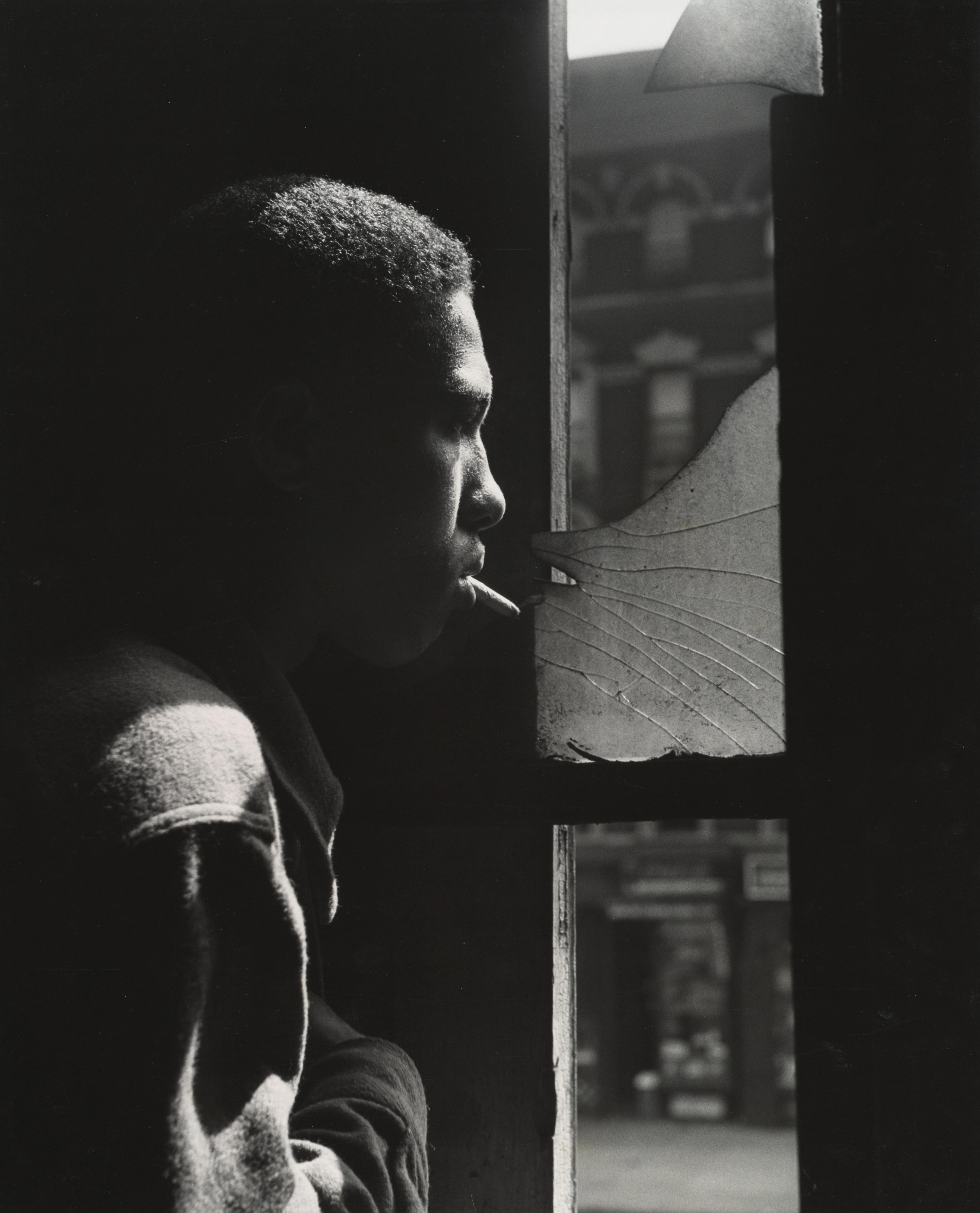
Gordon Parks (American, Fort Scott, Kansas 1912–2006 New York). Red Jackson, Harlem, New York, 1948. Gelatin silver print, 19 1/8 × 15 5/8 in. (48.5 × 39.6 cm). The Metropolitan Museum of Art, New York, Gift of Photography in the Fine Arts, 1959 (59.559.58). Courtesy of and copyright The Gordon Parks Foundation
My name is LaToya Ruby Frazier. I’m a photographer and an artist.
Since I was a teenager I’ve been obsessed with early twentieth-century social documentary photography. In the photo history books that I was trained with, one of the only significant African Americans is Gordon Parks. He allows the poor and the ostracized and the alienated to have power and an authority in their images, because he’s shooting it with so much dignity and human awareness and care.
This one print is really important because it’s from his first assignment with Life Magazine, known as The Harlem Gang Leader, where he photographs Leonard Jackson, who goes by the nickname 'Red.' In 1948, there isn’t much opportunity for young teenagers: the education system is failing, they’re living in squalor, and economically they’re disempowered.
Isolated on its own, it’s a nonjudgmental portrait. But then the way that it’s handled in the magazine—the subtitle has the words “violence” and “frustration”—they set up this whole layout to show Leonard as a threat or as a menace. People would rather only show this binary between good and bad images.
What is impressive about Gordon is that he was able to balance this cruel and tender world in a very poetic way. Aesthetically and formally I see Vermeer, I see the light and the shadow of a Rembrandt, I see Goya. I see beautiful understanding of texture, of framing, proximity, juxtaposition...
There’s tremendous beauty in people’s pain and their suffering. I mean, this is why we make art. The truth is we need social documentary, especially right now. When I look at this image, I think about this past summer and all these black men being killed by police, and the fact that there’s no justice for them.
This photograph also is very symbolic of Parks himself. In this photograph of Red, I can see the poetry of Gordon Parks. You see him as a filmmaker, as a composer. It’s a silent image, but I can hear it. There’s a sound that comes from this.
And that’s the genius of Gordon Parks, that’s what excites me about him, that’s what made me keep using my camera. He could take one person and completely smash any stereotype, by showing you so many multifaceted depths and dimensions of the psychology of a person. It’s so humane and universal. It’s undeniable.