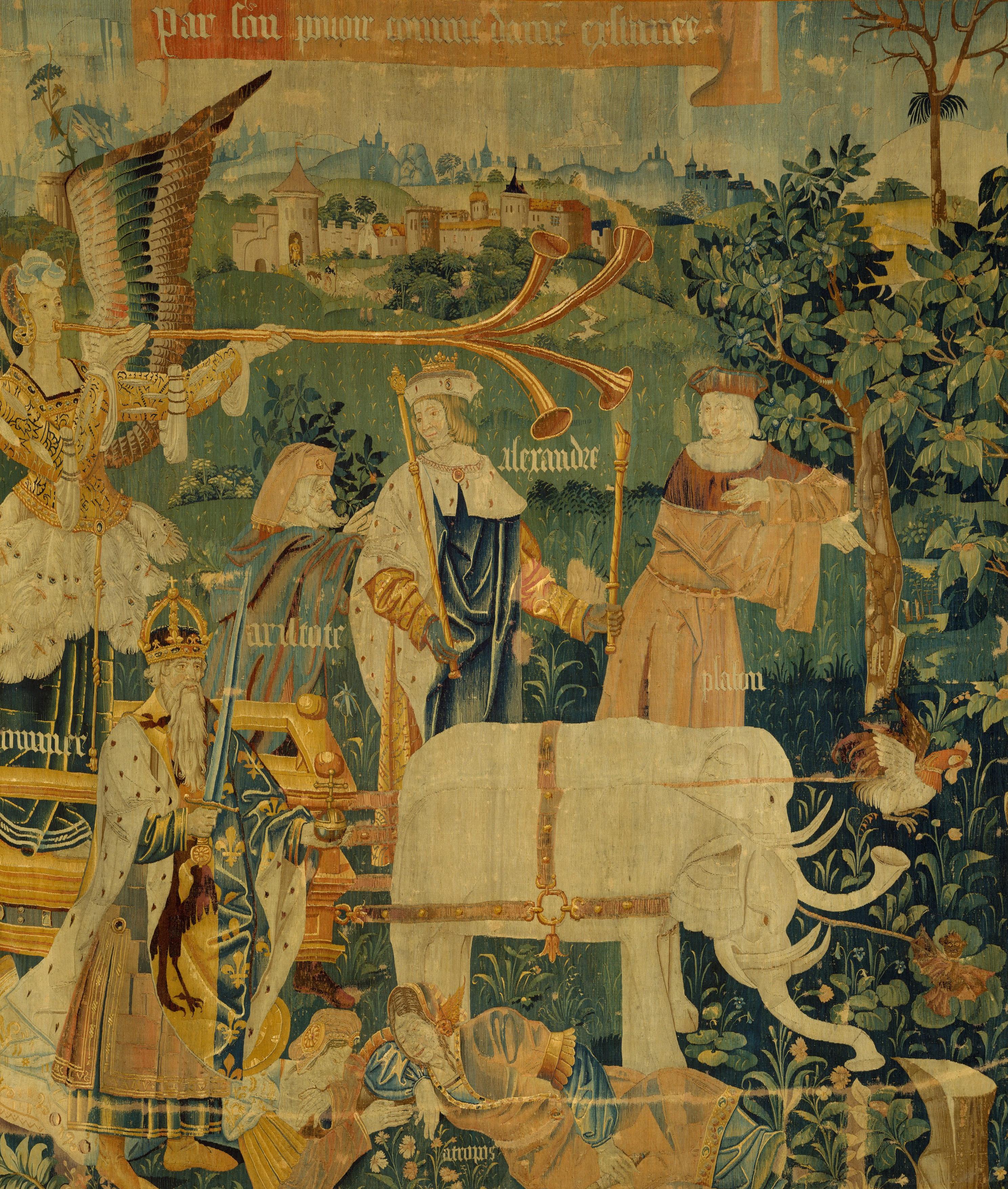
The Triumph of Fame over Death, ca. 1500–1530. South Netherlandish. Wool warp; wool and silk wefts, 144 x 128 in. (365.8 x 325.1 cm). The Metropolitan Museum of Art, New York, Bequest of George D. Pratt, 1935 (41.167.2)
I'm Matthew Ritchie. I'm an artist and my work is really about the shapes that information takes.
Well, I love the flat space of Medieval Art. And this—even though it’s being made quite a bit later—it still has that flatness. It’s doing a very different job than so-called 'naturalistic space' of later Renaissance art. And it’s trying to fit as much information as is possible into the picture space. As soon as your eye's caught on it, you're caught in this web of meanings and terms.
In many ways this is a picture of time based on a book by Petrach about the great rotational cycle of life. This is the Triumph of Fame and Life over Death. And the labels are a very effective, simple way of saying "decode this." This is a diagram of states of being. Fame is actually this lady. She's got this enormous trumpet. What is celebrated is not fame but renown, so Alexander is the most famous because he dies young. At the bottom of it you have the figure of Atropos, who is the cutter of the thread of life, which I imagine for tapestry makers is pretty special moment. They're literally weaving the thread of life. And the two elephants, which were traditional Roman symbols of fame, are being pulled by a rooster and a bat. The rooster is the symbol of day, and the bat is the symbol of night or envy. And Charlemagne, he's got in his hand the symbol of the world surmounted by the cross because he's the first revitalized Holy Roman Emperor. This was the stuff everyone talked about. To the people of the day knowing this would be no more than knowing who's who in Game of Thrones. Is this king as good as Charlemagne, or are they going to destroy us like that last king we had?
Because you're dealing with multiple hierarchies of meaning, everything has to be tiled up, also so you can see it. That creates these very peculiar, abstract spaces. And for me that's very similar to the screen of the computer, which is a flat space filled with lots of pieces you can move around, and you basically keep moving the pieces around till you fit everything in.
And we can only imagine the level of correspondence and careful diagrammatic reasoning that went into assembling these parts. This might have taken a year of work—different hands coming in doing a little bit here a little bit there—and it all had to somehow work out. This incorporates lots of different ideas. It doesn't insist on one reading, in fact it insists on multiple readings.
I don't know that I could have held all of that information together without making a diagram of the diagram to sort of engrave it in my brain in way, which is what I do with my own practice. But I think my practice is pretty post-Medieval as it is. I feel a tremendous sympathy for the makers of this trying to sort of glue together a tremendously disparate group of ideas, but nonetheless poignantly committed to a kind of whole.