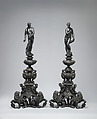
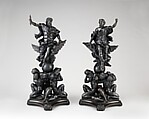
Andiron with figure of Venus (one of a pair)
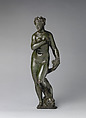
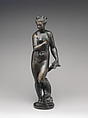
The Vulcan is one of many replicas of a model that Leo Planiscig attributed to Tiziano Aspetti or his circle.[2] The Venus is similar to another statuette in The Met’s collection (cat. 75), and both derive from Girolamo Campagna’s stone statue of Venus Marina on the upper balustrade of the Libreria Marciana, Venice (p. 00, fig. 75a). This related bronze is signed “IC” on the base, and Planisicig linked the initials to Girolamo (Latin: Ieronimus) Campagna.[3] Thus, the present andirons have also been connected to Campagna or his workshop, after having been unconvincingly ascribed to Jacopo Sansovino and then Aspetti.[4] Doubts about the owner of the “IC” initials have been expressed by Andrea Bacchi.[5] As an alternative, Peta Motture proposed the caster Giacomo Calderari, who produced firedogs on a large scale. In the postmortem inventory of his workshop, among the andirons are listed “two figures of Vulcan and Venus.”[6]
The identification of the “IC” master remains a conundrum. The Venus of the present firedogs is, however, a coarse approximation of the The Met’s much more beautiful and finished Venus Marina. As Motture and Victoria Avery have shown, utilitarian objects based on prototypes such as Campagna’s statues were mass-produced in the late sixteenth and seventeenth centuries in Venetian foundries like Calderari’s, and professional casters continued to manufacture them for a long time.[7] It is therefore reasonable to assume that our firedogs date to the early seventeenth century, or even later.
-FL
Footnotes
(For key to shortened references see bibliography in Allen, Italian Renaissance and Baroque Bronzes in The Metropolitan Museum of Art. NY: The Metropolitan Museum of Art, 2022.)
1. R. Stone/TR, August 2001 and October 18, 2012; Kryza-Gersch, October 2001, ESDA/OF.
2. See Claudia Kryza-Gersch in Bacchi et al. 1999, cat. 95.
3. Planiscig 1921, pp. 542–43.
4. Altman 1928, pp. 129–30, nos. 62, 63. Previously, they were attributed to Sansovino, as stated in a typed booklet kept in ESDA/OF.
5. Bacchi et al. 1999, pp. 410–11.
6. Motture 2003, p. 284.
7. See V. Avery 2013.
Artwork Details
- Title: Andiron with figure of Venus (one of a pair)
- Artist: After a model by Girolamo Campagna (Italian, Verona 1549–1625 Venice)
- Date: possibly early 17th century
- Culture: Italian, Venice
- Medium: Bronze
- Dimensions: Height: 44 1/2 in. (113 cm)
- Classification: Sculpture-Bronze
- Credit Line: Bequest of Benjamin Altman, 1913
- Object Number: 14.40.694
- Curatorial Department: European Sculpture and Decorative Arts
More Artwork
Related Content
 Free to download
Research Resources
The Met provides unparalleled resources for research and welcomes an international community of students and scholars. The Met's Open Access API is where creators and researchers can connect to the The Met collection. Open Access data and public domain images are available for unrestricted commercial and noncommercial use without permission or fee.
To request images under copyright and other restrictions, please use this Image Request form.
Feedback
We continue to research and examine historical and cultural context for objects in The Met collection. If you have comments or questions about this object record, please contact us using the form below. The Museum looks forward to receiving your comments.
Content Notice
The Metropolitan Museum of Art presents over 5,000 years of art from around the world, and our online collection reflects ongoing work conducted over the course of our more than 150-year history. You may encounter objects or images that may be inappropriate for some viewers or information that may be outdated.