Dish in the shape of a leaf
Artwork Details
- 唐 葉形鎏金銀盤
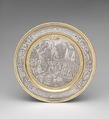
- Title: Dish in the shape of a leaf
- Period: Tang dynasty (618–907)
- Date: late 7th–early 8th century
- Culture: China
- Medium: Silver with parcel gilding
- Dimensions: L. 5 3/4 in. (14.6 cm)
- Classification: Metalwork
- Credit Line: Purchase, Arthur M. Sackler Gift, 1974
- Object Number: 1974.268.11
- Curatorial Department: Asian Art
Audio
7430. Dish in the Shape of a Leaf
The shapes and ornament of the objects in this case appear Near Eastern or Greco-Roman in character. They were produced during the Tang Dynasty, an imperial age with an extremely cosmopolitan culture. Numerous traders from Central Asia and beyond traveled to Ch’ang-an, the Tang Dynasty capital. Many cultures and religions co-existed peacefully in the city. In fact, the entire Sassanian court, which had been overrun by Islamic crusaders, moved there from Persia in the seventh century, to find safety. They brought with them a number of their artisans, including silversmiths. Sassanian forms and motifs became a part of the repertoire of silver vessels that were already being developed in China, resulting in an explosion of new decorative forms.
The leaf-shaped dish at the front is made of cast silver and decorated with floral scrolls that enclose birds—a Tang-dynasty variation of a late Roman motif. The bowl to its right bears a recumbent deer, a central Asian image. It is hammered and chased rather than cast, and parcel gilding highlights the naturalistic décor.
More Artwork
Related Content

Research Resources
The Met provides unparalleled resources for research and welcomes an international community of students and scholars. The Met's Open Access API is where creators and researchers can connect to the The Met collection. Open Access data and public domain images are available for unrestricted commercial and noncommercial use without permission or fee.
To request images under copyright and other restrictions, please use this Image Request form.
Feedback
We continue to research and examine historical and cultural context for objects in The Met collection. If you have comments or questions about this object record, please contact us using the form below. The Museum looks forward to receiving your comments.
Content Notice
The Metropolitan Museum of Art presents over 5,000 years of art from around the world, and our online collection reflects ongoing work conducted over the course of our more than 150-year history. You may encounter objects or images that may be inappropriate for some viewers or information that may be outdated.