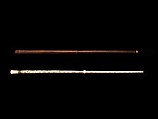
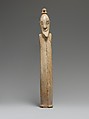
Narwhal Tusk
Narwhal tusks, believed to be those of unicorns, were safeguarded in churches from London to Cracow. Saint- Denis, outside Paris, possessed one said to have been given to Charlemagne in the ninth century by the Abbasid caliph Harun al-Rashid, while San Marco in Venice acquired one from Süleyman the Magnificent. Charles VI of France, his uncle Jean, duc de Berry, and Philip the Good, duke of Burgundy, all listed unicorn horns among their prized possessions. When Lorenzo de Medici died in 1492, the "unicorn horn" in his collection was valued at 6,000 florins.
Artwork Details
- Title: Narwhal Tusk
- Medium: Narwhal tusk
- Dimensions: Overall: 8 ft. (96 in.)
- Classification: Ivories-Narwhal
- Credit Line: Gift of Elaine Rosenberg, in honor of Alexandre Rosenberg, 2015
- Object Number: N.A.2015.18
- Curatorial Department: Medieval Art and The Cloisters
Audio
89. Kids: Narwhal Tusk
More Artwork
Research Resources
The Met provides unparalleled resources for research and welcomes an international community of students and scholars. The Met's Open Access API is where creators and researchers can connect to the The Met collection. Open Access data and public domain images are available for unrestricted commercial and noncommercial use without permission or fee.
To request images under copyright and other restrictions, please use this Image Request form.
Feedback
We continue to research and examine historical and cultural context for objects in The Met collection. If you have comments or questions about this object record, please contact us using the form below. The Museum looks forward to receiving your comments.
Content Notice
The Metropolitan Museum of Art presents over 5,000 years of art from around the world, and our online collection reflects ongoing work conducted over the course of our more than 150-year history. You may encounter objects or images that may be inappropriate for some viewers or information that may be outdated.