In celebration of Native American and Indigenous Heritage Month, we're offering a self-guided tour exploring The Met collection. Drawing inspiration from our weekly Member tours running through November 24, we invite you to use this guide to travel through the Museum’s galleries from anywhere.
With artworks selected by Museum guides, the tour explores pieces in our collection created by Native American and Indigenous communities that represent culture through splendid objects. If you’re not already a part of the Met Member community, we hope you’ll join as a Member to attend Heritage Month tours like this one and enjoy free admission, exclusive gallery access, and much more.
Our Members' support makes everything we do at The Met possible, including the study and preservation of invaluable pieces like these. Read on to learn more about powerful narratives and art across our galleries.
Tour Stops
Objects from The Met’s Art of Native America galleries in the American Wing honor the diversity of Native life, with more than fifty Indigenous groups represented.
The Homelands, Haudenosaunee Women’s Blanket
Gallery 744
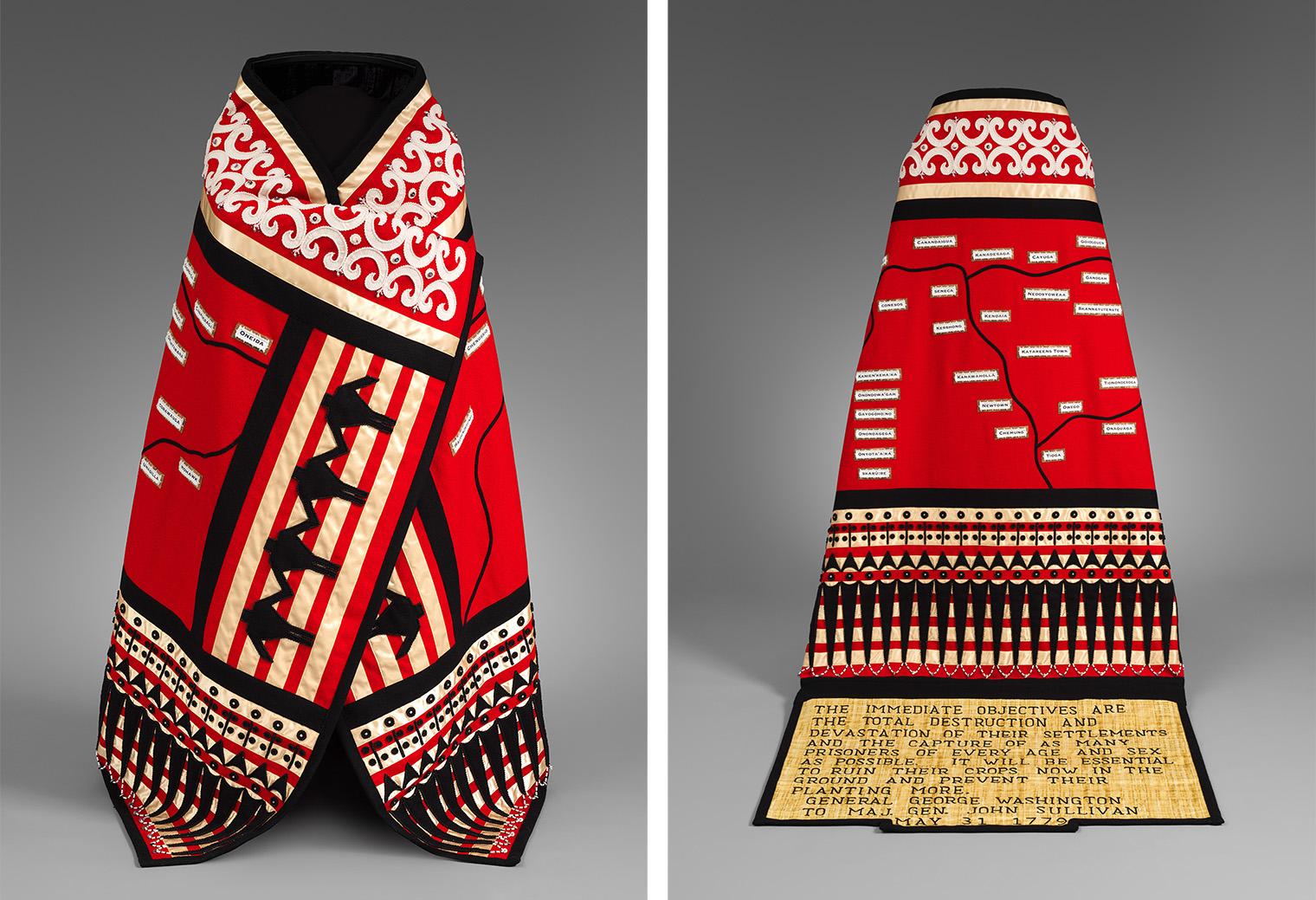
Carla Hemlock (Kahnawake, Mohawk Nation). The Homelands, Haudenosaunee Women’s Blanket, 2024. Wool, Shell, Glass Beads, Cork Cloth, Treaty Cloth (Wool), Silver Sequins, Larger section: 60 × 84 in. (152.4 × 213.4 cm), Quote/bottom section: 31 × 40 in. (78.7 × 101.6 cm), Weight: 10 lb. (4535.97g). The Metropolitan Museum of Art, New York, Purchase, 2024 Benefit Fund, 2024 (2024.574)
The hand-embroidered, hand-sewn Haudenosaunee Women’s Wearing Blanket features iconography and symbols interpreting the history and original territories of the Haudenosaunee peoples. Centered on the reverse side, a map depicts the communities and villages destroyed during George Washington’s 1779 military campaign, known as the "Sullivan Expedition.” Raised beadwork designs of figures and sky domes reflect Haudenosaunee oral histories, wampum, creation stories, and cosmologies.
Socorro black-on-white storage jar
Gallery 746
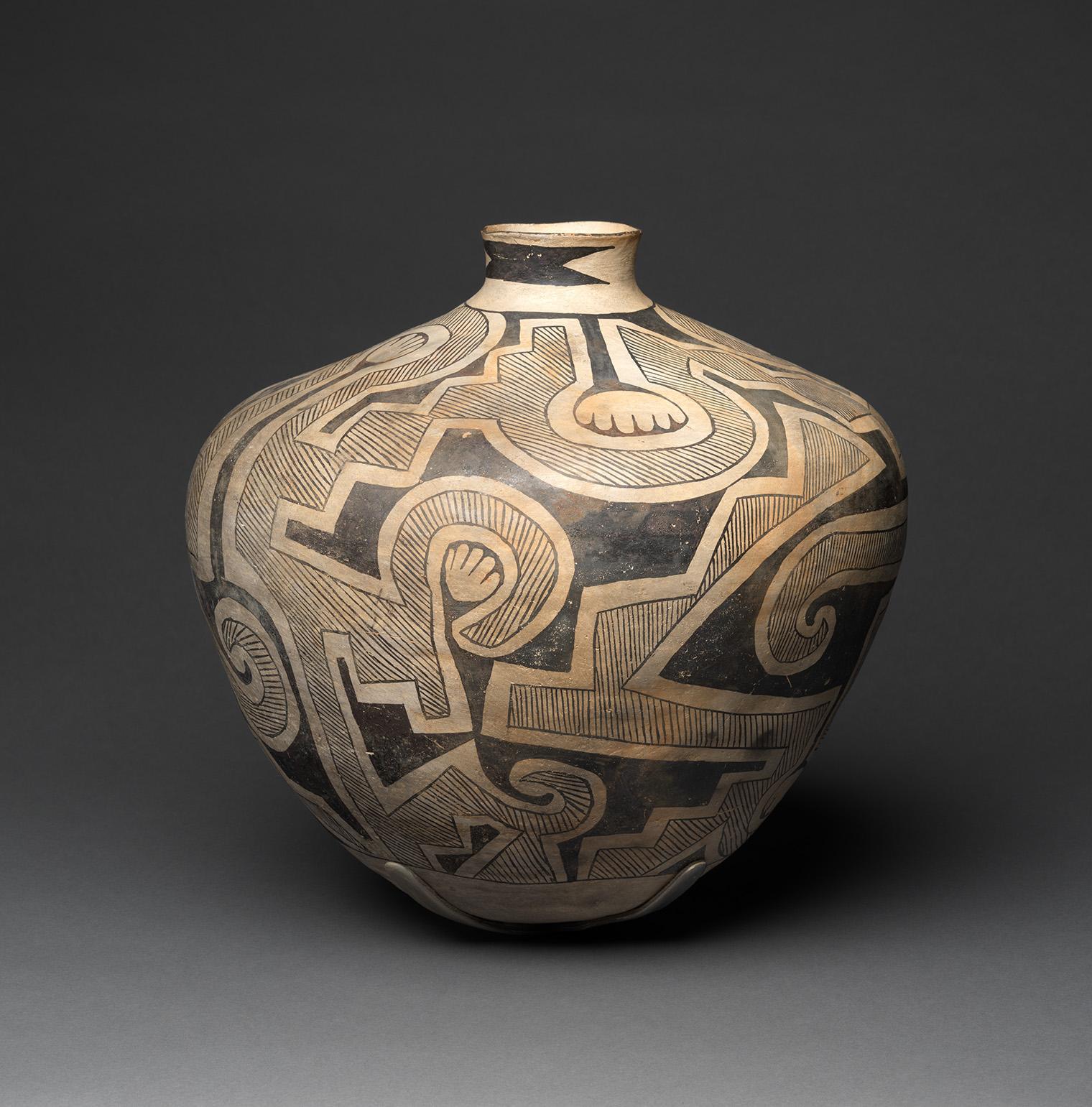
Socorro black-on-white storage jar, ca. 1050–1100. Ancestral Pueblo, Native American. Clay and pigment, 15 × 17 in. (38.1 × 43.2 cm). The Metropolitan Museum of Art, New York, The Charles and Valerie Diker Collection of Native American Art, Gift of Charles and Valerie Diker, 2019 (2019.456.21)
Ancestral Puebloan potters in the Southwest developed a spectacular, abstract pictorial painting on this water vessel in the late first millennium. The bold color scheme consists of a black iron-rich slip made from diluted organic materials and minerals on white clay. The imagery likely references water’s circulation beneath the earth and its precipitation from the sky, reflecting the society’s primary concerns around water management and their observation of the seasons.
Parka
Gallery 746
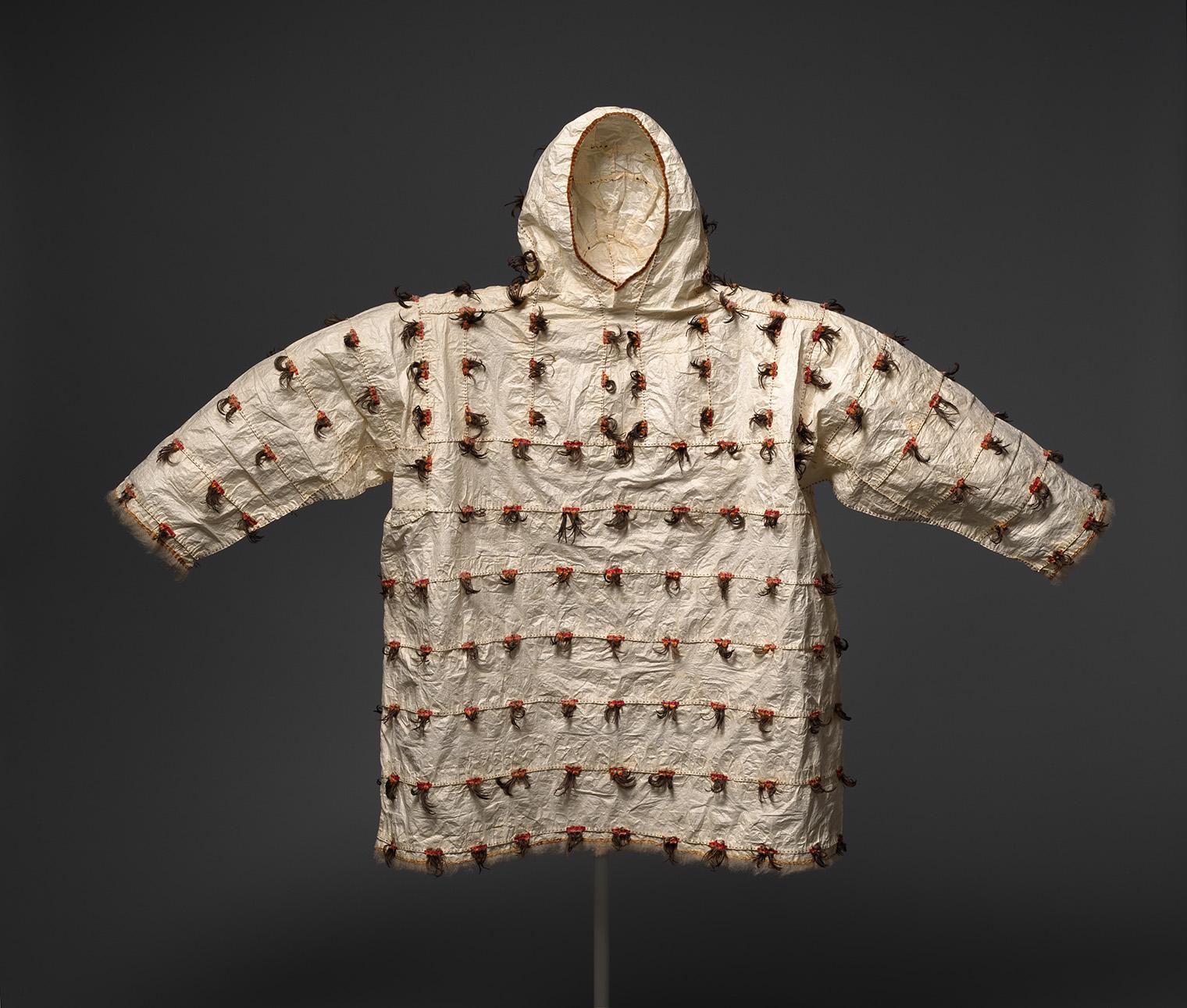
Edna Oktokiyuk (Yupik). Parka, ca. 1910. Marine mammal intestine, auklet beaks and feathers, tanned leather, and seal fur, 44 × 61 in. (111.8 × 154.9 cm). The Metropolitan Museum of Art, New York, Loan from the Charles and Valerie Diker Collection (L.2018.35.29)
Edna Oktokiyuk, a Yup'ik woman in Alaska, made this garment from dried seal intestines in the early twentieth century, honoring the animal’s soul through beauty and functionality. The beaks and feathers of the auklet, a small seabird, appear at regular intervals along the seams, providing a striking contrast to the parchment-like surface; fur trims the hem and cuffs. Yup'ik hunters wore coats such as this over fur parkas for protection against the wind and snow.
Mask
Gallery 746
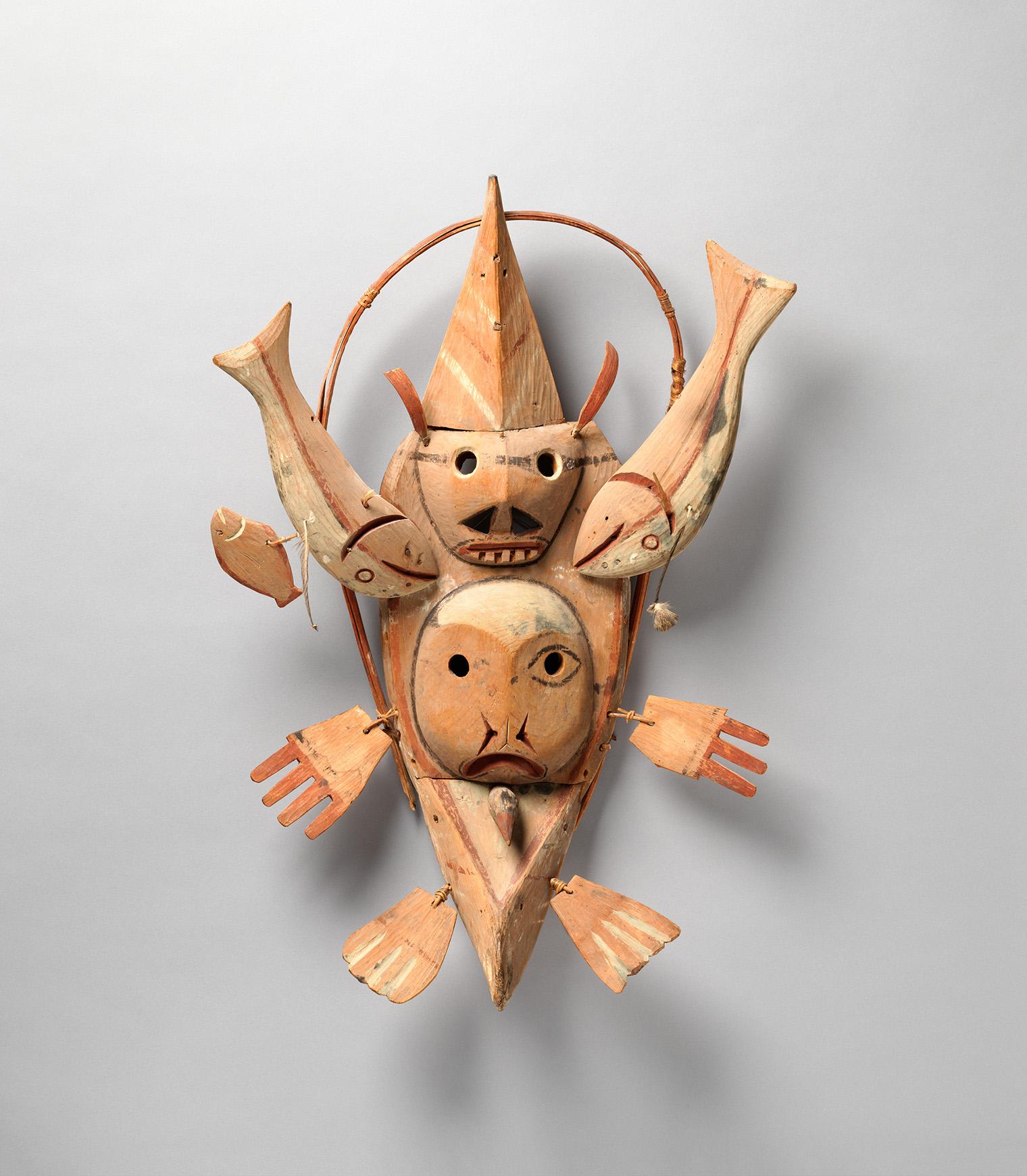
Mask, ca. 1900. Yup'ik, Native American. Wood, pigment, vegetal fiber, iron nails, and feathers, 34 1/2 × 22 × 9 1/2 in. (87.6 × 55.9 × 24.1 cm). The Metropolitan Museum of Art, New York, The Charles and Valerie Diker Collection of Native American Art, Gift of Valerie-Charles Diker Fund, 2017 (2017.718.3)
Within the bentwood border of this mask, a hunter’s kayak searches for quarry. Near the center of the boat, the face of a humanoid seal spirit emerges, with a tiny bird head at the bow possibly portraying the hunter as seen through the eyes of his prey. Fish and flippers surround the vessel, representing the supernatural animals that slip through the thumbless spirit hands and into the physical world to be hunted.
Basket bowl
Gallery 746
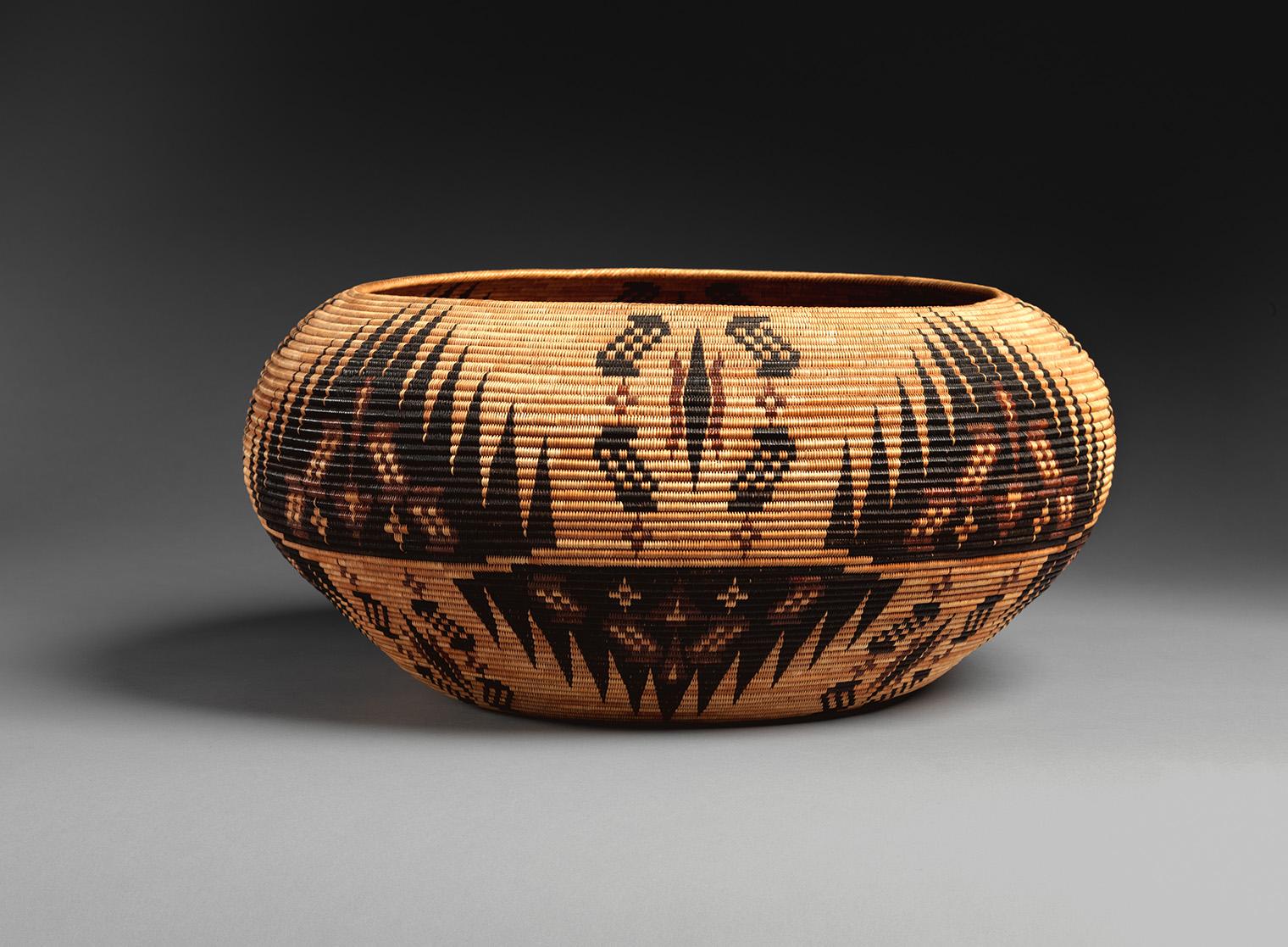
Carrie Bethel (Mono Lake Paiute, 1898–1974). Basket bowl, 1929. Willow shoots, sedge root, redbud shoots, and dyed bracken root, 9 × 19 1/2 in. (22.9 × 49.5 cm). The Metropolitan Museum of Art, New York, Loan from the Charles and Valerie Diker Collection (L.2018.35.61)
This large-scale basket demonstrates master weaver Carrie Bethel’s genius. The vessel took three years to complete, and the creative, multicolored backgrounds and designs were produced using materials from the landscape, such as sedge root and willow shoots. Awarded the best basket prize of fifty dollars for this piece in the 1929 Yosemite National Park Indian Field Days competition, Bethel later sold the work for one hundred eighty dollars.
Valise
Gallery 746
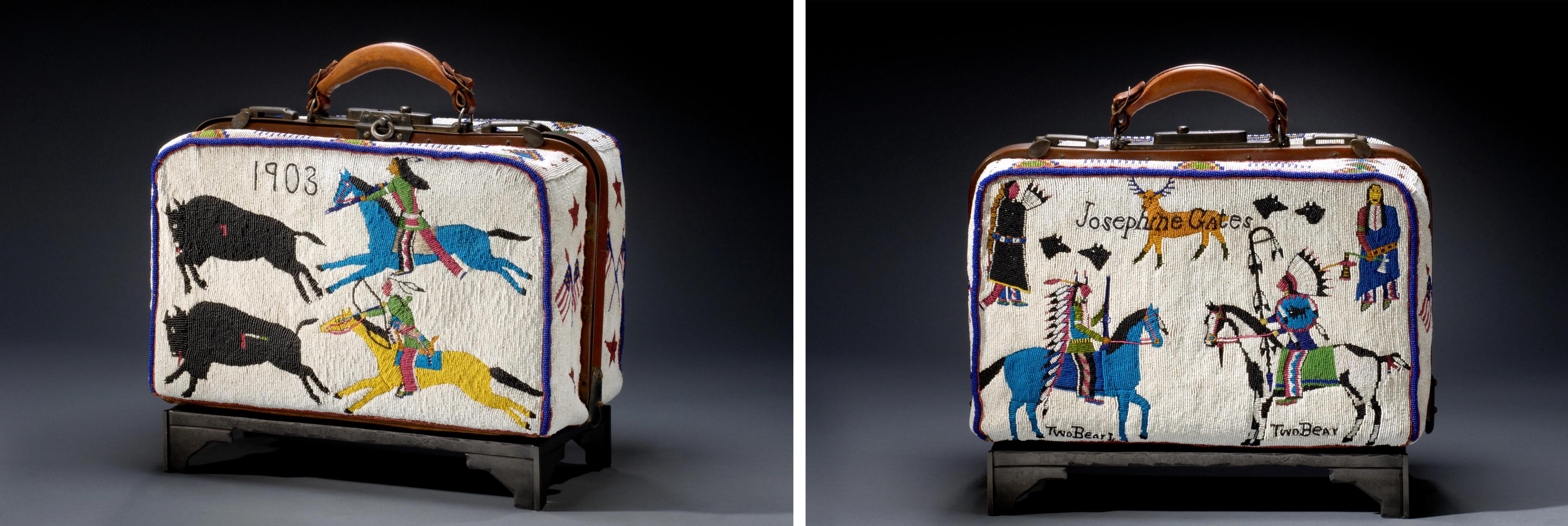
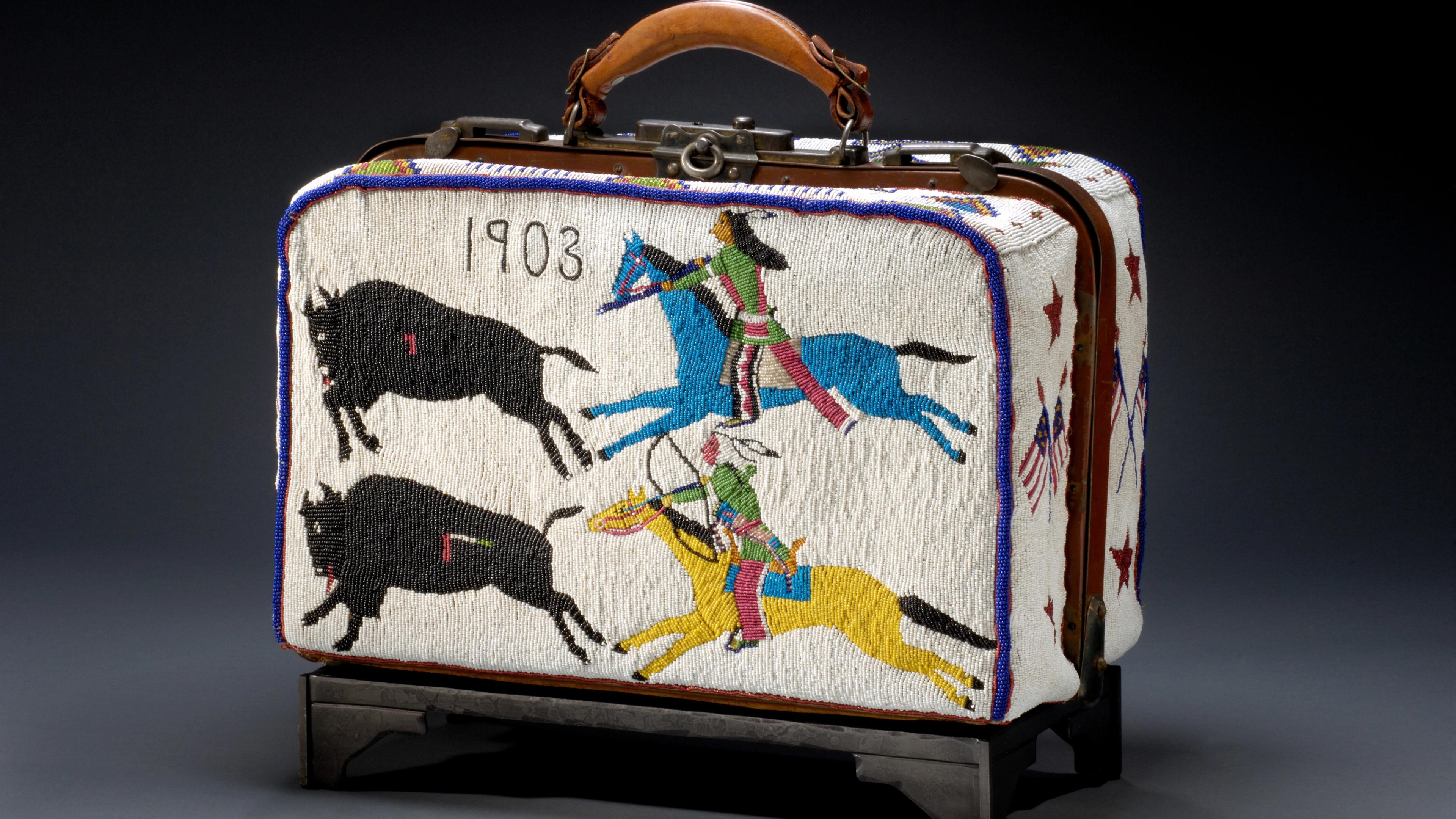
Nellie Two Bear Gates, Mahpiya Bogawin, Gathering of Clouds Woman (Native American, Dakota, Standing Rock Reservation, North Dakota, 1854–1935). Valise, 1903. Tanned leather, glass beads, and metal, 9 1/2 × 15 in. (24.1 × 38.1 cm). The Metropolitan Museum of Art, New York, Collection of Berte and Alan Hirschfield (L.2022.13)
Nellie Gates made this case for her daughter Josephine as a gift upon her graduation from the Carlisle Indian School in Pennsylvania. On one side, she beaded the deeds of her father, Two Bear, in the 1863 Battle of White Stone Hill. On the reverse, she created images of the Lakota’s last big buffalo hunt in 1882. Gates was one of the most accomplished bead workers of her time, creating many objects to honor meaningful events in her family history like this one.
Polacca polychrome water jar
Gallery 746
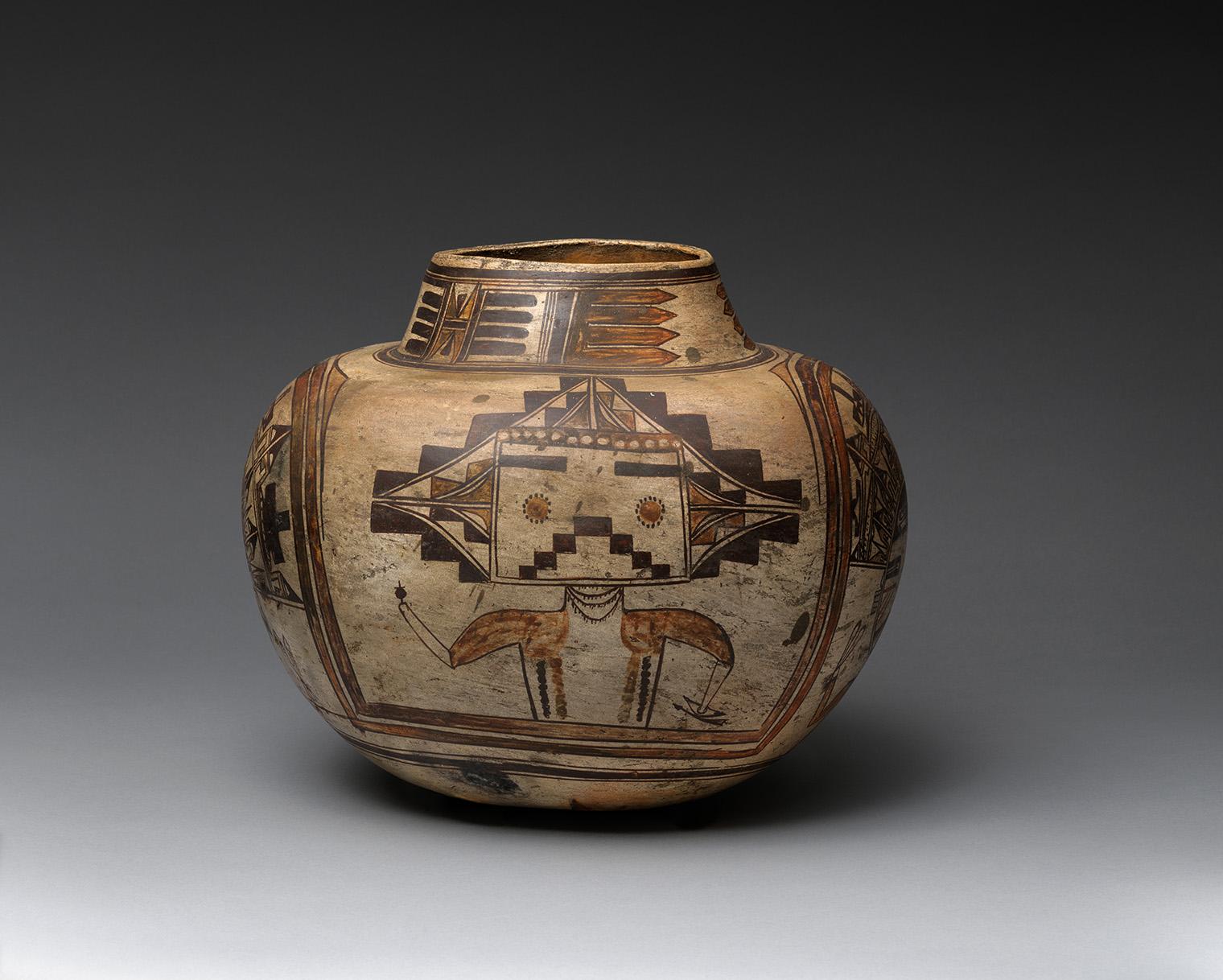
Nampeyo (Native American, Hopi-Tewa, ca. 1859–1942). Polacca polychrome water jar, ca. 1895–1900. Clay and pigment, 12 × 13 1/2 in. (30.5 × 34.3 cm). The Metropolitan Museum of Art, New York, The Charles and Valerie Diker Collection of Native American Art, Gift of Valerie-Charles Diker Fund, 2017 (2017.718.8)
The peoples of the American Southwest believe in a complex mythology around the vitality of the unpredictable desert landscape and the life-giving power of rainwater and mountains. Hand-built pottery, such as this superb piece by Nampeyo, often features imagery reflecting their deep spirituality. Nampeyo was the first Southwest potter to become recognized by name outside her Hopi community and is renowned for her technical skills and aesthetic sensibility. On this vessel, she depicts katsinam (spirit beings) with variations in headdresses and colors in an arching, rectangular double-line frame.
Man’s Coat
Gallery 746
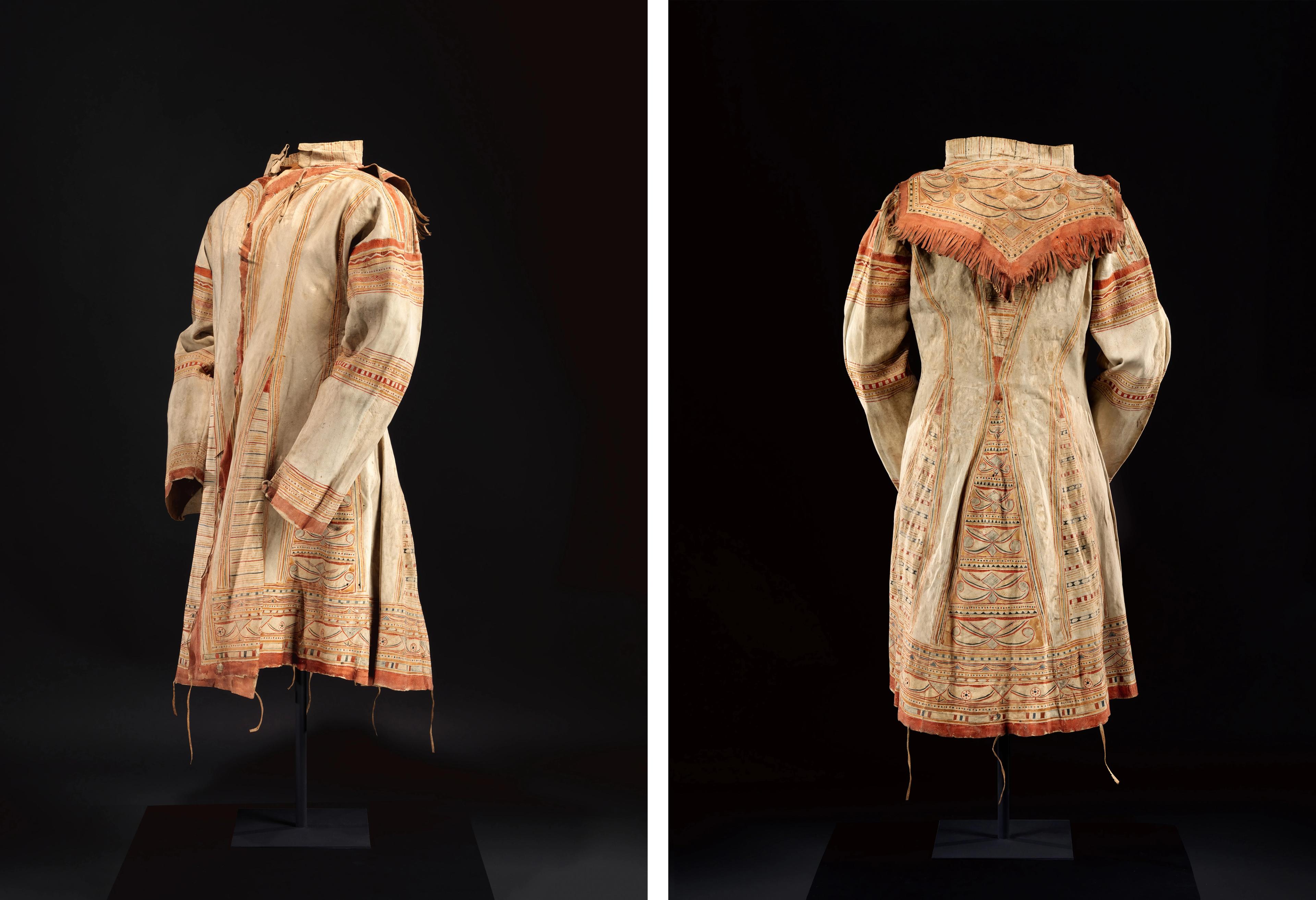
Man’s coat, ca. 1820. Innu/ Naskapi, Native American. Tanned leather and pigment, 41 1/2 × 69 1/4 in. (105.4 × 175.9 cm). The Metropolitan Museum of Art, New York, The Charles and Valerie Diker Collection of Native American Art, Gift of Valerie-Charles Diker Fund, 2017 (2017.718.9)
This frock coat with a high collar and cape constitutes a hybrid of European style and indigenous imagery. Together, the female artist and the hunter who would wear this coat conceived the geometric, colorful design based on the motifs that would give the hunter power and ensure his success. Coats such as this example were worn for only one caribou hunting season, as the Naskapis (Innus) believed they lost their protective power over time.
Next, head over to the Museum’s Arts of the Ancient Americas galleries, which present nearly seven hundred items representing the artistic legacy of Indigenous artists.
Portrait of K'inich Yo'nal Ahk II, seated ruler receiving a noble (Stela 5)
Gallery 360
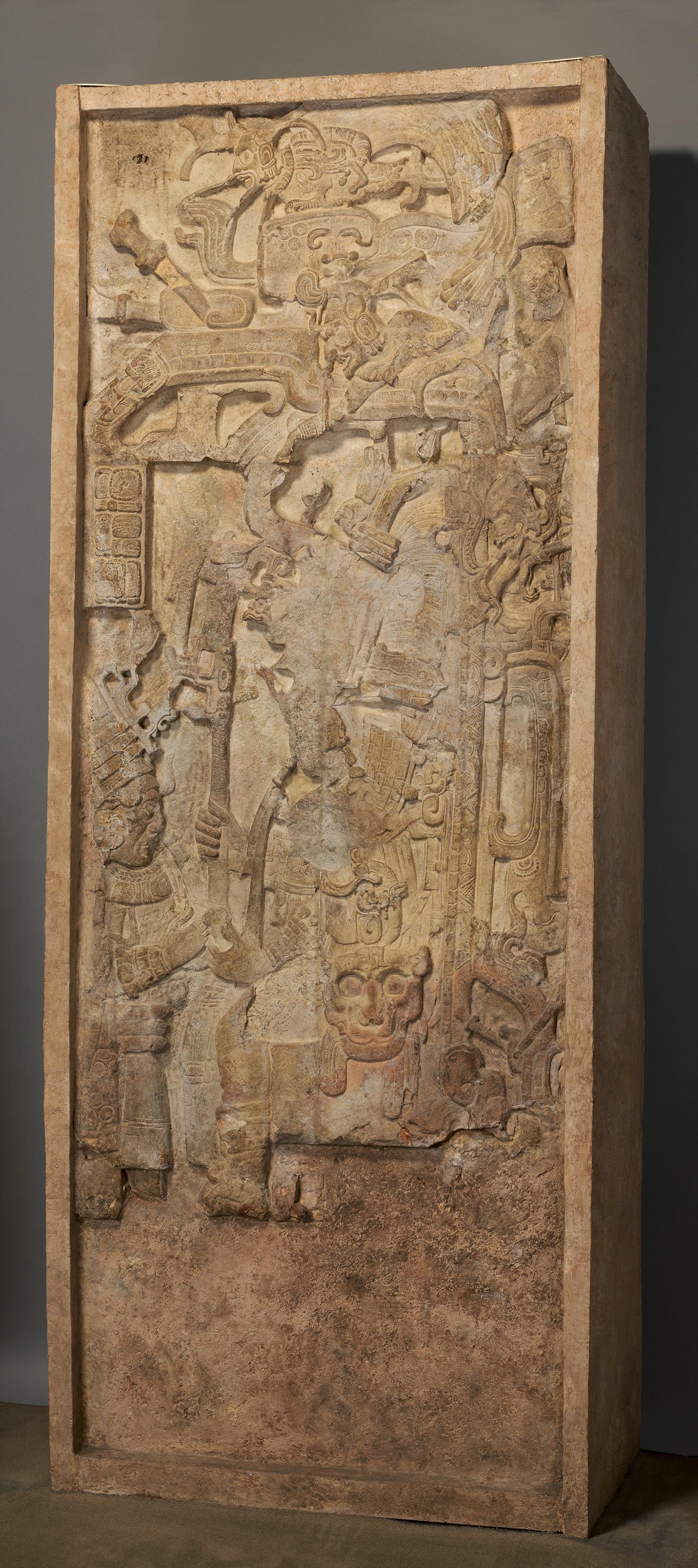
Maya artist(s). Portrait of K'inich Yo'nal Ahk II, seated ruler receiving a noble (Stela 5), 700–725 CE. Limestone, paint, H. 9 ft. × W. 47 1/2 in. × D. 25 in. (274.3 × 120.7 × 63.5 cm). Lent by the Republic of Guatemala, 1970 (L.1970.78)
On this intricately carved limestone stela, the ruler of Yok’ib (known today as Piedras Negras), K’inich Yo’nal Ahk II, sits on a throne and receives a noble visitor. Although the scene may reflect cultural reality, it includes fantastical elements: the fanged, open mouth of a personified mountain, a skeletal figure smoking a cigar, and the personification of the Maya Jaguar God of the Underworld. By incorporating both historical and mythical elements, Maya artist-scribes implied the ruler’s divine influence over both the human and superhuman realms and illustrated the interwoven nature of the mundane and the mythical.
Column
Gallery 360
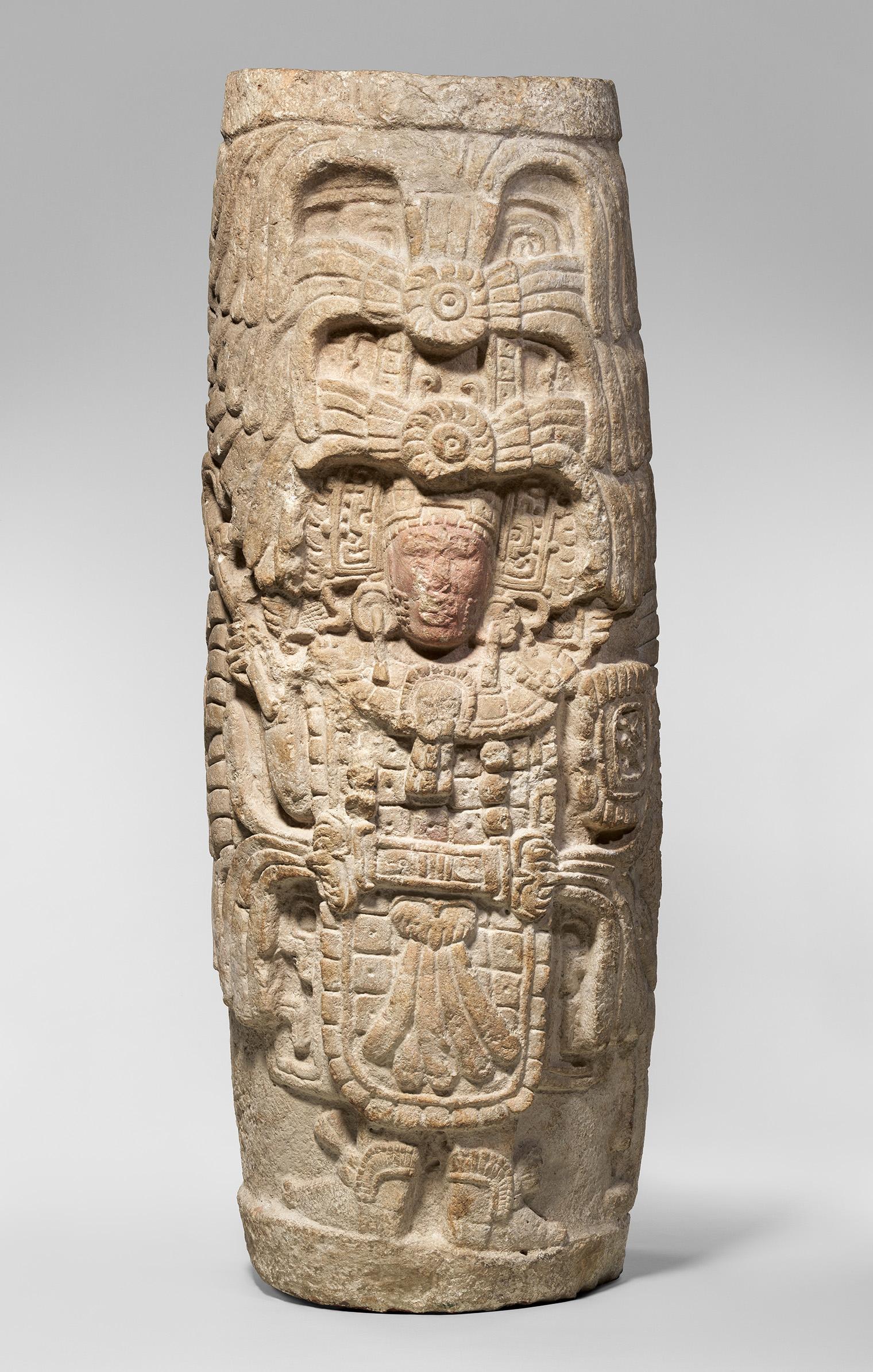
Maya artist(s). Column, 800–900 C.E. Limestone, pigment, H. 68 3/4 x W. 29 in. (173.4 x 73.7 cm). The Metropolitan Museum of Art, New York, The Michael C. Rockefeller Memorial Collection, Gift of Nelson A. Rockefeller, 1963 (1978.412.88)
This limestone column depicts an ornately dressed individual, most likely a Maya ruler, and a dwarf. The ruler’s costume and accessories, featuring an enormous headdress, hooked blade, and shield, refer to warfare, sacrifice, and agricultural fertility. For the Maya, carved stone monuments were not static representations of the people they depicted; rather, sculptures were powerful agentive beings. Chipping off the faces on stone monuments—just as this face has been damaged—offered one way of terminating that power.
Chahk (rain god)
Gallery 360
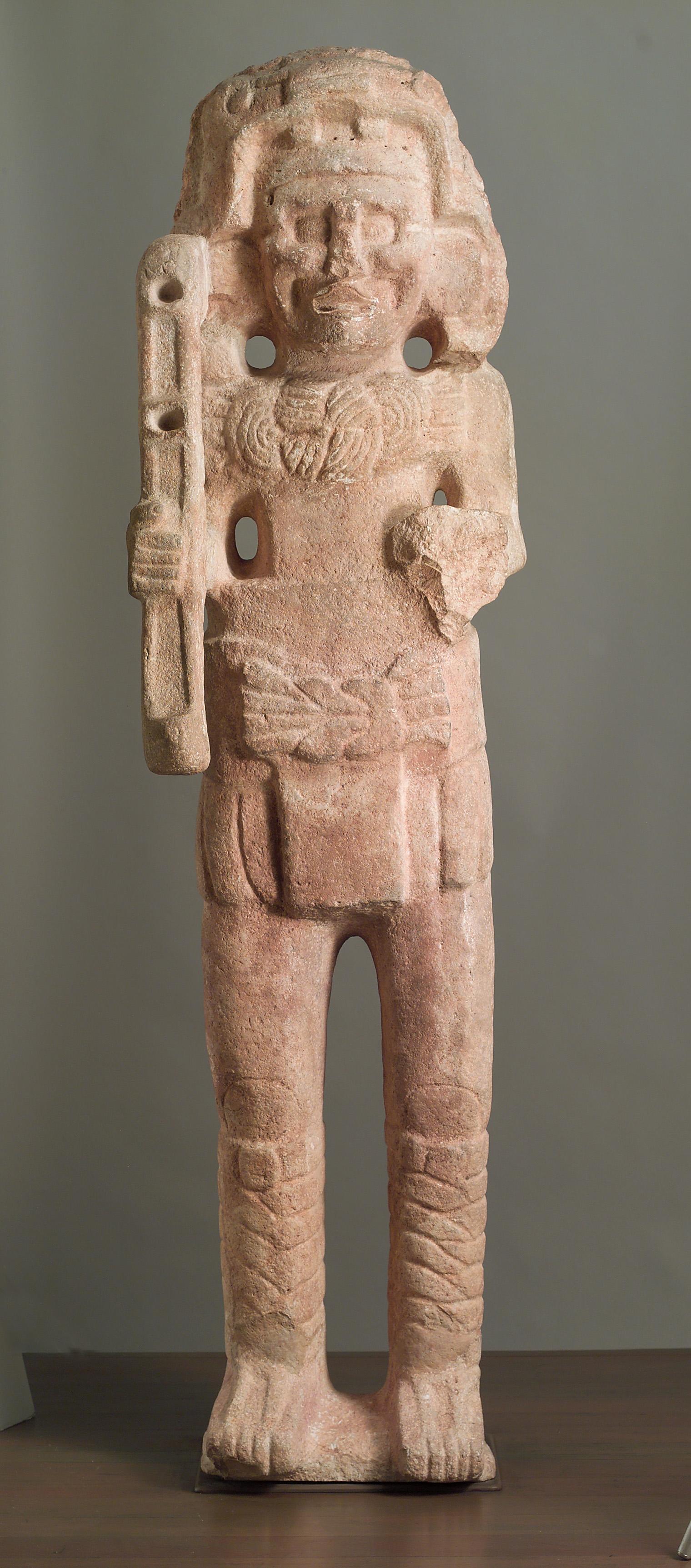
Maya artist(s). Chahk (rain god), 800–1000 CE. Limestone, 84 7/8 × 24 × 20 in., 969 lb. (215.6 × 61 × 50.8 cm, 439.5 kg). The Metropolitan Museum of Art, New York, Harris Brisbane Dick Fund, 1966 (66.181)
This grand sculpture portrays the Maya deity Chahk as the Storm God: an axe-wielding personification of rain, storms, and lightning, complete with an open mouth and pronounced cheeks as if shouting. Adding to his menacing appearance, Chahk’s headdress seems to be an animal’s head, perhaps a feline or a serpent, with its two blunt teeth protruding above his eyes. It likely formed part of a royal court building, fixing its imposing gaze on all who entered.
Check our Member Visit Guide for a full schedule of upcoming Membership events, tips for visiting, and much more. If you’re interested in joining a tour in person, you can find more information on our website here.
This tour was organized by volunteers in The Met's Education Department.


