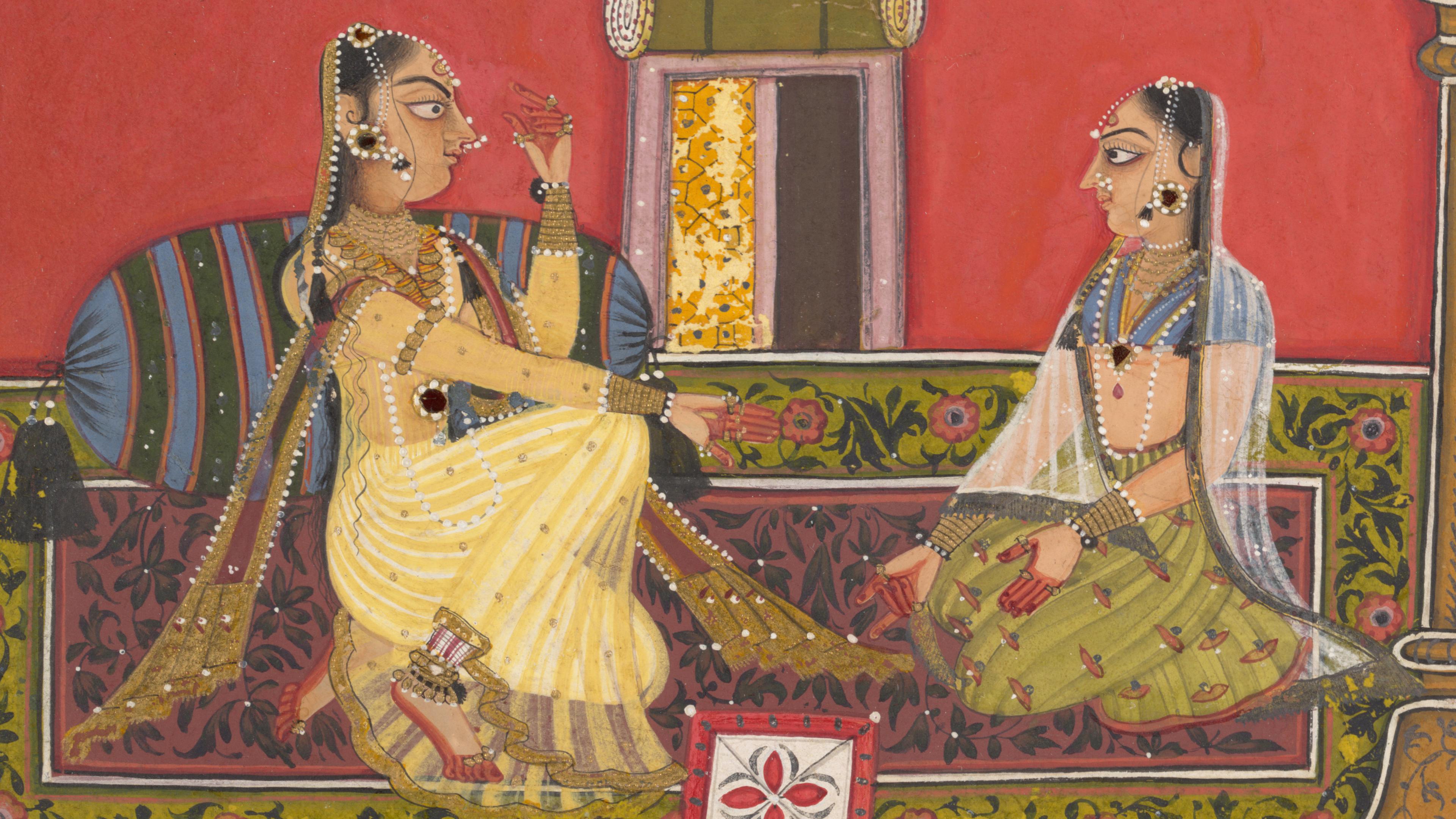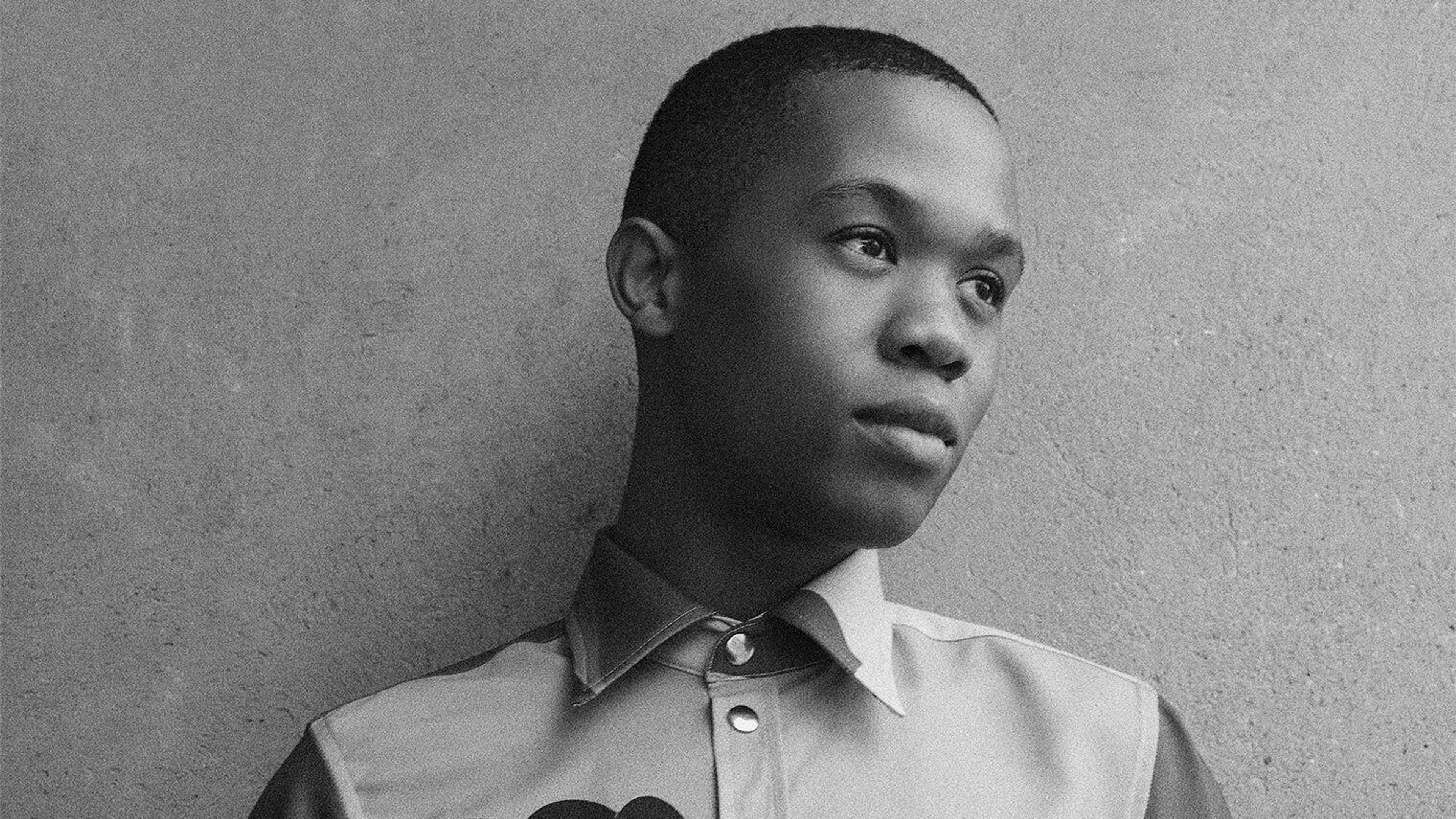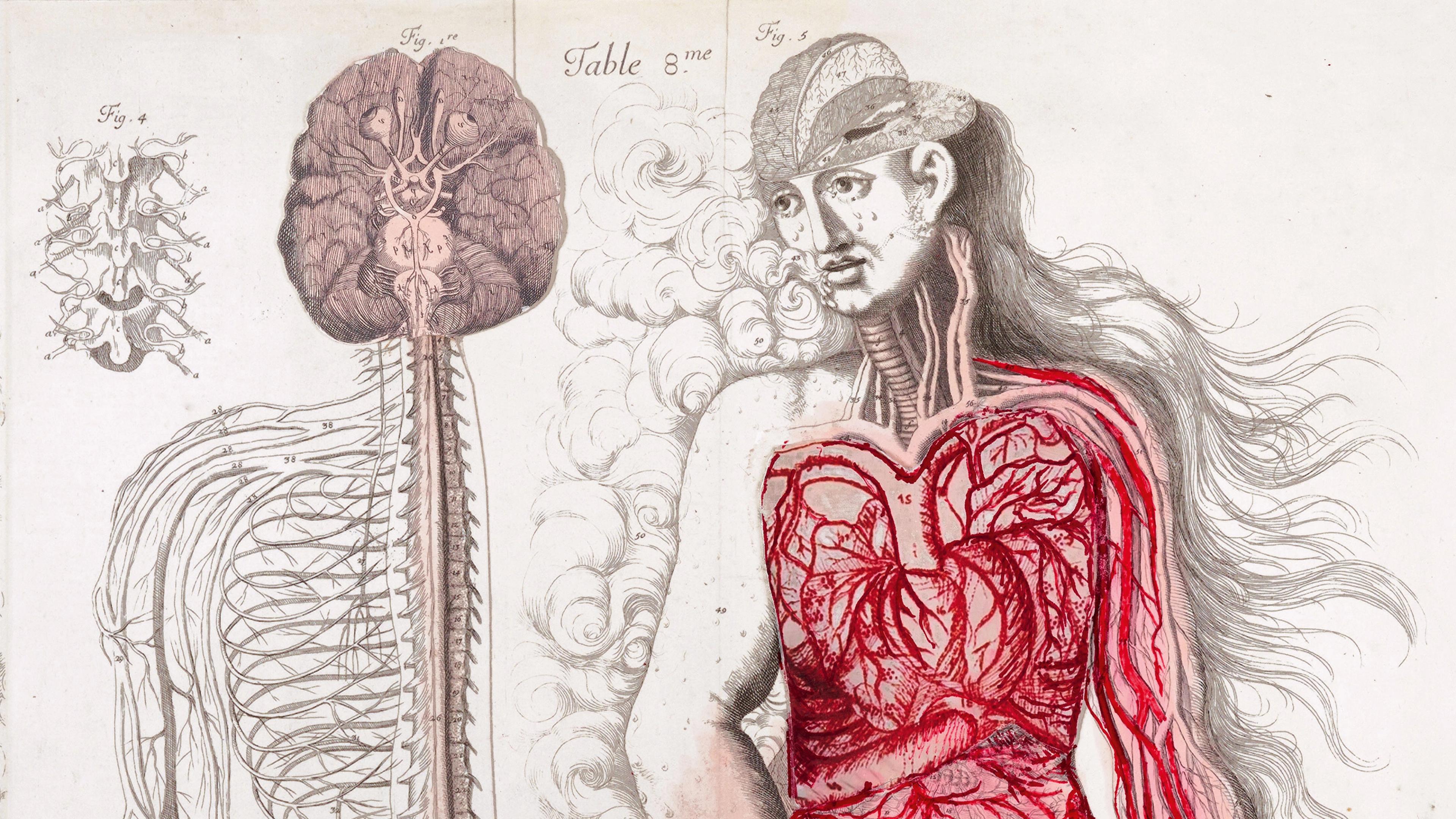
The Costume Institute’s spring 2026 exhibition Costume Art asserts the central role of the dressed body throughout art history. Focused primarily on Western art from prehistory to the present, the exhibition juxtaposes garments from The Costume Institute with a wide range of objects from The Met collection. These pairings present a spectrum of connections and experience: from the formal to the conceptual, the aesthetic to the political, the individual to the universal, and the playful to the profound.
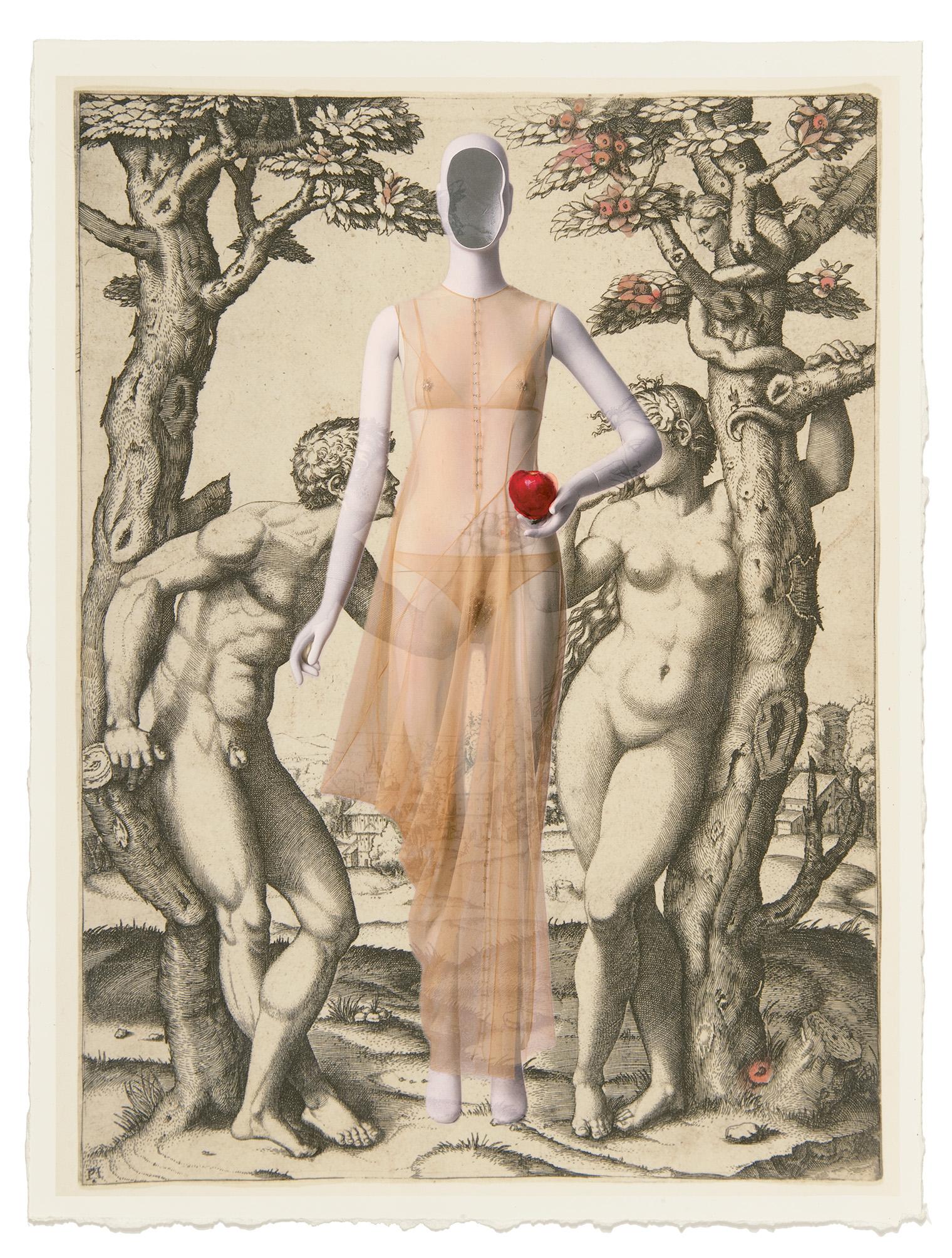
Marcantonio Raimondi (Italian, ca. 1480–before 1534), After Raphael (Raffaello Sanzio or Santi) (Italian, 1483–1520). Adam and Eve (detail), ca. 1512–14. Engraving, 9 1⁄2 × 6 15⁄16 in. (24.2 × 17.6 cm) (sheet). The Metropolitan Museum of Art, New York, Purchase, Joseph Pulitzer Bequest, 1917 (17.50.42); Lùchen (American, founded 2021). Lu Chen (Chinese, born 1994). “Adam with Apple” ensemble, spring/summer 2022. Beige nylon tulle and silver metal hooks and eyes. Courtesy Lùchen. Assemblage by Julie Wolfe.
Below are three specific themes from the exhibition, illustrated with iconic looks from this year’s red carpet at The Met Gala®. The questions animating this selection point to the ways humans have sought to shape and modify the body, through physical restriction and expansion or artful concealment and revelation.
How does a corset redefine the shape of a body?
For centuries, corsets have reflected changing ideas of beauty, showing how the “ideal” body has always been shaped by culture, not nature. While the term first appeared in the fourteenth century in reference to a dress with a fitted bodice, the earliest corsets originated in sixteenth-century Europe, in either Spain or Italy. Known as “stays” or “bodies” in English, they were generally laced in the back and structured with a busk (made of horn, wood, metal, or whalebone) in center front, which held a rigid line from bust to belly.
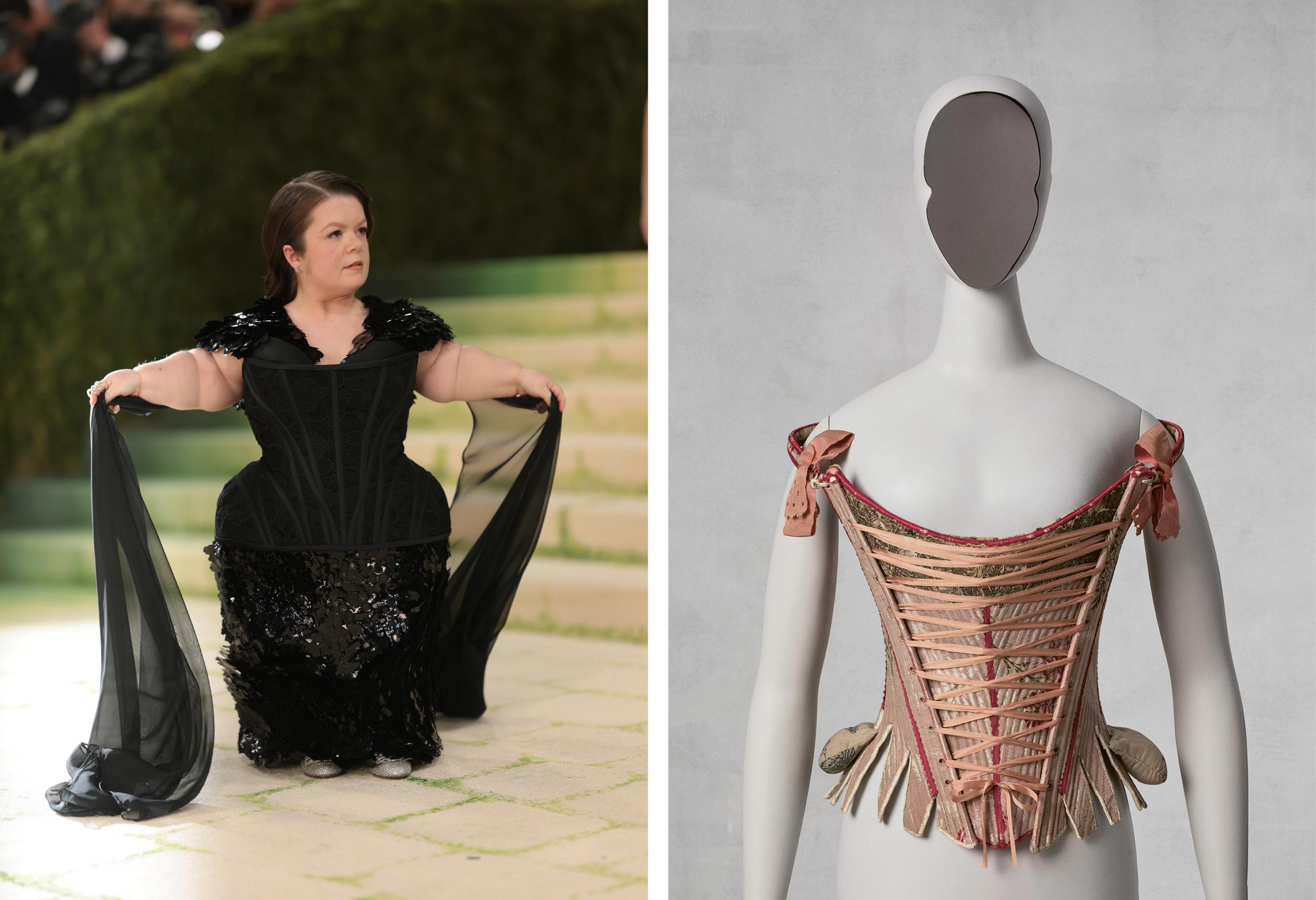
Left: Sinéad Burke attends the 2026 Met Gala® celebrating Costume Art at The Metropolitan Museum of Art on May 4, 2026 in New York City. Photo by Matt Winkelmeyer/MG26/Getty Images for The Met/Vogue. Right: Corset. European, 1750–75. Stays of polychrome brocaded silk edged with red silk satin and trimmed with pink silk grosgrain; stomacher of polychrome brocaded silk appliquéd with gold silk-and-metal lace. The Metropolitan Museum of Art, New York, Gift of Mr. Lee Simonson, 1939 (C.I.39.13.206a, b)
While early corsets were not as compressive as later iterations, they sculpted the human form to appear elongated. By the seventeenth century, stays molded the torso into a harsher, V-shaped form that reflected an increasingly stylized and severe vision of the body—forcing the breasts, rib cage, and stomach to conform to the era’s vogue for idealized geometric abstraction. Writer, academic, and disability activist Sinéad Burke wore a jet-black sequin corset gown by celebrated designer Christian Siriano for this year’s red carpet. Centered around its corsetry, Burke’s elegant ensemble served to foreground the figure by combining elements from historical and contemporary silhouettes.
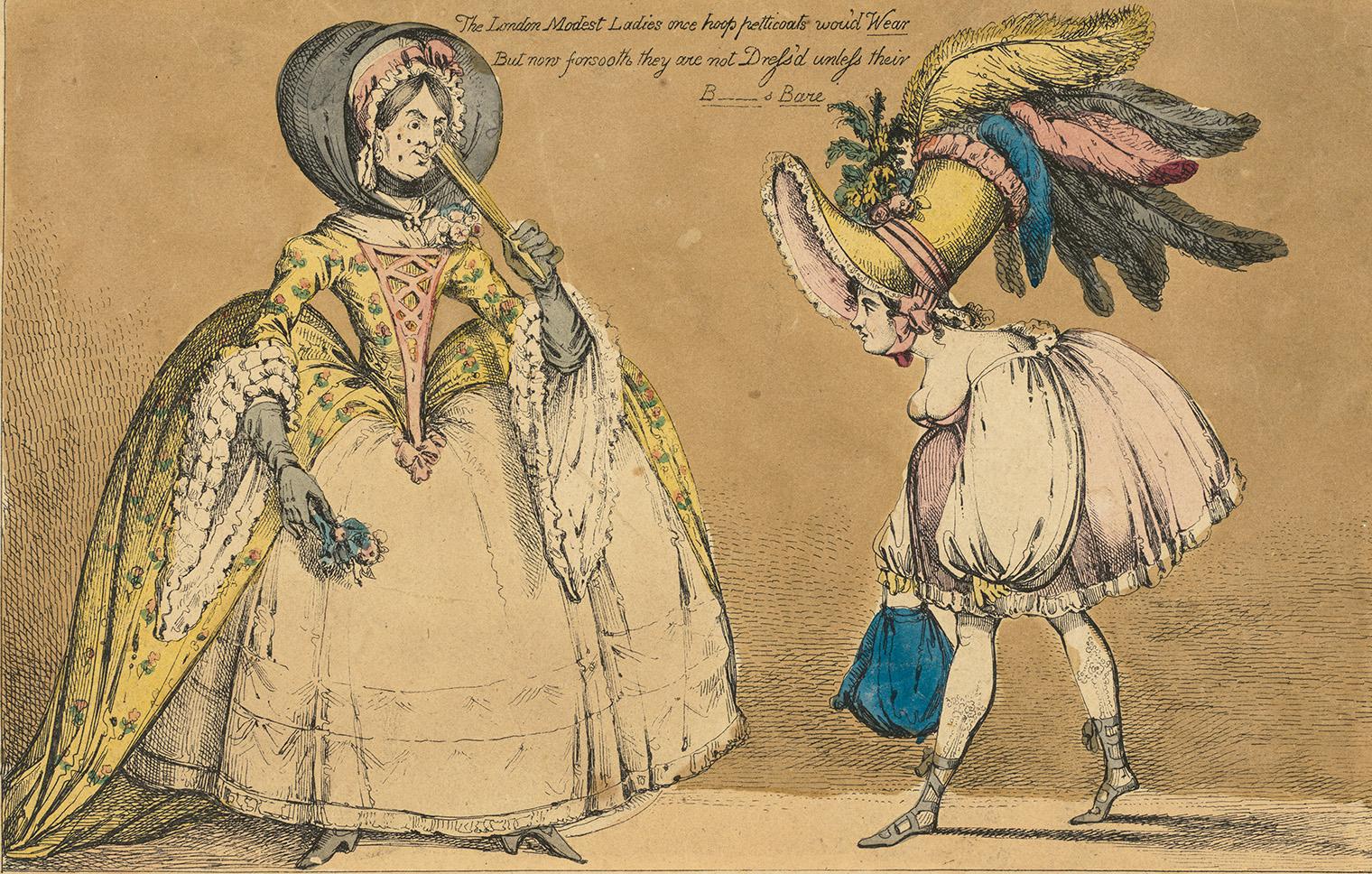
Attributed to William Heath (“Paul Pry”) (1794/95–1840). A Change in the Petticoats, or the Years 1780 & 1817, 1817. Hand-colored etching, 7 3⁄4 × 12 3⁄16 in. (19.7 × 31 cm) (image). The Metropolitan Museum of Art, New York, Gift of Jill Spalding, 2022 (2022.309.14)
In the eighteenth century, corsets became almost armorlike in their construction. Increasingly structured and pronounced, they created a smooth, conical silhouette that emphasized posture and control. Until this time, corset making was strictly a male profession with a distinct guild of tailors responsible for their manufacture, due to the skill and precision such work required.
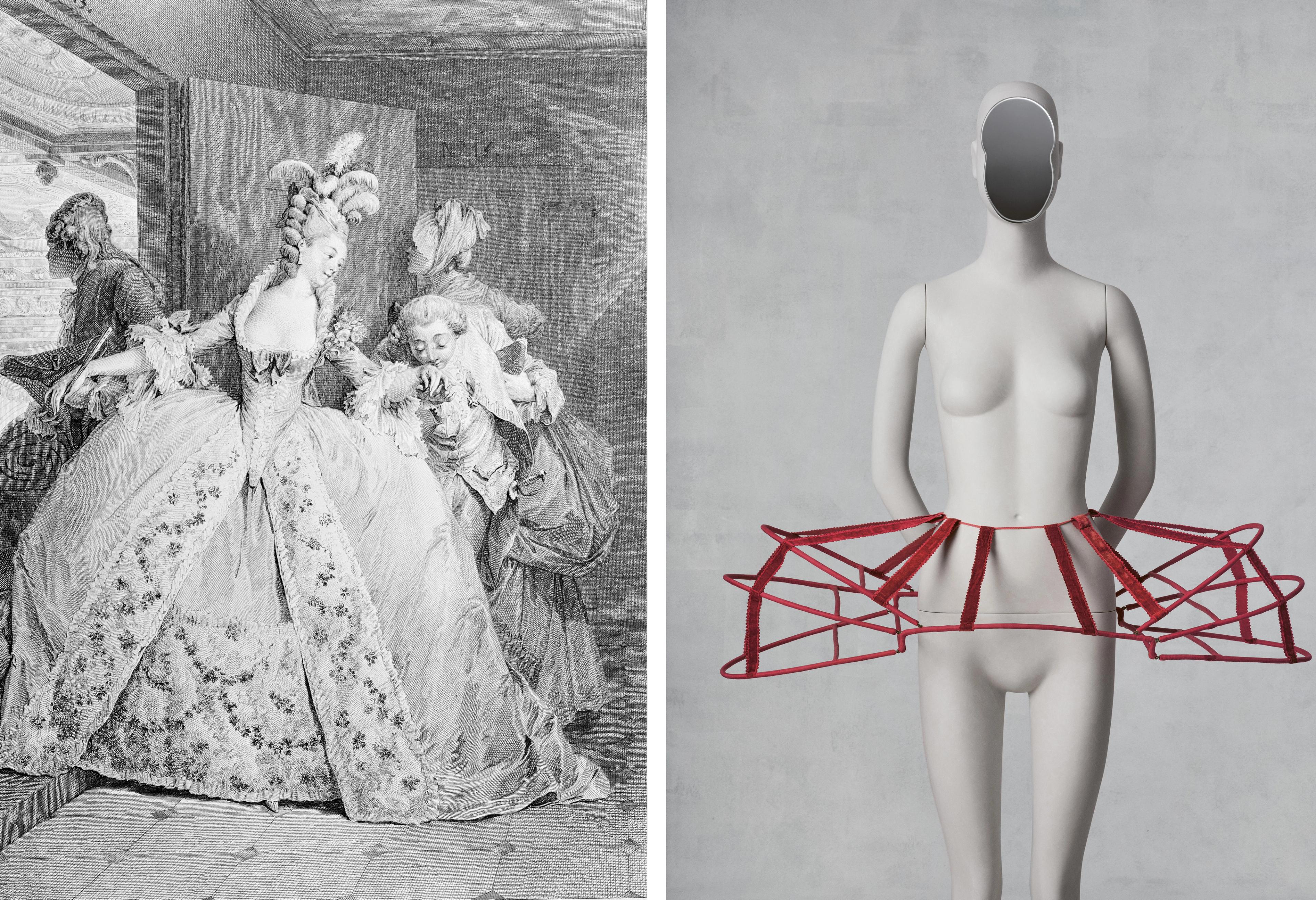
Left: Robert de Launay (French, 1749–1814), After Jean Michel Moreau le Jeune (French, 1741–1814). Les Adieux (The Farewells), from Le Monument du Costume, 1777. Etching and engraving, 10 ⅝ x 8 %16 in. (27 × 21.8 cm) (image). The Metropolitan Museum of Art, New York, Purchase, 1934 (34.22.1) Right: Panniers. French, 1760–70. Natural cane wrapped in red silk taffeta with red silk velvet ribbon and red silk cords. The Metropolitan Museum of Art, New York, Purchase, Friends of The Costume Institute Gifts, 2008 (2008.297a, b)
Eighteenth-century corsets began to include small hip pads to support side hoops known as panniers that extended the body outward, creating striking horizontal silhouettes. Often made of cane, wood, metal, or whalebone, the pannier widened the sides of a dress while flattening the front and back. Panniers famously tested a woman’s “natural” grace. The ability to carry oneself elegantly and with the impression of ease despite such cumbersome undergarments was a learned skill and a marker of high social status.
How can you conceal and reveal the body through drapery?
Drapery refers to garments that fall and fold around the body rather than tightly structuring it. In draped clothing, fabric follows the body’s natural contours, highlighting its materiality and enhancing the form rather than controlling it. In classical art, this technique was used to emphasize balance, symmetry, and an idealized human form.
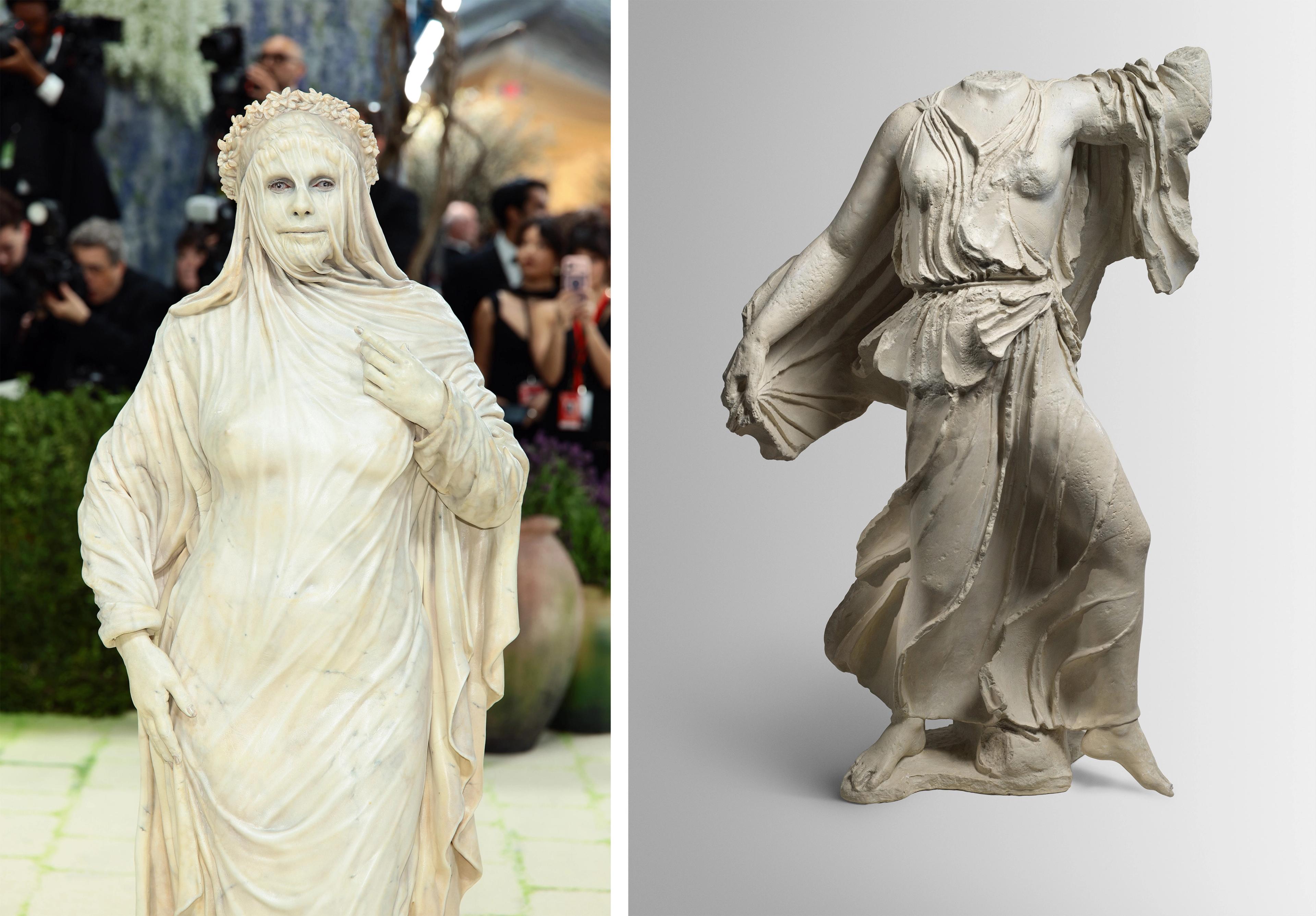
Left: Heidi Klum attends the 2026 Met Gala® celebrating Costume Art at The Metropolitan Museum of Art on May 4, 2026 in New York City. Photo by Dimitrios Kambouris/Getty Images for The Met/Vogue. Right: Reproduction of a statue of a Nereid from the Nereid Monument (390–380 BCE), late 19th-early 20th century. Plaster, 60 x 43 × 38 in. (152.4 x 109.2 x 96.5 cm). The Metropolitan Museum of Art, New York, Cullum Collection, Purchase, George W. Cullum Bequest, 1892 (Cast cat. 554B)
Art historians use the term “wet drapery” to describe fabric that appears to cling to the body in soft, flowing folds. This characteristic is exemplified by certain sculptural forms such as an ancient Greek terracotta statuette of Nike, the personification of victory, or a reproduction life-size statue of a sea nymph from the Nereid Monument, a Lycian sculpted tomb from Xanthos. Taking inspiration from Roman drapery, Heidi Klum’s 2026 Met Gala® ensemble evoked carved stone drapery. The model’s statuesque appearance playfully contradicts the soft foam latex that Academy Award–nominated makeup artist Mike Marino employed.
Contemporary designers such as Bex McCharen are interested in exploring the expressive potential of this classical genre. On their website, McCharen writes that they seek to reclaim “the ‘Wet T-shirt’ beyond the hetero male gaze” and investigate “the vulnerability inherent in wearing a giant T-shirt over your swim[suit], when you’re too uncomfortable to wear a bathing suit in public.” In a nod to wet drapery, McCharen poured water over the model before she walked onto the runway.
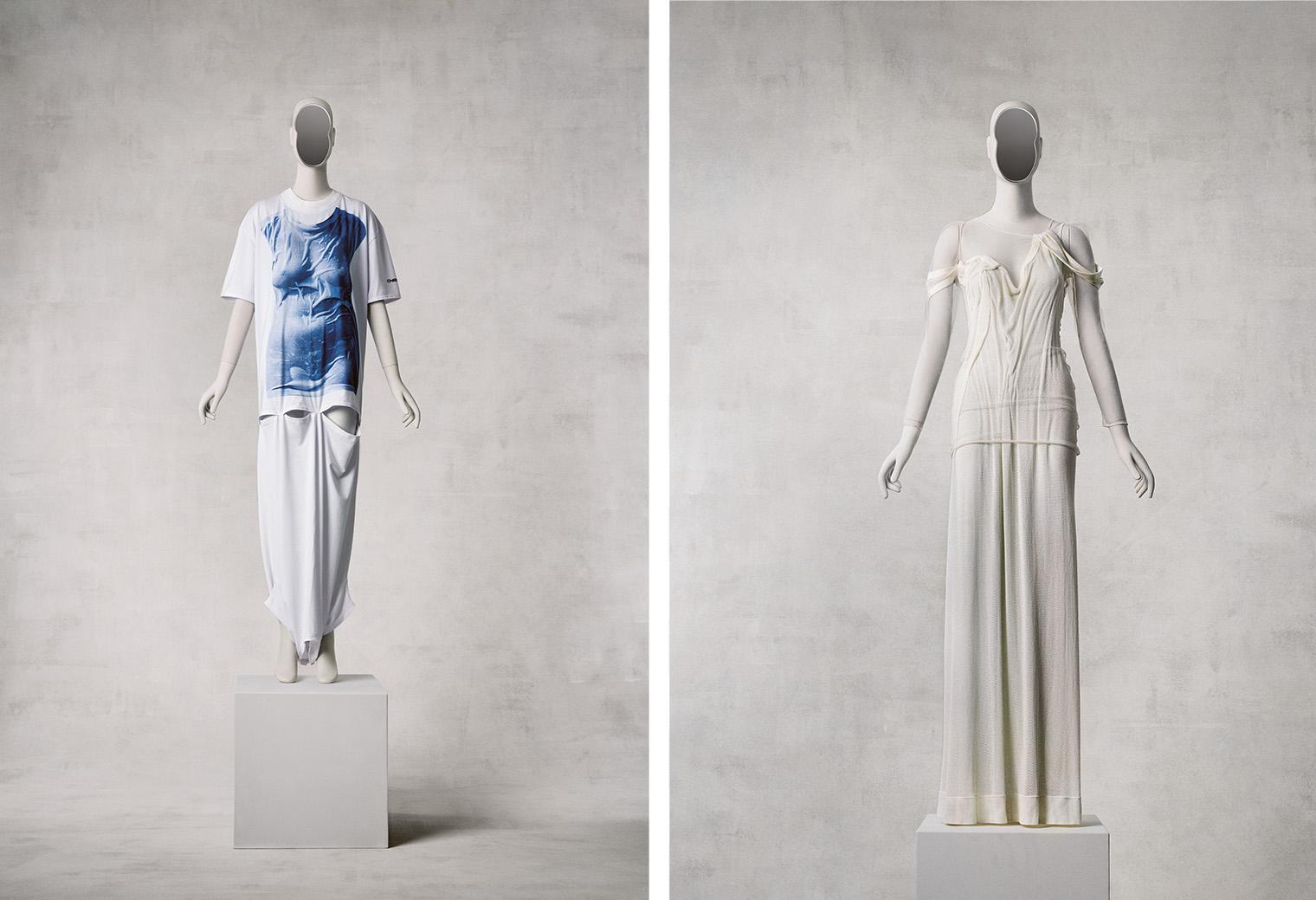
The exhibition catalogue includes additional objects beyond those featured in the galleries, such as the two ensembles above. Left: Chromat (American, founded 2010). Bex McCharen (American, born 1984). "Saturation" dress, spring/summer 2019, edition 2025. White cotton-polyester knit printed with a blue image of Venus. The Metropolitan Museum of Art, New York Purchase, Friends of the Costume Institute Gifts, 2026 (2026.3). Right: Maison Margiela (French, founded 1988). Martin Margiela (Belgian, b. 1957). Ensemble, spring/summer 1990. Dress of white cotton mesh; top of white nylon mesh. The Metropolitan Museum of Art, New York, Purchase, Lila Acheson Wallace Gift, 2025 (2025.81a, b)
In his spring/summer 1990 ensemble, Martin Margiela sought to bring this classicizing effect to quotidian items of dress in contemporary life. Grading up a man’s white cotton mesh singlet to the nonexistent size XXXXL, he layered over it a fitted sheer nylon long-sleeved T-shirt, slyly simulating the frozen yet dynamic sculptured folds of classical statuary.
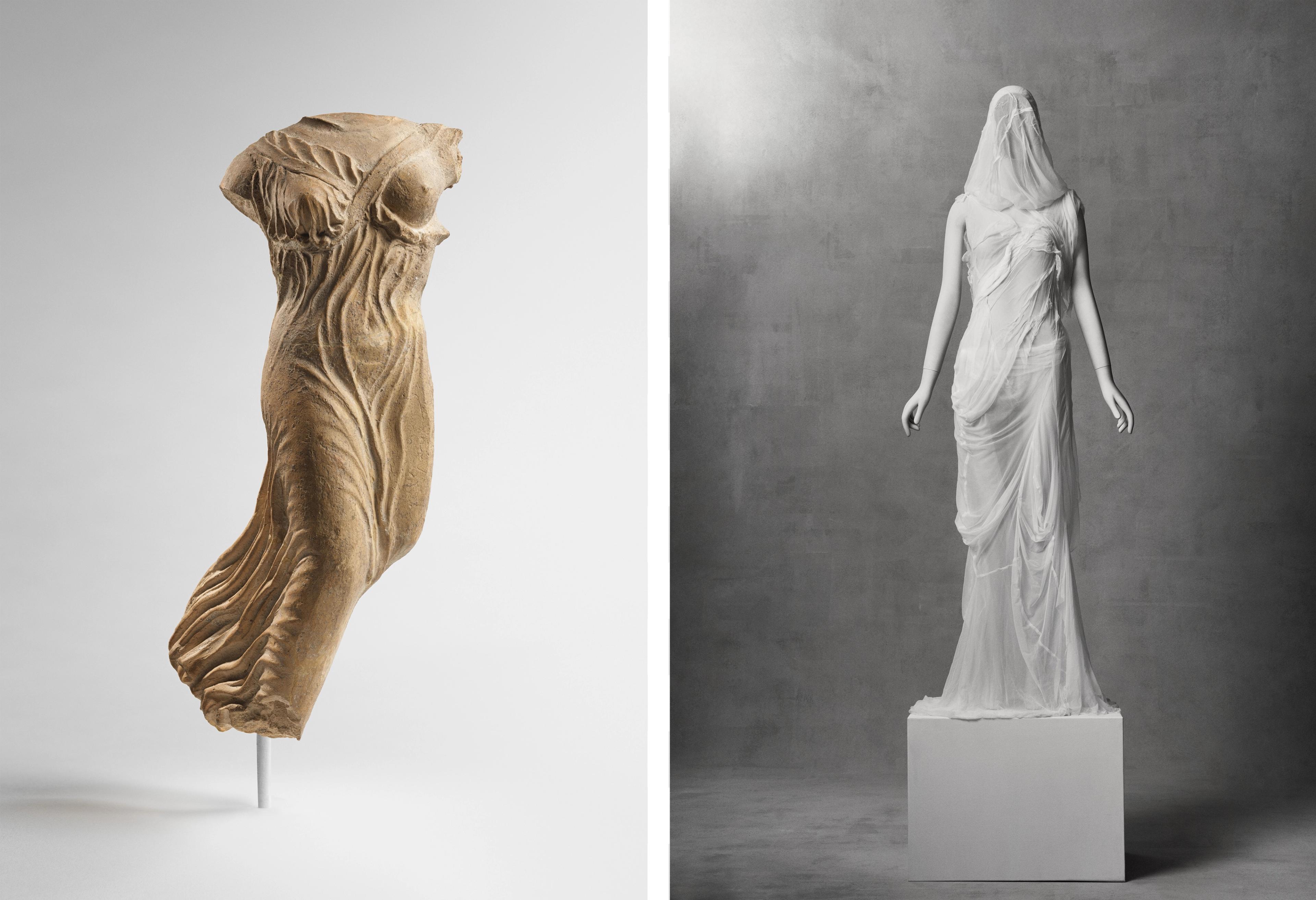
Left: Terracotta statuette of Nike, the personification of victory. Greek, late 5th century BCE. 7x2¼ x 2¾ in. (17.8 x 7.3 x 7 cm). The Metropolitan Museum of Art, New York, Rogers Fund, 1907 (07.286.23) Right: Maison Margiela (French, founded 1988). John Galliano (British, born Gibraltar, 1960). Ensemble, autumn/winter 2020–21 haute couture. Dress of nude silk tulle overlaid with white silk gauze and trimmed with red silk thread; veil of white silk gauze. The Metropolitan Museum of Art, New York, Gift of Maison Margiela, 2026 (2026.187a, b)
Sculptures of veiled figures rose to great popularity in the 1700s, a subject revived by artists like Raffaele Monti—whose life-size sculpture The Veiled Woman (1854) masterfully elicits the illusion of a translucent veil carved from marble. In an autumn/winter 2020–21 ensemble for Maison Margiela, John Galliano attempted the opposite, employing his signature “circle cut” (which relies on interlocking circular panels of fabric) to create a sense of structural flow. Drapery often plays with opacity and transparency, creating a dynamic tension between what is seen and unseen.
Is the body... art?
Some garments go beyond the body’s surface, exposing muscles, organs, and veins. These pieces make the hidden body visible, a reminder that we are all flesh and blood. Inspired by Renaissance anatomical drawings, artists and designers ranging from Raphael to Alexander McQueen believed that understanding the body’s interior was essential to truly representing and dressing it. They aimed to capture the feeling of the body as living, physical matter—not just an ideal form.
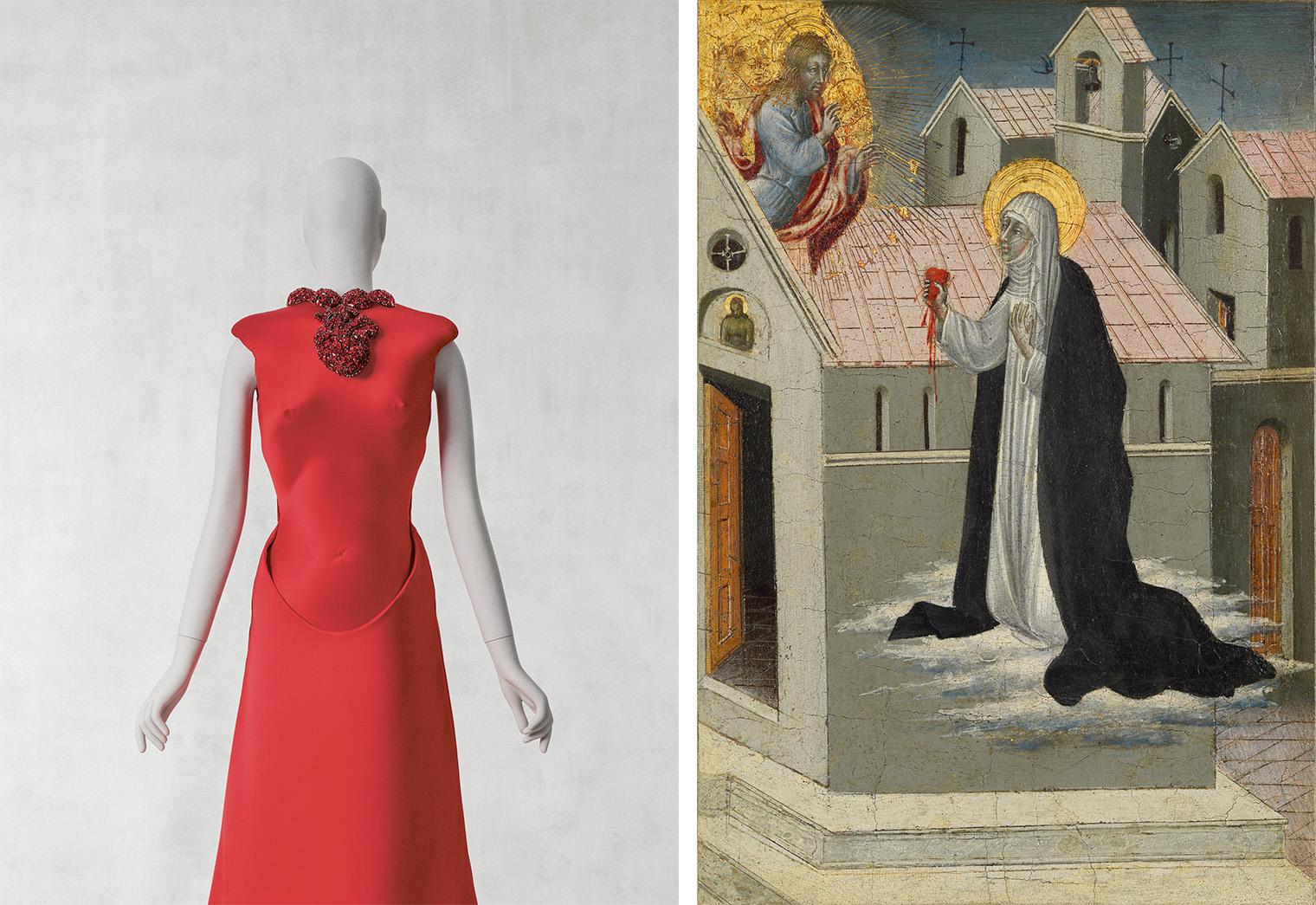
Left: Schiaparelli (French, founded 1927). Daniel Roseberry (American, born 1985). Dress, autumn/winter 2025–26 haute couture. Dress of red silk duchess satin and molded foam; necklace of silver brass and red Swarovski crystals. Courtesy Of Patrimoine Schiaparelli, Paris Right: Giovanni di Paolo (Giovanni di Paolo de Grazia) (Italian, 1398-1482). Saint Catherine of Siena Exchanging Her Heart with Christ, 15th century. Tempera and gold on wood, 11 ¾ x 9 ½ in. (29.8 × 24.1 cm) (with added strips). The Metropolitan Museum of Art, New York, Bequest of Lore Heinemann, in memory of her husband, Dr. Rudolf J. Heinemann, 1996 (1997.117.3)
The heart is the primary organ that pumps blood around the body, a primary source of vitality and passion; it often symbolizes life, emotion, and human connection. In the Christian context, it stands for the intense devotion of its followers, as illustrated in Giovanni di Paolo’s fifteenth-century painting Saint Catherine of Siena Exchanging Her Heart with Christ. And in secular contexts, it can represent undying love, as expressed in the Daniel Roseberry autumn/winter 2025–26 haute couture dress with a heart necklace that mechanically beats.
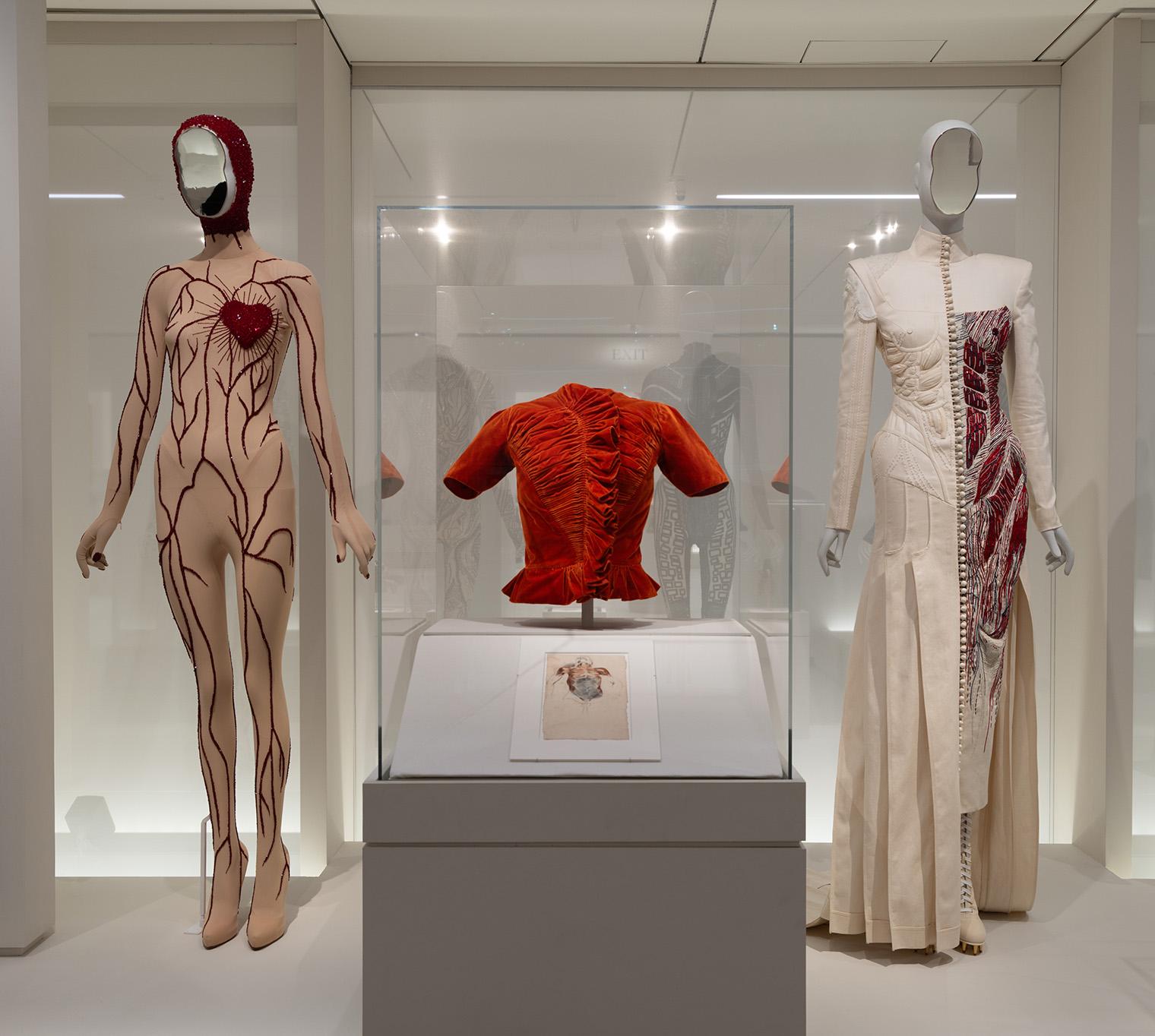
Installation view of the “Anatomical Body” section in the 2026 exhibition Costume Art.
By turning the inside out, these designs blur the line between appearance and reality, making the body visible in a powerful way. At the 2026 Met Gala®, tennis star Naomi Osaka wore a brilliant white coat to reveal a stunning red dress by the couturier Robert Wun. According to Wun, the gown “totals over 3,280 hours of handiwork and thousands of faceted Swarovski crystals in four shades of red that illustrate the human anatomy, needle by needle, crystal by crystal.” Here, Osaka’s dress becomes part of a larger lineage of both art and fashion that affirms the body as a perennial source of inspiration.
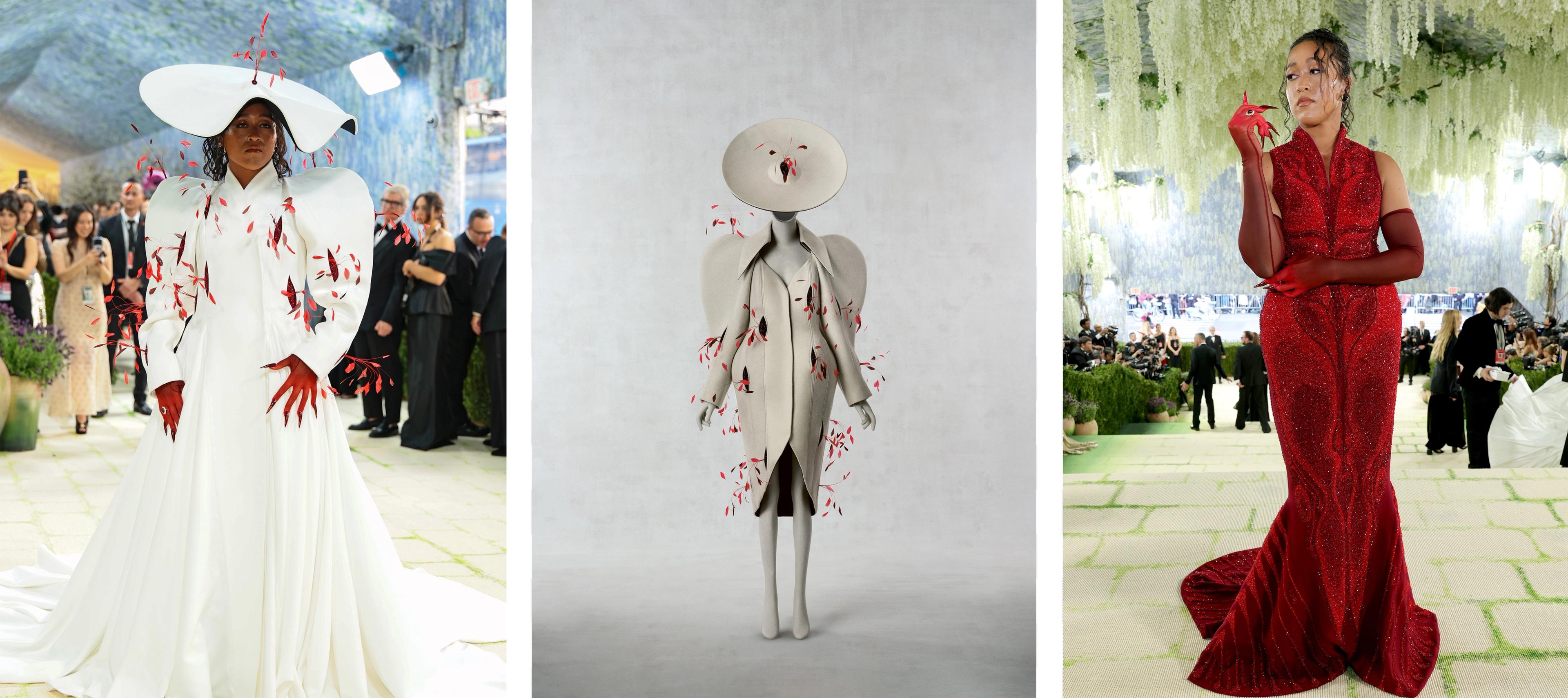
Left and right: Naomi Osaka attends the 2026 Met Gala® celebrating Costume Art at The Metropolitan Museum of Art on May 4, 2026 in New York City. Photo by Dimitrios Kambouris/Getty Images for The Met/Vogue. Center: Robert Wun (Chinese, born 1991). “The Bleeding” ensemble, spring/summer 2023 haute couture. Coat of ivory fused wool plain weave appliquéd with black nylon net and black silk tulle embroidered with black Swarovski crystals and red coque feathers; hat of black felt and wool plain weave appliquéd with black nylon net and black silk tulle embroidered with black Swarovski crystals and red coque feathers. The Metropolitan Museum of Art, New York, Purchase, Friends of The Costume Institute Gifts, 2026 (2026.151a–c)
Costume Art reveals how fashion acknowledges myriad corporeal forms. This manifestation is rooted deeply in history and exhibits human strength and fragility, resilience and vulnerability, normative ideals and singular idiosyncrasies. By exposing, concealing, and transforming the body, fashion extends aesthetics into the realm of embodied life and affirms the value of our differences.
This essay is adapted in part from the catalogue for Costume Art. The exhibition is on view through January 10, 2027.