
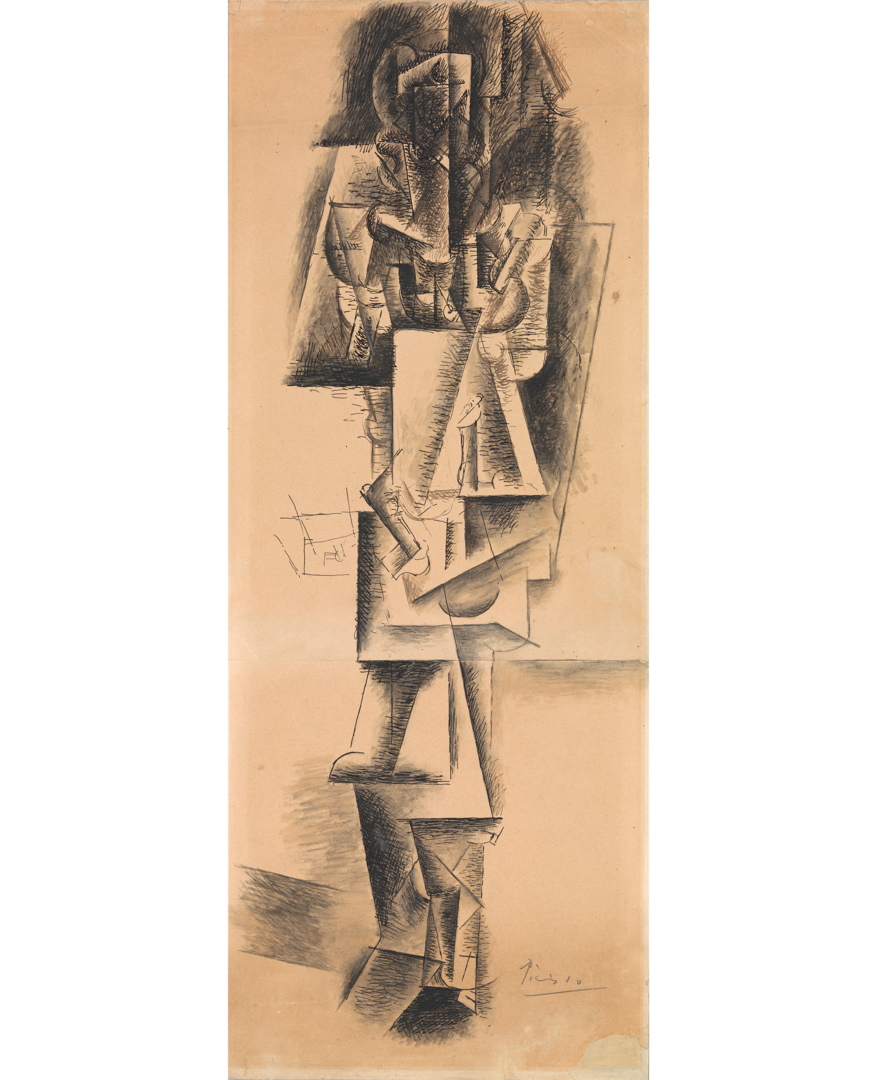
Pablo Picasso (Spanish, 1881–1973). Standing Woman, 1912. Ink, charcoal dipped in oil, and gouache on two sheets of off-white wove paper, 21 3/4 x 8 5/8 in. (55 x 21.7 cm). The Metropolitan Museum of Art, New York, Leonard A. Lauder Cubist Collection, Gift of Leonard A. Lauder, 2016 (2016.237.34) © 2026 Estate of Pablo Picasso / Artists Rights Society (ARS), New York
Standing Woman (1912) is composed of two sheets of paper. The smooth side of the upper sheet is juxtaposed with the rough side of the lower sheet, its texture created by tiny diamond-shaped voids. It was not uncommon for Picasso to use several different types of black inks or charcoals in a single drawing as he did here. He must have been aware of the variations in their tones, although over time the differences have become more pronounced. One of the inks that appears only in the top sheet of Standing Woman now appears brown, which suggests that Picasso first conceived of this drawing on a single sheet and added the lower sheet as the design evolved. Picasso applied the brownish ink with a metal nib pen in short, quick looping strokes that have characteristic hooks at the end of each line. He then used charcoal, a material comprised of small particles that transfer and adhere to paper primarily through friction.
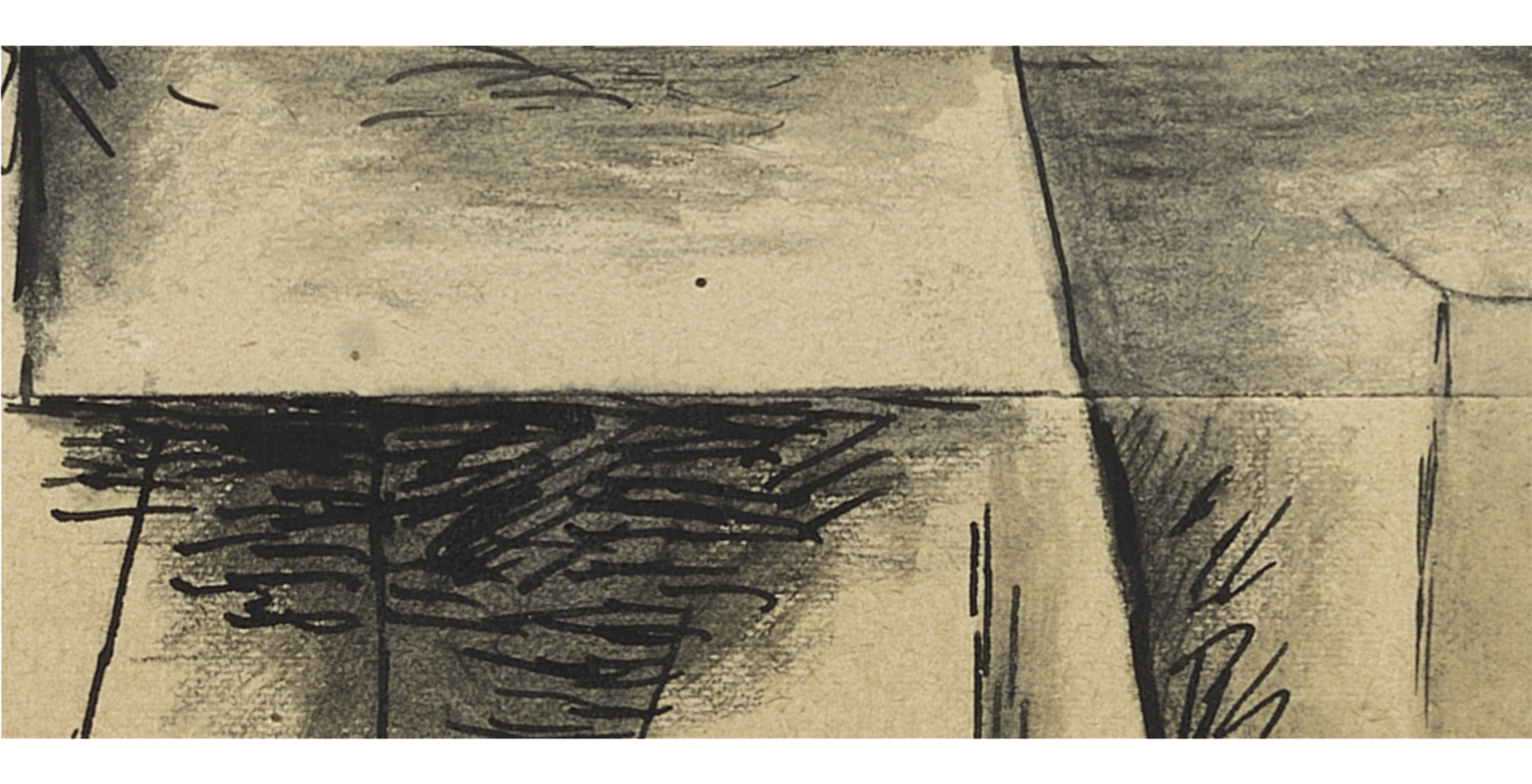
This detail of Standing Woman shows the horizontal line where the two sheets of paper are joined. The texture of the lower sheet is visible, as is the smeary, paint-like nature of the oil-and-charcoal mixture.
The powdery nature of charcoal allows artists to smudge it and create smoky atmospheric passages as well as varying shades of gray. Picasso altered the working properties of the charcoal by dipping it into oil before applying it to the paper. This technique allowed the friable drawing material to behave more like paint. The artist smeared, stretched, and manipulated it with the back of a paintbrush, and even scraped it with his fingernail. In some areas, the loops of oil and charcoal follow the ink lines underneath, while in others, the charcoal appears as soft passages of gray tone. This effect is achieved through repeated campaigns of dipping the charcoal in oil before drawing and working the media on the sheet. Lines of black ink were added as the final layer. Picasso’s forceful working on the sheet abraded the paper, leaving pilling on the surface.
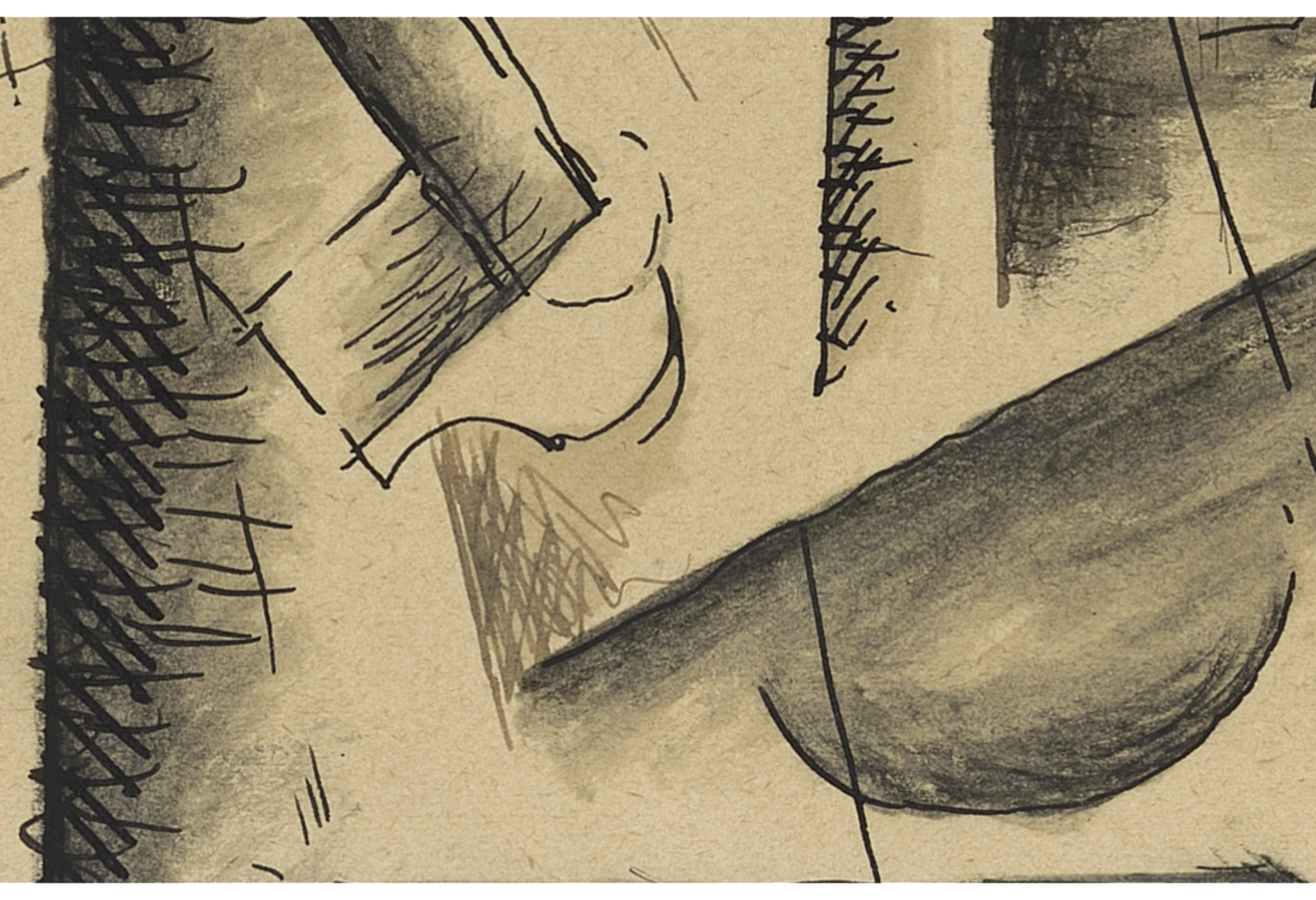
This detail of Standing Woman shows the charcoal-oil mixture that Picasso used to shade underneath the ink lines.


