
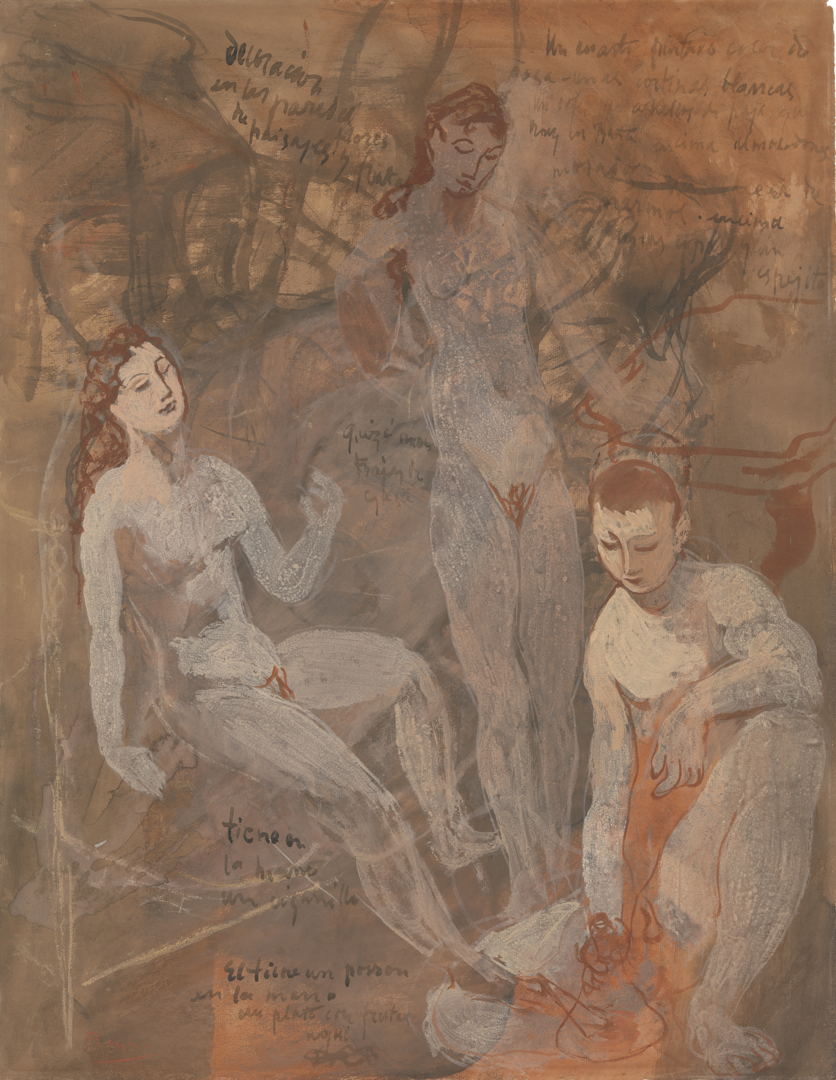
Pablo Picasso (Spanish, 1881–1973). Three Nudes, 1906. Gouache, ink, watercolor, and charcoal on white laid paper, 24 3/8 × 18 7/8 in. (61.9 × 47.9 cm). The Metropolitan Museum of Art, New York, Leonard A. Lauder Cubist Collection, Gift of Leonard A. Lauder, 2016 (2016.237.10) © 2026 Estate of Pablo Picasso / Artists Rights Society (ARS), New York
Pablo Picasso’s Three Nudes (1906) has a complex, layered structure. The three figures on the top layer—the final image—are painted in white gouache that Picasso thinned with water and frothed with his brush, resulting in streaky, bubbly strokes. He also used a brush to add details such as the jug and the inscriptions. By contrast, the diffuse, smeary shades of pink, rust, white, and gray in the background were probably applied with his fingers. The density of this application is an indication that Picasso wanted to obscure his earlier designs.
Analytical imaging techniques enhanced by digital manipulation reveal some of the hidden layers in the work, allowing us to learn more about Picasso’s process. With infrared reflectography (IRR), a camera captures light outside of the visible range. This method of examination penetrates top layers of paintings and drawings to show earlier applications of media such as graphite and charcoal. When Three Nudes was examined with IRR, a pencil sketch of a seated figure oriented upside down became quite clear. Changes to this drawing could be seen in the nose, eyes, and garment sleeves.
A faint image on the verso of the sheet corresponds to the one seen in IRR; however, they do not line up exactly. A faint and uneven distribution of fine black particulates on the verso were revealed under magnification, indicating that the image was probably transferred to the back of the sheet while Picasso was drawing on the front. This image transfer could have occurred if the paper was resting against a charcoal-dusted surface.
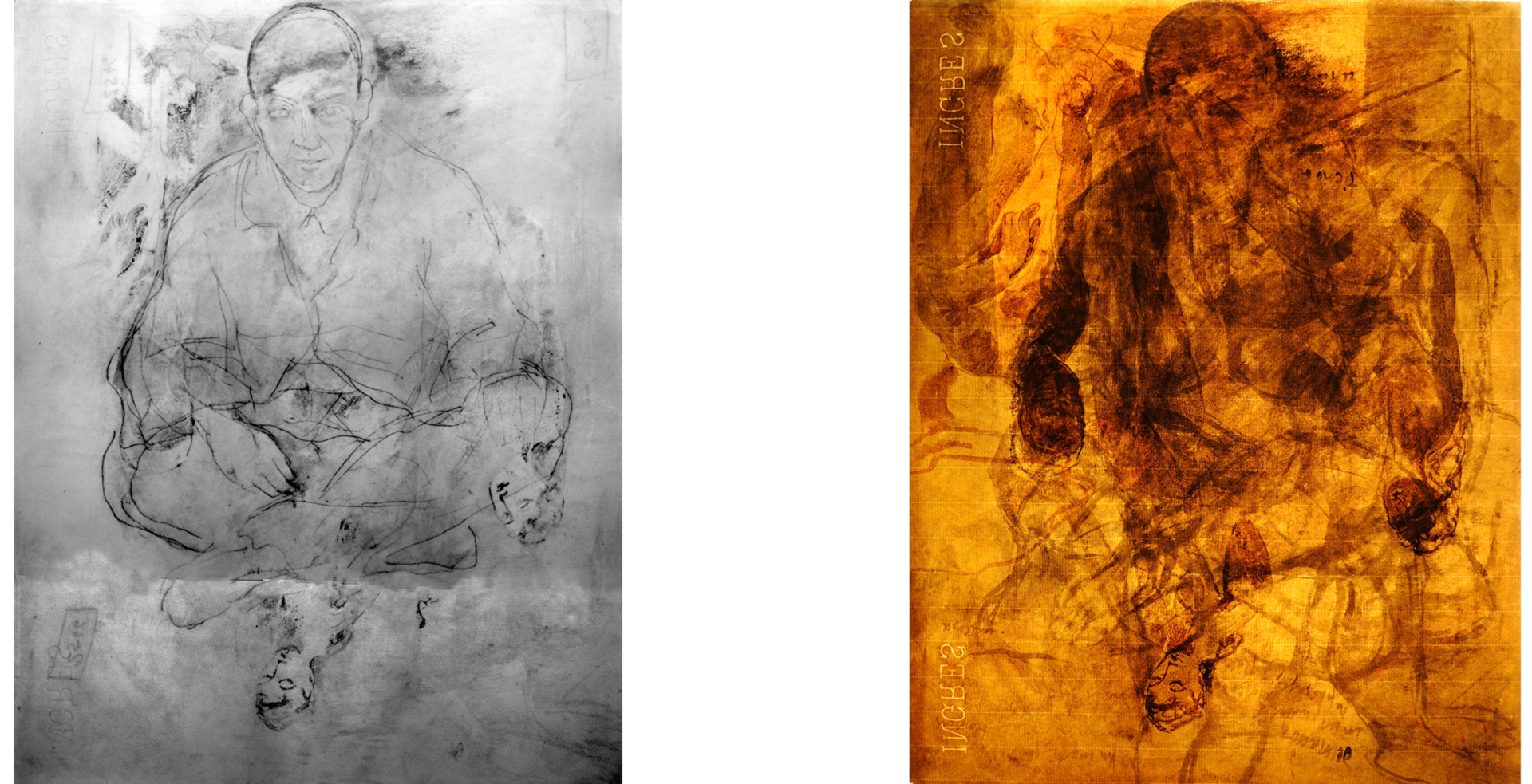
FIG. 1. (at left) Picasso's Three Women (upside down) seen with IRR.
FIG. 2. (at right) Picasso's Three Women (upside down) seen with transmitted light.
Knowing that Picasso used a variety of media, some of which cannot be detected with IRR, was also examined with transmitted light. Shining a light through a sheet of paper can reveal a variety of densities, colors, and textures, elements that can be further refined when images are layered and false color is applied. This method led to the realization that the dark rounded dome at the bottom of the drawing is actually the head of a large seated figure that Picasso created when the sheet of paper was turned upside down. He worked up the sketch of the seated figure with watercolor or another brush-applied media, adding details and shading to the face and drapery. These watercolor lines correspond to the drawing on the verso.


