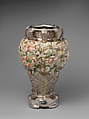
El jarrón Bryant
Artwork Details
- Título: El jarrón Bryant
- Artista: Diseñado por James Horton Whitehouse, estadounidense, 1833–1902; realizado por Tiffany& Co., estadounidense, 1837–presente
- Fecha: 1875–1876
- Material: Plata
- Dimensiones: 85,1 x 35,6 x 28,7 cm
- Crédito: Donación de William Cullen Bryant, 1877
- Número de inventario: 77.9a, b
- Curatorial Department: The American Wing
Audio
4526. The Bryant Vase
MORRISON HECKSCHER: The opulent Bryant vase was the first piece of American silver to enter the Museum’s collection, in 1877.
BETH WEES: And, at the time, it would have been a brand-new piece of silver. It would have been modern art.
MORRISON HECKSCHER: Curator Beth Wees.
BETH WEES: It was made in 1875-1876 for presentation to the poet and newspaper editor William Cullen Bryant. And it was commissioned on the event of his eightieth birthday by a group of his friends.
MORRISON HECKSCHER: The Greek-shaped vase is tour-de-force of chasing, which is sculpting the silver with small steel tools. All the ornamental motifs are symbolic. American flora, such as apple blossoms, cover the entire vase. And oval Renaissance revival medallions show scenes from Bryant’s life and work – such as an image of him writing in his library.
BETH WEES: There's also a wonderful, rather classical portrait of him on the front wearing a sort of Greek robe and with his great wooly beard.
MORRISON HECKSCHER: It’s very difficult to see, but under Bryant’s shoulder is the monogram “EJS” of the man who chased the vase.
BETH WEES: So we know a great deal about this. We know who designed it. We know who chased it. We know that five of the medallions were designed by the great American sculptor Augustus Saint-Gaudens. So there's a great artistic, as well as literary, component to this vase.
MORRISON HECKSCHER: And inlaid around the neck of the vase is one of Bryant’s most famous verses, which says: "Truth crushed to earth shall rise again."
More Artwork
Related Content
Perspectives
Articles, audio, and video from The Met's online magazine.
Timeline of Art History
Entries and chronologies from The Met's art encyclopedia.

Publications
Books, guides, and catalogues published by The Met.
Research Resources
The Met provides unparalleled resources for research and welcomes an international community of students and scholars. The Met's Open Access API is where creators and researchers can connect to the The Met collection. Open Access data and public domain images are available for unrestricted commercial and noncommercial use without permission or fee.
To request images under copyright and other restrictions, please use this Image Request form.
Feedback
We continue to research and examine historical and cultural context for objects in The Met collection. If you have comments or questions about this object record, please contact us using the form below. The Museum looks forward to receiving your comments.
Content Notice
The Metropolitan Museum of Art presents over 5,000 years of art from around the world, and our online collection reflects ongoing work conducted over the course of our more than 150-year history. You may encounter objects or images that may be inappropriate for some viewers or information that may be outdated.