Sampler
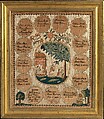
Charlotte’s sampler is among a small group of known Female Association samplers that date between 1813 and 1825. Reflecting the classical Quaker aesthetic, it features delicate precise lettering and finely stitched motifs – many of which are found on other Female Association samplers, as well as samplers from Quaker schools such as Westtown (See MMA 2005.20). These motifs include at the top a leafy green and gold vine border tied at the center with a bow-knot, two baskets with pyramids of fruit, an acorn beneath each basket, below which are sprigs of rose buds. At the lower edge, a broad stylized red strawberry and green vine border, often seen on New York City samplers from the 1810s and 20s, completes the design.
Artwork Details
- Title: Sampler
- Maker: Embroidered by Charlotte Gardner (born 1801)
- Date: December 23, 1813
- Geography: Made in Manhattan County, New York, New York, United States
- Culture: American
- Medium: Silk embroidery on linen
- Dimensions: 7 3/4 x 7 1/2 in. (19.7 x 19.1 cm)
- Credit Line: Purchase, Anna Glen B. Vietor Gift, in memory of her husband, Alexander Orr Vietor, 2009
- Object Number: 2009.413
- Curatorial Department: The American Wing
More Artwork

Related Content

Research Resources
The Met provides unparalleled resources for research and welcomes an international community of students and scholars. The Met's Open Access API is where creators and researchers can connect to the The Met collection. Open Access data and public domain images are available for unrestricted commercial and noncommercial use without permission or fee.
To request images under copyright and other restrictions, please use this Image Request form.
Feedback
We continue to research and examine historical and cultural context for objects in The Met collection. If you have comments or questions about this object record, please contact us using the form below. The Museum looks forward to receiving your comments.
Content Notice
The Metropolitan Museum of Art presents over 5,000 years of art from around the world, and our online collection reflects ongoing work conducted over the course of our more than 150-year history. You may encounter objects or images that may be inappropriate for some viewers or information that may be outdated.