Horse Muzzle
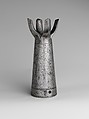
The central rosette on the front is adorned with a two-headed and two-tailed dragon in relief. Each of the dragon's heads holds a ring in its mouth. Two other dragon heads and necks are also curving around the top of the nostrils' openings. The side panels are decorated with heraldic lions and vegetal scrolls. The center of the crown (the upper part of the basket) displays the imperial two-headed eagle. Between the eagle and the dragon is a pierced cartouche bears the letters C.F.B.E.W., the initials of an unknown motto, probably in German.
Horse muzzles were used to preventing stallions from biting. Such pieces, however, seem to have above all been used as lavish equestrian ornaments, particularly in fashion in eastern Germany in the second half of the 16th and the early 17th century. This pierced decoration is typical of the work of the spur makers living in the southeast of Germany and Saxony at this period. Despite their name, spur makers not only made spurs, but also small equestrian hardware like bits, stirrups, muzzles, cavessons or curry-combs, sometimes adorned with the same intricate decoration.
Artwork Details
- Title: Horse Muzzle
- Date: last quarter 16th century
- Culture: German
- Medium: Iron, tin
- Dimensions: H. 10 in. (25.4 cm); W. 8 7/16 in. (21.4 cm); D. 9 in. (22.9 cm); Wt. 1 lb. 8.7 oz. (700.2 g)
- Classification: Equestrian Equipment
- Credit Line: Gift of William H. Riggs, 1913
- Object Number: 14.25.1682
- Curatorial Department: Arms and Armor
More Artwork
Press the down key to skip to the last item.
Research Resources
The Met provides unparalleled resources for research and welcomes an international community of students and scholars. The Met's Open Access API is where creators and researchers can connect to the The Met collection. Open Access data and public domain images are available for unrestricted commercial and noncommercial use without permission or fee.
To request images under copyright and other restrictions, please use this Image Request form.
Feedback
We continue to research and examine historical and cultural context for objects in The Met collection. If you have comments or questions about this object record, please contact us using the form below. The Museum looks forward to receiving your comments.
Content Notice
The Metropolitan Museum of Art presents over 5,000 years of art from around the world, and our online collection reflects ongoing work conducted over the course of our more than 150-year history. You may encounter objects or images that may be inappropriate for some viewers or information that may be outdated.