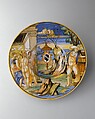
Armorial dish: The story of Phaeton
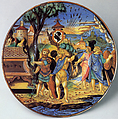
Thirty-seven pieces from the maiolica service survive (including four in the Lehman Collection: see also 1975.1.1131; 1975.1.1134; 1975.1.1137), all painted in Urbino by the celebrated maiolica painter Francesco Xanto Avelli da Rovigo in 1532 and 1533. Some pieces were sent to Gubbio to be completed with luster decoration under Xanto’s direction.
The subject depicted here is the mythological story of Phaeton, a mortal youth, who fell to his death from the celestial chariot of his father, the sun-god Phoebus. This plate shows the aftermath, as Phaeton’s loved ones are literally transformed by their grief: at right, his sisters change into trees, and at left, his friend Cygnus becomes a swan. The figure of Cygnus, like several appearing in Xanto’s imagery, was adapted from a print source.
Artwork Details
- Title: Armorial dish: The story of Phaeton
- Artist: Francesco Xanto Avelli da Rovigo (Italian, Rovigo ca.1487–1542)
- Date: 1532
- Medium: Maiolica (tin-glazed earthenware)
- Dimensions: Diam. 10 9/16 in. (26.9 cm)
- Classification: Ceramics-Pottery
- Credit Line: Robert Lehman Collection, 1975
- Object Number: 1975.1.1135
- Curatorial Department: The Robert Lehman Collection
More Artwork
Related Content
 Free to download
Research Resources
The Met provides unparalleled resources for research and welcomes an international community of students and scholars. The Met's Open Access API is where creators and researchers can connect to the The Met collection. Open Access data and public domain images are available for unrestricted commercial and noncommercial use without permission or fee.
To request images under copyright and other restrictions, please use this Image Request form.
Feedback
We continue to research and examine historical and cultural context for objects in The Met collection. If you have comments or questions about this object record, please contact us using the form below. The Museum looks forward to receiving your comments.
Content Notice
The Metropolitan Museum of Art presents over 5,000 years of art from around the world, and our online collection reflects ongoing work conducted over the course of our more than 150-year history. You may encounter objects or images that may be inappropriate for some viewers or information that may be outdated.