Close Helmet
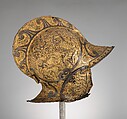
As a precursor to the spectacular embossed armors made by Filippo and Giovan Paolo Negroli (ca. 1513–1569), Gian Giacomo’s son and nephew, respectively, and their brothers, for powerful Italian and foreign patrons, including the Emperor Charles V of Austria (1500–1558) and the Dauphin Henry II of France (1519–1559), the helmet under consideration occupies a unique place in the oeuvre of the Negrolis. Until its acquisition, and in the absence of known precedents, it had seemed that Filippo’s and Giovan Paolo’s embossed armors had no immediate forerunners. This helmet, which exhibits both the boldness of design and virtuosity of execution that characterize their works, strongly suggests that the art of embossing armor in Milan began a generation earlier, with the work of Gian Giacomo. Made at least a decade before Filippo’s first known work––a burgonet (helmet) that he made in 1532 for Francesco Maria della Rovere (1490–1538), duke of Urbino––this helmet now ranks as the earliest identified embossed work by any of the Negroli armorers. It is the hitherto missing precedent for the ambitious and highly regarded embossed armors made by Filippo and Giovan Paolo Negroli, and as such a point of departure in the historical development of a style of luxury armor that would bring great fame to Milan and the Negrolis in particular.
This helmet is the first work by the Negrolis to incorporate into an entirely functional and serviceable helmet the fantasy for which they earned great fame and are perhaps best remembered today––in this instance seashells embossed in relief on the bowl and visor. While early sixteenth-century Italian armor was sometimes decorated with embossed ribs or seashells on the rear of the helmet’s bowl, the couters (elbow defenses), and poleyns (knee defenses), the seashell embossed on the visor of Gian Giacomo’s helmet is unprecedented, and an unmistakable manifestation of the master’s creativity and audacity.
It is also a rare example of Italian armor made in the German style (alla tedesca), presumably for export north of the Alps or for an Italian client with northern tastes. Unlike the standard type of Italian cavalry helmet, which is constructed with cheekpieces hinged to the lower edge of the bowl, it has a visor and a bevor designed to rotate on common pivots at the sides of the bowl, in the manner of most German examples of the period. In this, it may be compared to a backplate decorated with flutes in the German fashion, which bears the marks of Francesco Negroli, in the Metropolitan Museum’s collection (acc. no. 2014.154).
Artwork Details
- Title: Close Helmet
- Armorer: Gian Giacomo Negroli (Italian, Milan 1463–1543)
- Date: ca. 1510–20
- Geography: Milan
- Culture: Italian, Milan
- Medium: Steel, gold
- Dimensions: H. 13 1/8 in. (33.3 cm); W. 8 1/2 in. (21.6 cm); D. 12 in. (30.5 cm); Wt. 4 lb. 15 oz. (2239.6 g)
- Classification: Helmets
- Credit Line: Purchase, Arthur Ochs Sulzberger Gift, 2014
- Object Number: 2014.282a–d
- Curatorial Department: Arms and Armor
More Artwork
Related Content
Research Resources
The Met provides unparalleled resources for research and welcomes an international community of students and scholars. The Met's Open Access API is where creators and researchers can connect to the The Met collection. Open Access data and public domain images are available for unrestricted commercial and noncommercial use without permission or fee.
To request images under copyright and other restrictions, please use this Image Request form.
Feedback
We continue to research and examine historical and cultural context for objects in The Met collection. If you have comments or questions about this object record, please contact us using the form below. The Museum looks forward to receiving your comments.
Content Notice
The Metropolitan Museum of Art presents over 5,000 years of art from around the world, and our online collection reflects ongoing work conducted over the course of our more than 150-year history. You may encounter objects or images that may be inappropriate for some viewers or information that may be outdated.