Part of the pleasure of cataloging comes from knowing that what you’re creating will be used by other people, not just people who visit the library where you work but by library patrons across the world. The whole point of library cataloging is to create a record for a thing (oftentimes a book, but all sorts of other things as well: musical scores, maps, magazines, etc.) that can then be (re)used by every other library that has that same thing. So instead of every library in the world having to create their own record for the recent Met exhibition catalog Art for the Millions: American Culture and Politics in the 1930s, we can create a single bibliographic record for it that any other library can then bring into their local catalog once they acquire a copy of that book. This is what transforms what oftentimes feels like a solitary act—cataloging a book alone in one’s cubicle—into a way of connecting with libraries (and their users) all over the world.
Just as libraries are places that exist to freely share information with the people who visit them, library data exists to be freely shared with other libraries. Whenever we get a new book, the first thing we’ll do is search to see if a bibliographic record for it already exists (i.e. if some other cataloger in some other cubicle somewhere else in the world has already created a record for it). If it does, we’ll bring it into our system and voilà—our users immediately know that we have a copy of the book. This is called “copy cataloging.” If a record hasn’t been created, however, then we’ll create a record for it. This is called “original cataloging.” Any other library in the world can then import the record we created into their system so that their users will know that their library has that book.
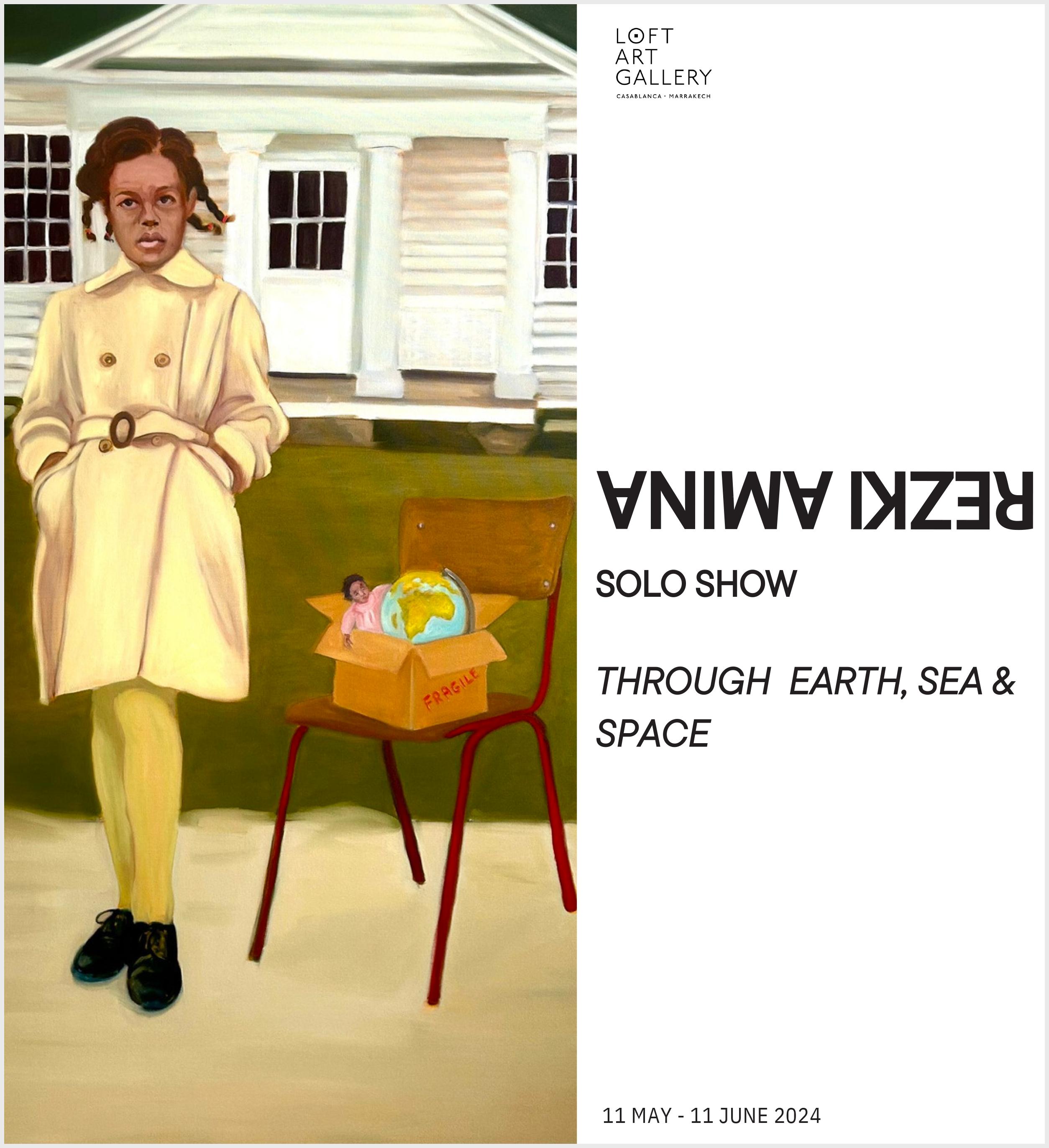
Amina Rezki, catalog for the exhibition Through Earth, Sea & Space, 2024. Loft Art Gallery, Morocco. The cataloging process for this exhibition catalog will be discussed in detail below.
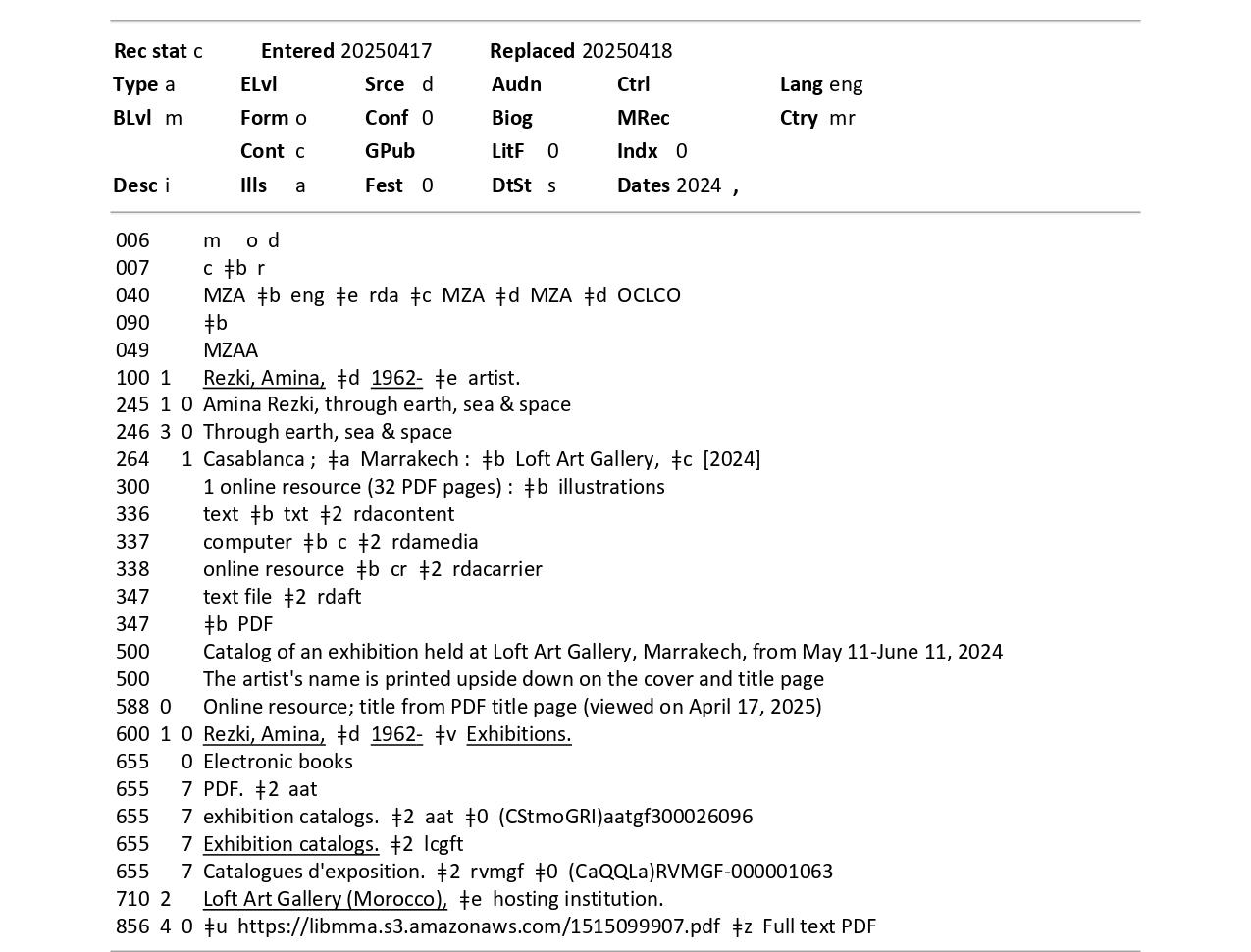
To illustrate what the process of library cataloging looks like, I thought I’d discuss how I created a record for a catalog of a recent exhibition, Amina Rezki, Through Earth, Sea & Space, held at a Moroccan art gallery called Loft Art Gallery. This catalog was donated to Watson Library by Loft Art Gallery as part of a larger project within our library called the Contemporary Catalogs Project (which you can read about here and here; it is meant to help us actively build our collection of contemporary gallery exhibition catalogs). The catalog came to us as a PDF, which allows us to not only create bibliographic records that we can share with other libraries, but also to make the PDF itself directly accessible through the record. This means that any library that brings in the record we created can provide their users with direct access to this catalog. This is done by including an 856 field (in the MARC bibliographic record), which looks like this to the cataloger:

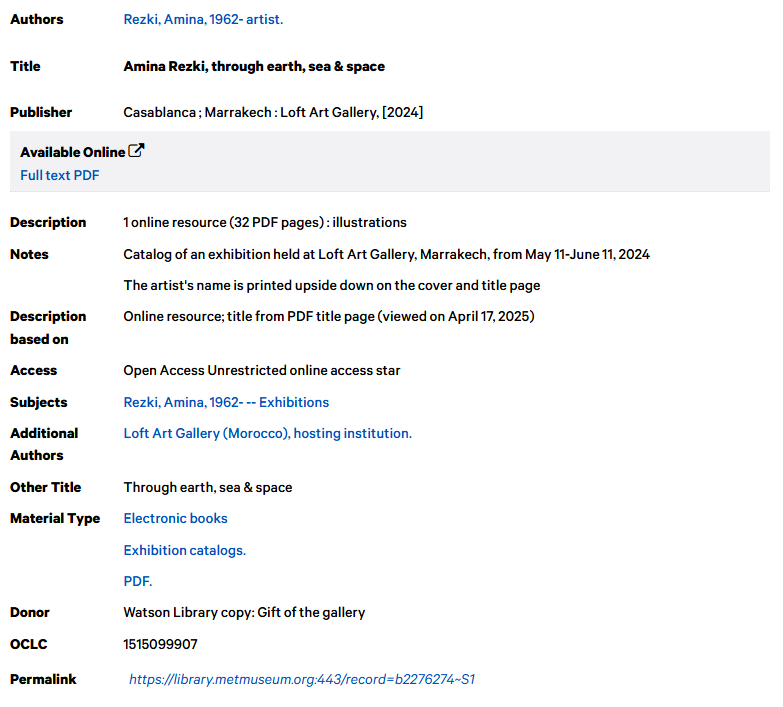
But looks like this to the library patron:

If you click the “Full text PDF” link, it takes you directly to the catalog itself. Try it out!
In addition to making the catalog itself accessible through the record, I make sure that the artist and gallery are both easily discoverable as well. In order to do this, catalogers rely upon Library of Congress’s Name Authority File (NAF), which provides “over 11 million name authority records for persons, organizations, places, and meetings/conferences.” By creating an “authorized” form of a name, it ensures consistency across records, so that a cataloger creating a record in New York will use the same form of a name as a cataloger in Albuquerque or New Orleans or Casablanca (where Loft Art Gallery is based).
When I was creating this record, however, I discovered that an authority record for the gallery did not yet exist, so I created it. This appears in the 710 field in our record, which displays in our catalog like this:

Since fields containing authorized forms of names are indexed, when you click on the name of the gallery it takes you to all our holdings of material from this gallery (thanks to the Contemporary Catalogs Project, we now have twenty-eight catalogs in our collection from Loft Art Gallery!):
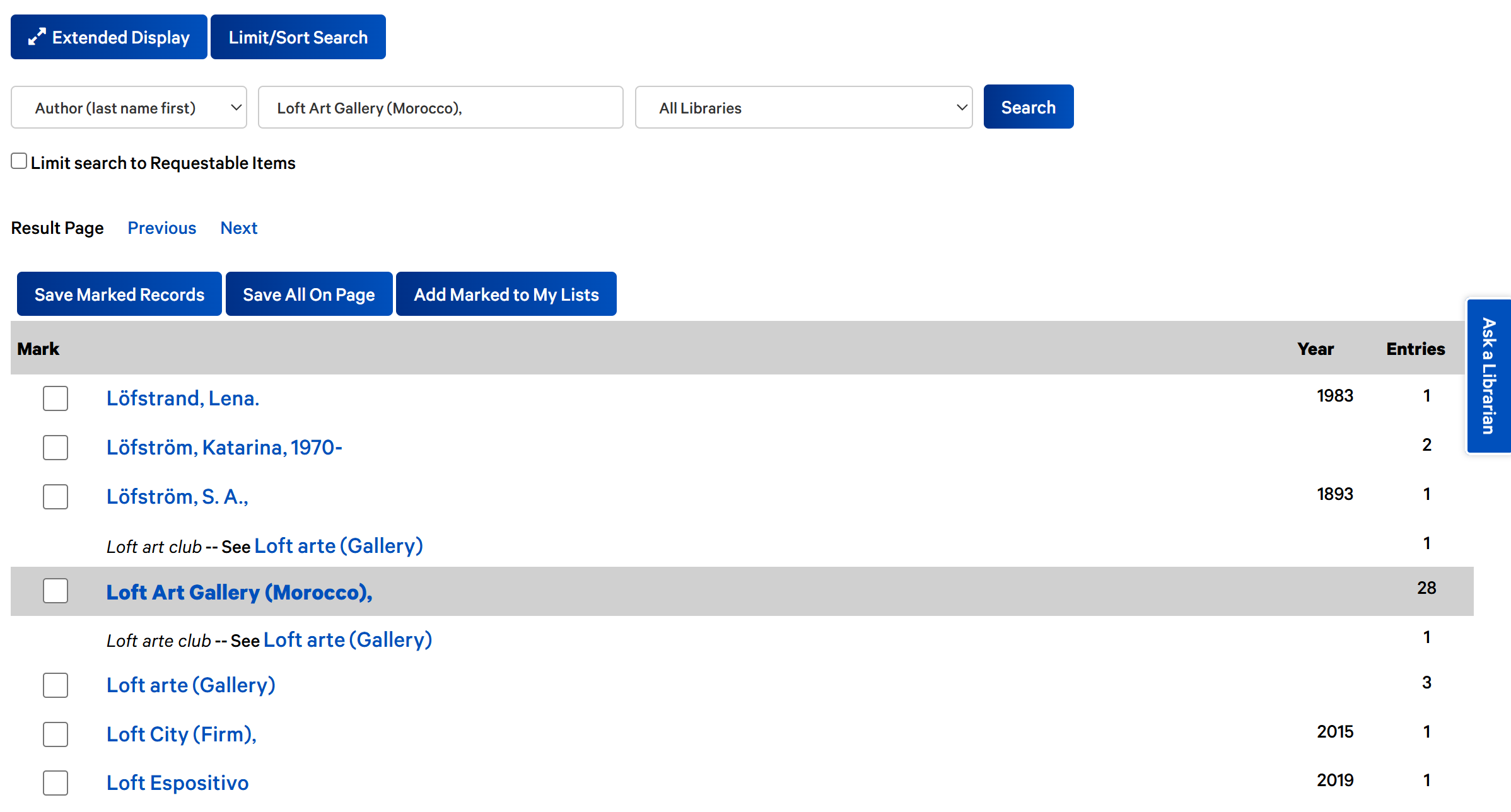
Since I created the authority record for Loft Art Gallery (which means it now has a record in NAF), any cataloger creating a record for something from this gallery will now use the “authorized” form of the name that I created:
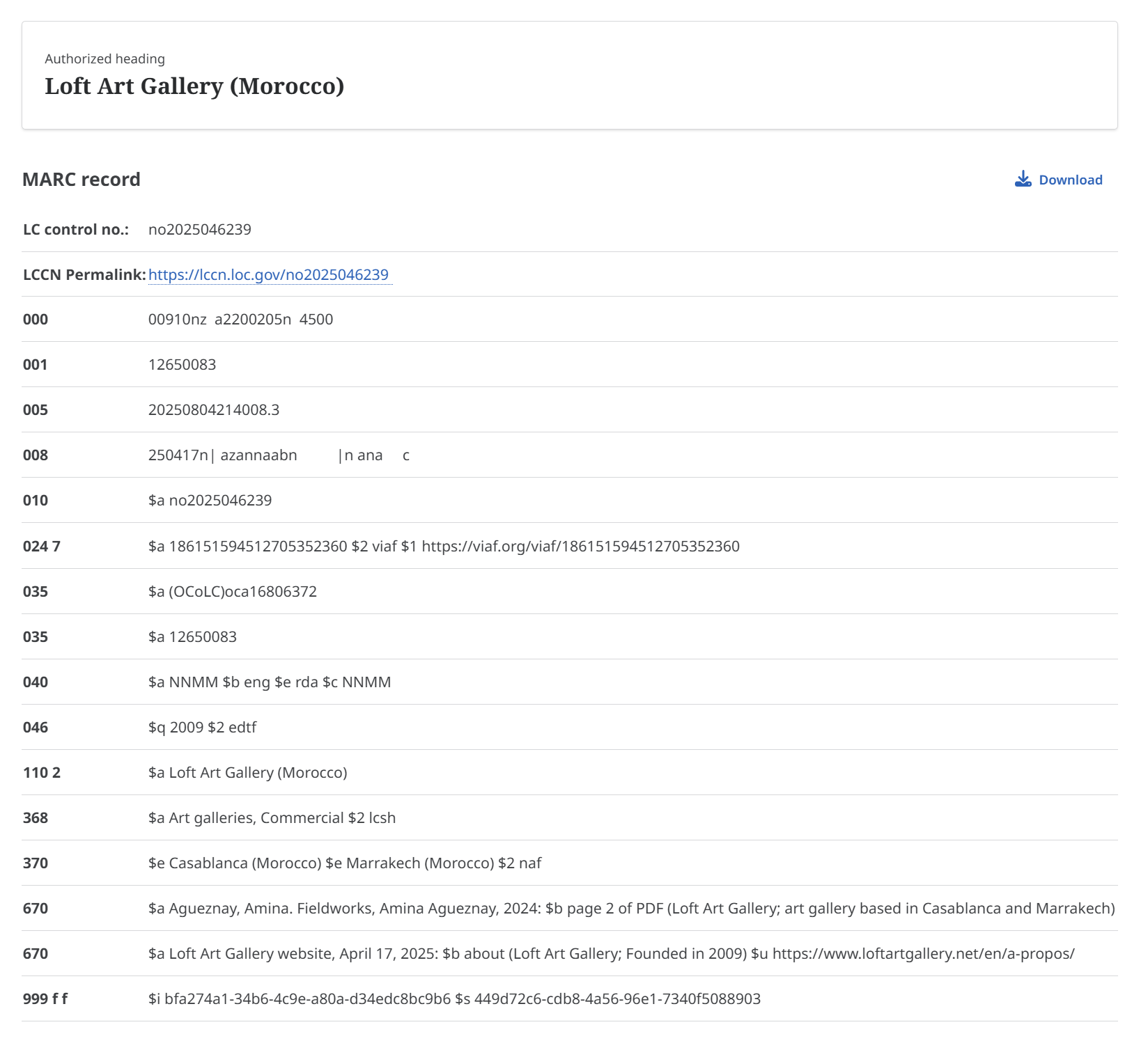
This “authorized” form of the name also helps distinguish it from other, similarly named galleries, like “Loft arte (Gallery),” which is an art gallery in Valdagno, Italy (which we have three catalogs from).
In addition to the gallery needing an authorized heading, the artist, Amina Rezki, needed an authorized heading. Using information from the catalog itself, as well as biographical information found on the Loft Art Gallery website, I was able to create an authorized heading for the artist:
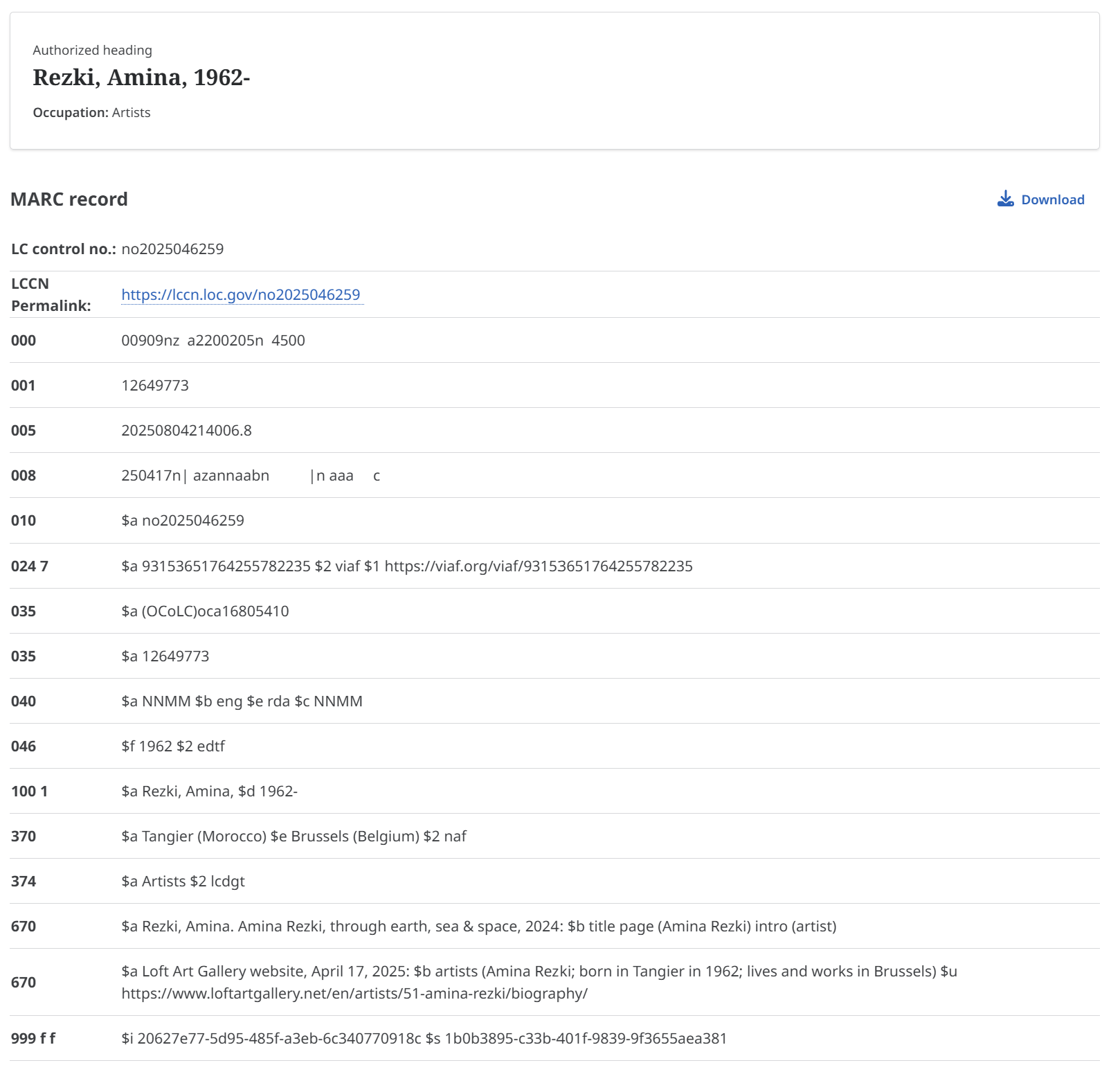
Now anytime a cataloger is creating a record of a work by or about this artist, this authorized form of her name will appear: “Rezki, Amina, 1962–”. We currently have two exhibition catalogs featuring her work, both of which were donated by Loft Art Gallery (and both of which can be viewed in full online).
While there is more to the cataloging record than that, I will spare you a field-by-field breakdown of the thing (for both your sanity and my own), but here is what a complete MARC (machine-readable cataloging) record looks like:
This MARC record is then translated into a more user-friendly display in our online catalog, which looks like this:
While cataloging itself is a solitary act, it creates something that goes beyond the bounds of one’s cubicle, creating data that can be shared by librarians everywhere, be it importing a bibliographic record into a local library catalog or using the authorized form of a name for an artist or gallery. And this data can then be accessed and used by you, the people using the library, which is the point of all the work that we librarians do.


