Every week the Sherman Fairchild Center for Book Conservation team receives a cart of material in need of preservation processing and treatment. Although most of what we receive is newly acquired special collections material, we occasionally receive objects that are already part of our collection. Reviewing and assessing the needs of these arbitrarily grouped materials can become a serendipitous journey towards new learning opportunities, as was the case with Album de Marine, a facsimile of a Henri de Toulouse-Lautrec (1864–1901) sketchbook.
Based on the inscription found in the album, the facsimile entered the library’s collection in 1953. It is housed in a slipcase, accompanied by commentary written in French by Madeleine Grillaert Dortu, an art historian, collector, and author of Toulouse-Lautrec’s catalogue raisonné. In her introduction, Dortu celebrates Toulouse-Lautrec’s artistic talent and love for nature and the world around him. One example is a sketchbook he created on his trip to the Mediterranean coast near Nice when he was fifteen years old. The illustrations in this album reveal that the young artist was intrigued by the world of sailors, rowing, and sailboats, all of which are depicted in seventeen watercolors and twenty-seven black chalk and graphite sketches in this sketchbook. According to Dortu’s commentary, the Album De Marine facsimile was admirably and fully reproduced. The skill and mastery of the printer’s hand undoubtedly catch one’s immediate attention, along with its presentation, selection of material, and overall production.
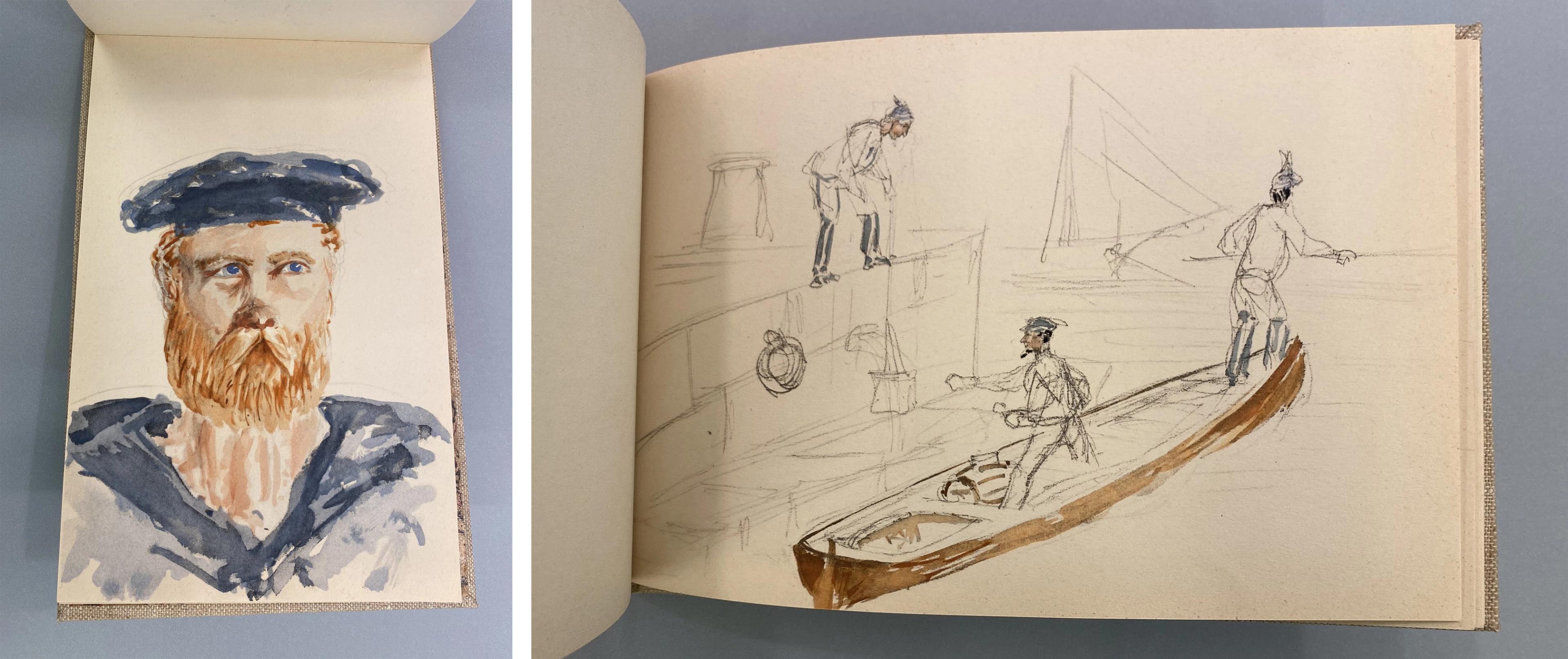
Toulouse-Lautrec captures sailors, rowing, and sailboats on his trip to Mediterranean coast. Published by Daniel Jacomet (French, 1894–1966). Album de Marine [Henri de Toulouse-Lautrec], [1953]
The facsimile arrived in the book conservation lab with its inner hinge torn and detached from the front cover, as well as a partially torn and abraded back cover hinge. A corner of its slipcase was missing but preserved. Although it was evident that the condition of this facsimile was a result of its structural and material weaknesses, I needed to compare it to the original or another copy of the same facsimile before deciding on its treatment. I was thrilled to find that the original sketchbook, Album de Marine: Sketchbook of 48 folios containing 17 watercolors and 27 black chalk and graphite sketches (1879–80), is held by the Museum’s Department of Drawings and Prints.
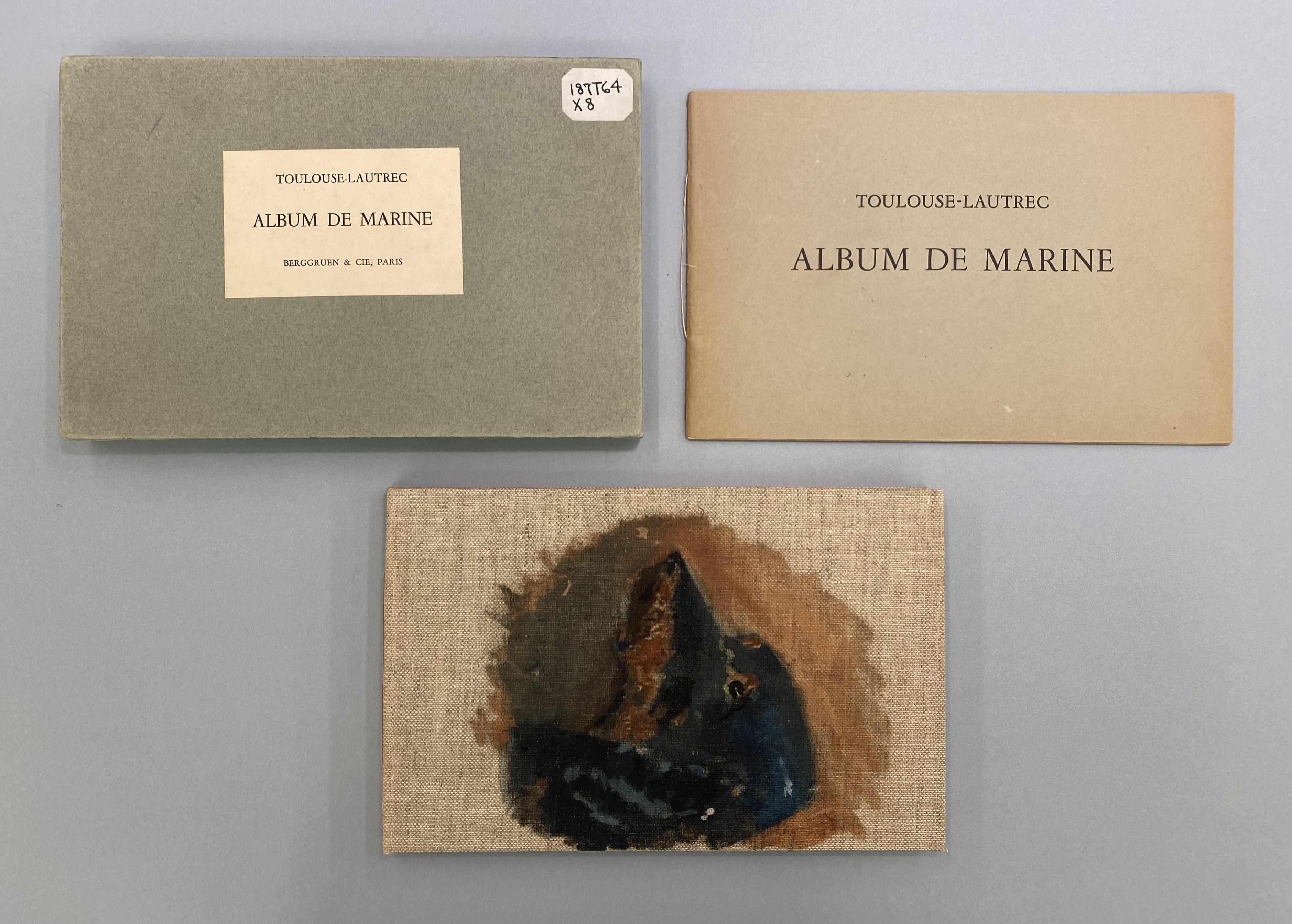
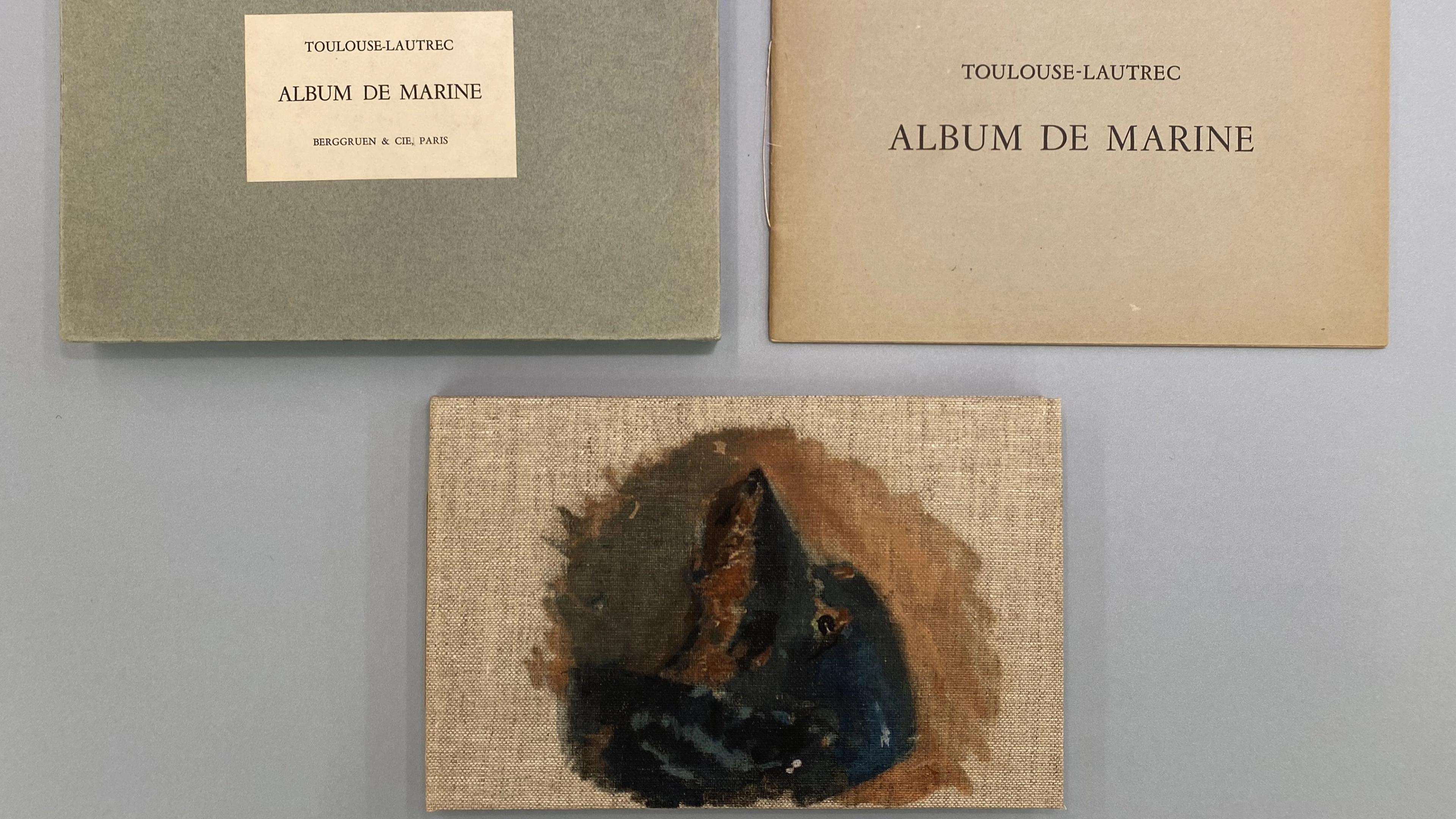
The facsimile of Album de Marine’s box, slipcase, and front cover.
The word “facsimile” derives from the Latin fac simile, meaning “make alike,” and refers to reproductions of original works. The degree of resemblance between a facsimile and its original can vary widely: some facsimiles replicate only content, while others reproduce the materials and conditions of their originals. Watson Library’s expansive and complex collection of facsimiles illustrates this range. A search for material/type “facsimile” in Watsonline, our library catalog, returns nearly a thousand such works. The library’s holdings include numerous reproductions of early manuscripts through more current twentieth-century materials. Only a small number of volumes were made to look and feel like their originals.
The facsimile Album de Marine was published in France in an edition of 550 copies in the studio of Daniel Jacomet (1894–1966), who was an artist and printmaker known for inventing the “Daniel Jacomet process.” This method combines collotype, a technique that utilizes the projection of the photographic negative onto a printing plate coated with light-sensitive gelatine, and pochoir, a printing technique where the image is created by applying the color by hand into a series of stencils. As a young printer, Jacomet worked for the printer and publisher André Martyr, known for collaborating with many renowned artists, including Toulouse-Lautrec, and in his own studio from the 1920s, he worked with artists such as Chagall, Miró, Picasso, and Braque.
In this album, illustrations are printed on two types of machine-made wove paper: heavier-weight yellow and green paper, as well as lighter-weight white paper. The selection of papers references the color, weight, and arrangement of the paper in Toulouse-Lautrec’s sketchbook. The printer reproduces the artist’s watercolors by combining two printing processes: collotype and color lithography. In some instances, it is evident that the facsimiles of sketches are reproduced using the collotype process, while in other cases, the illustrations appear to be chalk style lithographs. Lithography is a printing process that typically uses a flat stone or metal plate, where the image to be printed is ink-receptive, while the blank areas remain ink-repellent. To create color lithographs, multiple stones or plates are used.
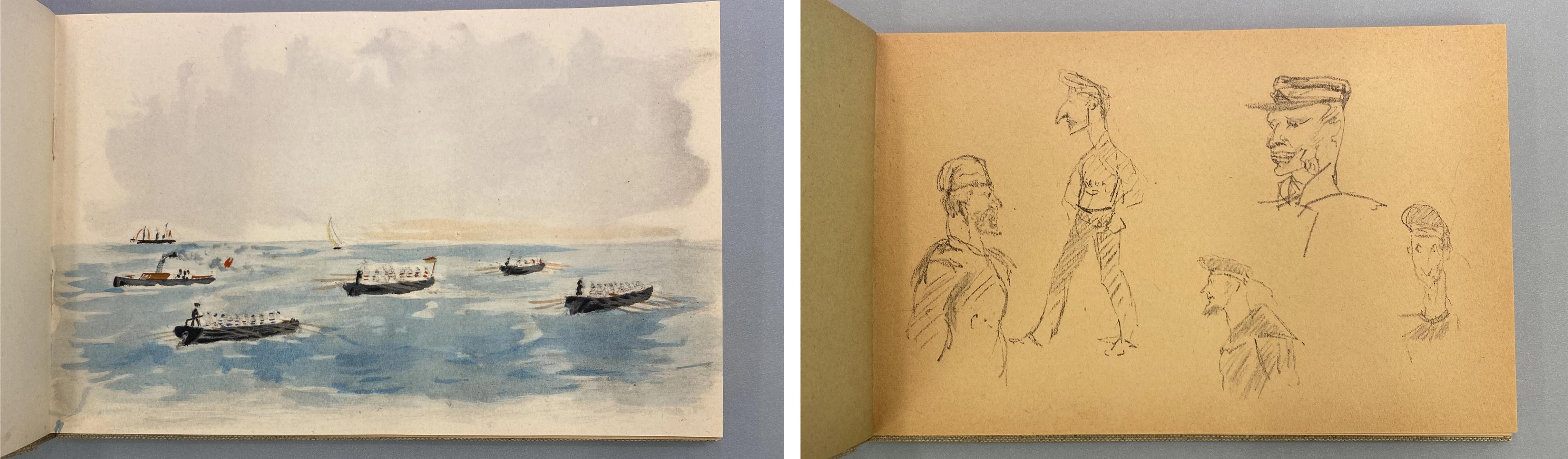
Lithography and collotype printing on machine-wove papers of different weights.
Considering Toulouse-Lautrec’s own enthusiasm for this printmaking process, the selection of lithography as a printing process for this facsimile was particularly suitable for the reproduction of the artist’s work. Toulouse-Lautrec produced over three hundred lithographs in the last ten years of his life, working both in color as well as in pen-and-ink style lithography. Some of his most celebrated works are lithographic posters of late-nineteenth-century Parisian nightlife that contributed to the recognition of this medium as fine art.
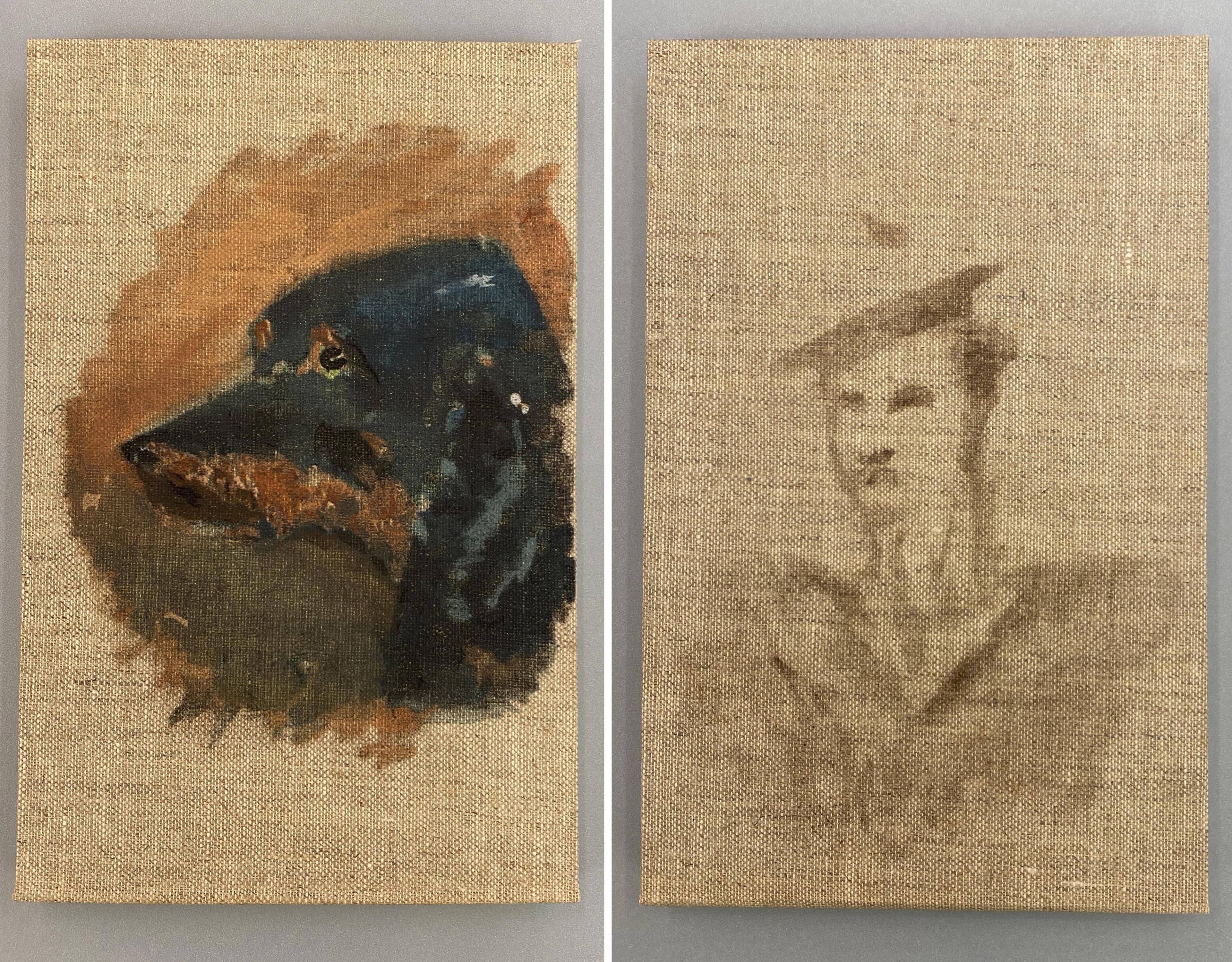
Front and back cover pages of the facsimile Album de Marine.
The condition of the facsimile was not the same as its original. The facsimile is case-bound in natural color linen cloth printed with an image of the artist’s dog on the front cover and a portrait of a sailor on the back. Its endpapers are marbled, featuring an Italian pattern resembling marbled stone in ochre, red, and black. Slightly larger in size, Toulouse-Lautrec’s actual sketchbook is bound in thin, soft natural linen over binders’ boards that create a natural round spine. The first glimpse inside the covers reveals Italian marbled paper that the facsimile is mimicking from the original. Toulouse-Lautrec’s sketchbook is beautifully worn and has that perfect patina of care coupled with time. As Dortu promises in her introduction, this facsimile admirably replicates its original. While my goal was not to compare the facsimile to its original and evaluate its accuracy beyond its condition, I learned that this book, like many facsimiles, is more than an important preservation and study tool. It’s also a testament to the incredible skills of artists, printers, and craftsmen, as well as the technologies they were using and occasionally even inventing.


