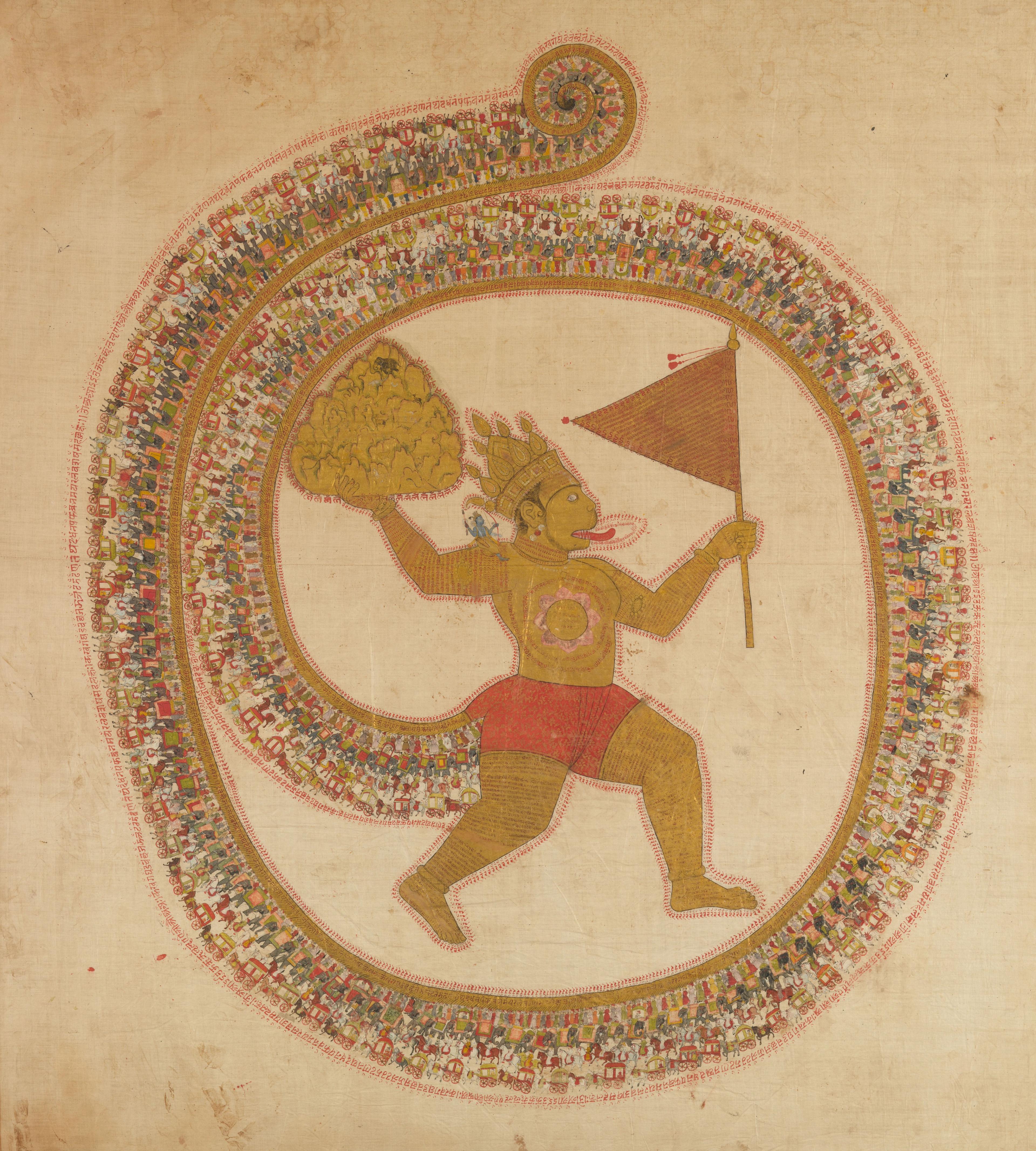
Hanuman Bearing the Mountaintop with Medicinal Herbs, ca. 1800. India (Rajasthan). Ink and opaque watercolor on cloth, 51 1/4 x 45 3/4 in. (130.2 x 116.2 cm). The Metropolitan Museum of Art, New York, Gift of Edward M. Bratter, 1957 (57.70.6)
My name is Nalini Malani.
I’m a narrative artist; I tell stories. I’m not a Hindu, but I’m attracted to the myths because, for me, it’s a language to link with people. There are so many characters that give you complex psychological stories which have come down to us through the ages, where there are universal truths.
There is this character, Hanuman (monkey/human), who then becomes the icon of devotion. I found this to be a very unusual work. It’s on cloth. It’s worked on with ink. It looks as if it's something that you see from afar, but then I saw this entire universe on the tail. I mean, if you start to count all those people, it’s so fine and it’s perfect drawing. So, obviously, it must have been a reed pen, maybe a bamboo one, sliced.
Hanuman was a very muscular creature. The curvature of the lettering gives you the idea of how thick and muscular his thigh is. The other thing that interests me is that comic book aspect of what’s coming out of his mouth: you see the tongue is out and he’s saying a few things. Those letters are going completely all around him, creating kind of a tremulous agitation as if he’s moving. Another quirky thing is that the artist made a little cover for his tail. Can you imagine how Hanuman must have squeezed himself in these shorts? He must have put his tail in first!
For me this work has three senses of time, which as a narrative device is extremely crucial. There’s the event, which is that Hanuman has been asked to go to the Himalayas and pick medicinal herbs because Ram has been wounded in battle. He goes right across all of India but then he forgets what are the herbs. So he picks the top of the mountain in hopes that those are the right ones.
And the second sense of time is that we see the little Ram on his shoulder, like a little puppet. Ram is still in the battlefield; he’s not sitting there really. It’s a fantasy. So he carries the idea of God with him, saying that, “I’m devoted to this little creature, and I will do everything possible to get this right.”
Finally there’s one other sense of time, because what you see around his tail is not the army that’s fighting. This is more like a welcoming: it’s a parade. So he’s already predicting that this is going to lead to victory. We are going to win this battle.
So these are the three senses of time. I find this totally fascinating. If I were to use the iconography and the narrative, I would put a lot of doubts and questions in the work. This kind of victory isn’t really victory in the end. In our world today we have too many conflicts happening. We’re in this very ambiguous situation, and I don’t know victory would be.