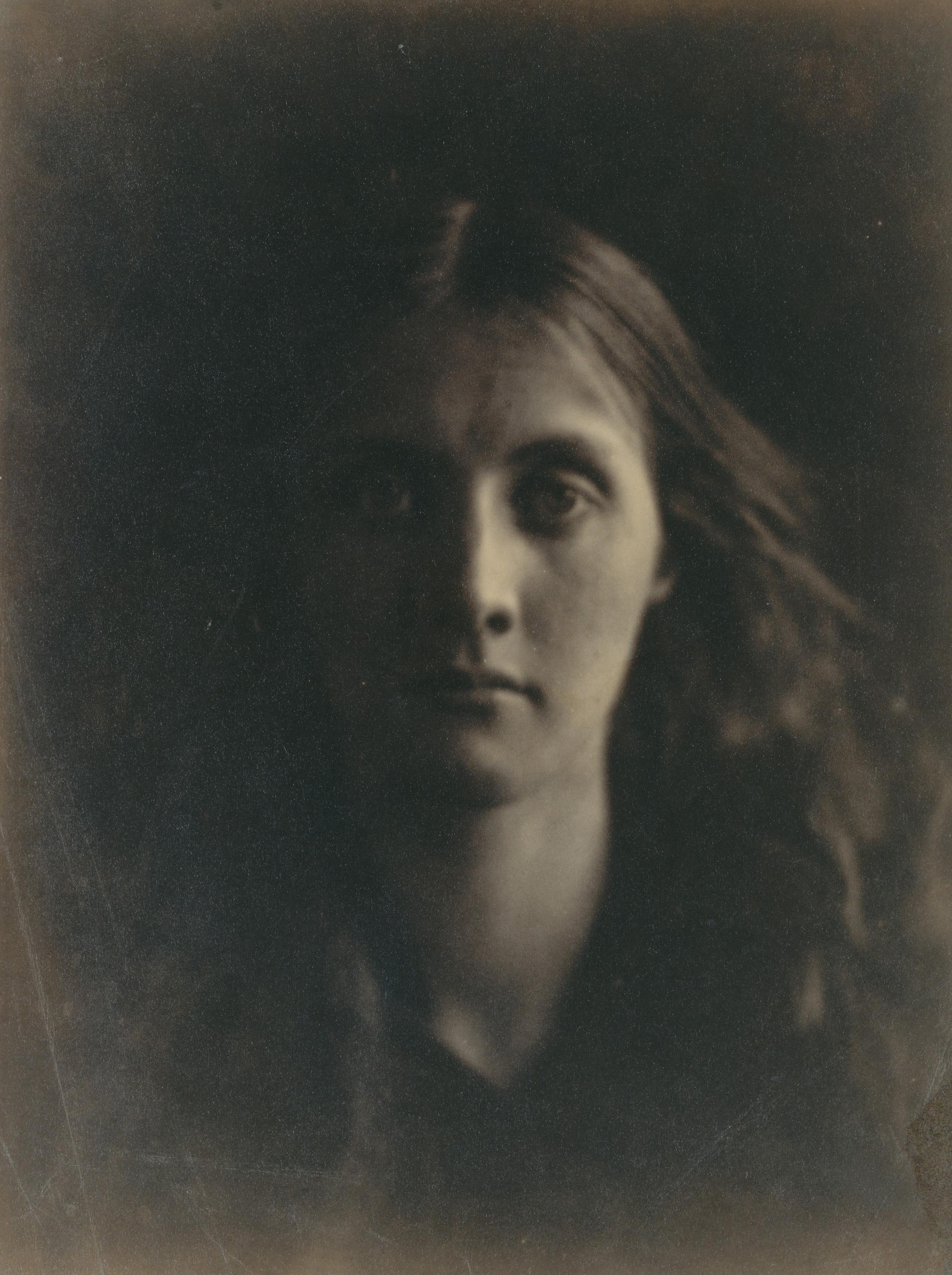
Julia Margaret Cameron (British (born India), Calcutta 1815–1879 Kalutara, Ceylon). Julia Jackson, 1867. Albumen silver print from glass negative, 10 7/8 x 8 1/8 in. (27.4 x 20.6 cm). The Metropolitan Museum of Art, New York, Purchase, Joseph Pulitzer Bequest, 1996 (1996.99.2)
I’m Nan Goldin. My work is photography.
I was given a hard time by male photographers for years, both for my lack of technical ability and my subject matter. I had issue with a lot of the philosophy of photography. I don’t think there’s such a thing as the Cartier-Bresson “decisive moment.” I think every moment is decisive. And it’s the moments between that art can be most interesting.
I never liked Julia Margaret Cameron because I thought of her as technically heavy, until I came here and discovered her to be a kindred spirit. Her work was unprecedented at the time, because they’re out of focus. She was using a big camera. People had to sit still, and so the very earliest pictures were out of focus. It was a mistake, and she decided she loved it and said she didn’t want things to be sharp. And that’s been the history of my work, too, is: the best stuff is from mistakes.
She shows the soul of people, especially the ones where their eyes are kind of floating. She released the women from the frames. At the time, women weren’t allowed to show emotions; it was all very polite.
She photographed the same people over and over again, and you can see that these pictures couldn’t have happened unless there was trust. People made me aware that my work was political for gender politics, which hadn’t occurred to me. And I think the same with her, is that she was tracing a big change in Victorian women that can be seen as political. She was celebrating the beauty, but also, increasingly, the autonomy of women, which was a new thing in that era.
She is also very interested in mythology, and so in some of these the women are playing roles of saints, of famous characters like Sappho and the Goddess of Summer. This picture is of Alice Liddell, who’s the same Alice as Alice in Wonderland. The way she’s putting her hand on her waist, she’s not just modeling as a beauty, she’s tough. She’s showing us how autonomous she is and how strong she feels.
Her favorite model was Julia Jackson, who was her niece and the mother of Virginia Woolf. And she made her into a Madonna. She’s otherworldly, but you feel that you’re looking at a woman who’s very much present, looking right into the camera.
There’s no distinction between my work and my life, and I think that must have been true for her.
I don’t know how many women have done such strong work of other women. I just don’t think a man could have taken these pictures. She photographed the relationships between women. It’s a celebration of love, which for me is the highest thing art can do.