Warrior (Musketeer)
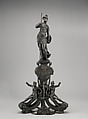
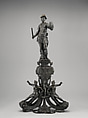
The composition of The Met’s Warrior is known in several editions that vary above all in the treatment of the surface of the cuirass. The piece closest to ours is in the Szépművészeti Múzeum, Budapest, and features the same shirtlike cuirass that seems to be made of plaited basketwork or—and this would make more sense—interwoven leather straps.[1] That statuette lacks the gun, but it has a companion dressed in the same manner rendered in a less dancelike contrapposto.[2] Another version of the New York Warrior is in the Kunsthistorisches Museum.[3] While that soldier also loads a musket, his cuirass has no texture and is equipped with epaulette-like strips covering the shoulders, conveying a more classical demeanor.
Leo Planiscig was the first to attribute this type of warrior to the Paduan sculptor Tiziano Aspetti, a suggestion (among other points of contention) that became the subject of a scholarly controversy between him and Adolfo Venturi, who called the statuettes in Vienna and Budapest “eighteenth-century Landsknechts . . . Mardi Gras gewgaws, would-be Mars puppets.”[4] Venturi’s attack led to a riposte from Planiscig, in which he elaborated upon the reasons for his attributions of the Warriors, comparing them to Aspetti’s two reliefs with scenes of the martyrdom of Saint Daniel, executed in 1592–93 for the Duomo in Padua (see cat. 169).[5] On these reliefs appear a variety of differently dressed soldiers, some of which also wear classical armor combined with plumed helmets and mustaches. However, that does not mean that every similarly attired military man must be by Aspetti. Without belittling Planiscig’s enormous achievements, one must admit that in this case Venturi’s critique, although delivered in a needlessly offensive manner, is essentially correct. In his entire oeuvre, Aspetti is never, not even slightly, playful. On the contrary, he usually strives for an almost heavy substantiality using classical poses and serious expressions. He also never displays any interest in superficial decoration. The vestments of his figures tend to be simple and aim at underscoring their sculptural gravitas. While a comparison with the soldatesche on Aspetti’s reliefs yielded convincing and widely accepted attributions, such as the Mars in the Frick (p. 00, fig. 62a),[6] one has to draw a careful line when it comes to the commercialization of a given type, which seems to be the case here.
For instance, a “Viennese” type with smooth cuirass and epaulettes together with a female figure extinguishing a torch and therefore representing Peace appeared on the art market in 1999.[7] The same pairing exists also in a version in the Museo Correr, Venice; here, however, the soldier wields—again rather playfully—a sword in his right hand, causing a different position of the arms.[8] A variation of the “Viennese” type can be found in a private collection in Europe, featuring a smooth cuirass with a skirt that is longer than those of the other casts and covered with tiny punched-in dots.[9] The most elaborate version of the “Viennese” type belongs to the Lehman Collection in The Met (fig. 64a). This warrior has not only the musket but also a powder flask dangling at his left hip from a lovingly rendered strap running over his right shoulder. The cuirass has no tassels but is decorated with an interlaced ornament of plantlike scrolls on a dotted ground, which also covers the sumptuously plumed helmet. As observed by Frits Scholten, the figure is strongly reminiscent of prints by Hendrick Goltzius and embodies a type of “ideal and civilized Soldier.”[10] If one compares the Lehman warrior, for instance, with Goltzius’s Horatius Cocles (fig. 64b), the similarities in the concept, if not of the physical type, are so evident that one wonders if some of these statuettes were produced by a Dutch foundry.
As pointed out by Richard Stone, the present Warrior features a remarkable detail, namely a bayonet mount for attaching the statuette to its support, which was most likely an andiron.[11] Since Venetian andirons are virtually always assembled “on long threaded iron rods fastened with large square nuts under the base,” this technical peculiarity may be further inducement to look beyond Venice for the production locale of some of these problematic warrior figures.
-CKG
Footnotes
(For key to shortened references see bibliography in Allen, Italian Renaissance and Baroque Bronzes in The Metropolitan Museum of Art. NY: The Metropolitan Museum of Art, 2022.)
1. Inv. 5306; see Planiscig 1921, p. 569; Balogh 1975, vol. 1, pp. 175–76, no. 232.
2. Balogh 1975, vol. 1, p. 176, no. 233. Another cast of this type was offered at Tajan, Paris, April 26, 2017, lot 106.
3. Planiscig 1921, pp. 566–68; Manfred Leithe-Jasper in Feuchtmüller 1976, pp. 93–94, cat. 101; Kryza-Gersch 2001, p. 152.
4. Planiscig 1921, pp. 568–69; Venturi 1930, p. 191.
5. Planiscig 1930–31, pp. 25–26.
6. Kryza-Gersch 2001.
7. Christie’s, London, July 6, 1999, lot 83; resold Christie’s, London, December 12, 2000, lot 31.
8. Mariacher 1968, cats. 26, 27; Mariacher 1971, p. 37, nos. 139, 142.
9. Banzato 2004, pp. 82–84, cat. 28.
10. Scholten 2011, p. 52.
11. R. Stone/TR, November 22, 2010.
Artwork Details
- Title: Warrior (Musketeer)
- Date: 17th century
- Culture: Italian, possibly Venice
- Medium: Bronze
- Dimensions: Overall (confirmed): 21 7/8 × 6 7/8 × 6 in. (55.6 × 17.5 × 15.2 cm)
- Classification: Sculpture-Bronze
- Credit Line: Gift of Irwin Untermyer, 1970
- Object Number: 1970.314
- Curatorial Department: European Sculpture and Decorative Arts
More Artwork
Related Content
 Free to download
Research Resources
The Met provides unparalleled resources for research and welcomes an international community of students and scholars. The Met's Open Access API is where creators and researchers can connect to the The Met collection. Open Access data and public domain images are available for unrestricted commercial and noncommercial use without permission or fee.
To request images under copyright and other restrictions, please use this Image Request form.
Feedback
We continue to research and examine historical and cultural context for objects in The Met collection. If you have comments or questions about this object record, please contact us using the form below. The Museum looks forward to receiving your comments.
Content Notice
The Metropolitan Museum of Art presents over 5,000 years of art from around the world, and our online collection reflects ongoing work conducted over the course of our more than 150-year history. You may encounter objects or images that may be inappropriate for some viewers or information that may be outdated.