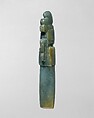
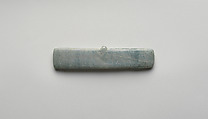
Bird pendant
Greenstone pendants were manufactured from a variety of raw materials in the Central and the Greater Nicoya regions of Costa Rica starting as early as 500 BCE, until around 800 CE. Although some of those materials were locally available, the nearest known source specifically of jadeite is in the region of the Motagua River in Guatemala. Therefore, the use of jadeite in ancient Costa Rica reveals long-distance connections across Central America. The appearance of this distinctive style of pendant, made from imported materials, during a period of incipient social inequalities, suggests that they were a sign of prestige and differentiation.
Artwork Details
- Title: Bird pendant
- Artist: Central Region artist(s)
- Date: 300–700 CE
- Geography: Costa Rica, Central Region
- Culture: Central Region
- Medium: Jadeite
- Dimensions: H. 2 5/8 x W. 3/4 x D. 1 7/8 in. (6.7 x 1.9 x 4.7 cm)
- Classifications: Stone-Ornaments, Jade
- Credit Line: The Michael C. Rockefeller Memorial Collection, Bequest of Nelson A. Rockefeller, 1979
- Object Number: 1979.206.1138
- Curatorial Department: The Michael C. Rockefeller Wing
Audio
1614. Bird Pendant
More Artwork
Related Content
 Free to download
Research Resources
The Met provides unparalleled resources for research and welcomes an international community of students and scholars. The Met's Open Access API is where creators and researchers can connect to the The Met collection. Open Access data and public domain images are available for unrestricted commercial and noncommercial use without permission or fee.
To request images under copyright and other restrictions, please use this Image Request form.
Feedback
We continue to research and examine historical and cultural context for objects in The Met collection. If you have comments or questions about this object record, please contact us using the form below. The Museum looks forward to receiving your comments.
Content Notice
The Metropolitan Museum of Art presents over 5,000 years of art from around the world, and our online collection reflects ongoing work conducted over the course of our more than 150-year history. You may encounter objects or images that may be inappropriate for some viewers or information that may be outdated.