English
DonateMembershipTickets

Qur'anic Compilation Page

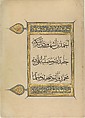
The manuscript this folio comes from contains the five suras, or chapters, from the Qur'an that start with the phrase al-hamd li-allah (praise to God). The pages of the manuscript were laid out and decorated in the same way as a complete Qur'an: each page has five lines of beautiful muhaqqaq script outlined with brush-applied gold, rosettes mark the end of each verse, and bands of illumination indicate the start of each chapter. Folios from the manuscript are now dispersed, but the name of the calligrapher, Abu Muhammad 'Abd al-Qayyum ibn Muhammad ibn Karamshah al-Tabrizi, is given in the colophon on a page in a private collection. The colophon does not provide the date of the manuscript or the name of its patron, but the style of the illumination and calligraphy is comparable to that in Qur'ans made for Mamluk patrons in the late fourteenth century and in slightly later copies made for the early Timurid rulers. The manuscript is thought to have been commissioned by a member of the Jalayirid royal family, probably Shaykh Uvays, who reigned from 1356 to 1374 and had a capital at Baghdad.

Artwork Details

Object Information
  • Title: Qur'anic Compilation Page
  • Calligrapher: Abu Muhammad 'Abd al-Qayyum ibn Muhammad ibn Karamshah al-Tabrizi
  • Date: ca. 1370
  • Geography: Possibly made in Iraq, Baghdad
  • Medium: Ink, gold, and opaque watercolor on paper
  • Dimensions: Text block:
    H. 14 7/16 in. (36.7 in.)
    W. 10 1/2 in. (26.7 cm)
    Full page:
    H. 16 15/16 in. (43 cm)
    W. 13 3/4 in. (35 cm)
  • Classification: Codices
  • Credit Line: Purchase, Louis E. and Theresa S. Seley Purchase Fund for Islamic Art and A. Robert Towbin Gift, 2008
  • Object Number: 2008.31
  • Curatorial Department: Islamic Art
More Artwork
Folio from a Qur'an Manuscript, Ahmad ibn al-Suhrawardi al-Bakri, Ink, opaque watercolor, and gold on paper
Calligrapher Ahmad ibn al-Suhrawardi al-Bakri
Illuminator Muhammad ibn Aibak ibn 'Abdallah
dated 707 AH/1307–8 CE
Folio from a Mu'nis al-ahrar fi daqa'iq al-ash'ar (The Free Man's Companion to the Subtleties of Poems) of Jajarmi, Muhammad ibn Badr al-Din Jajarmi  Iranian, Ink, opaque watercolor, and gold on paper
Author Muhammad ibn Badr al-Din Jajarmi
dated 741 AH/1340–41 CE
"Preparing Medicine from Honey", from a Dispersed Manuscript of an Arabic Translation of De Materia Medica of Dioscorides, 'Abdullah ibn al-Fadl , Baghdad, Ink, opaque watercolor, and gold on paper
'Abdullah ibn al-Fadl
dated 621 AH/1224 CE
"The Feast of Sada", Folio 22v from the Shahnama (Book of Kings) of Shah Tahmasp, Abu'l Qasim Firdausi  Iranian, Opaque watercolor, ink, silver, and gold on paper
Author Abu'l Qasim Firdausi
Painting attributed to Sultan Muhammad
ca. 1525
Opening Folio of the 26th Volume of the  "Anonymous Baghdad Qur'an", Ahmad ibn al-Suhrawardi al-Bakri, Ink, opaque watercolor, and gold on paper
Calligrapher Ahmad ibn al-Suhrawardi al-Bakri
Illuminator Muhammad ibn Aibak ibn 'Abdallah
706 AH/1306–7 CE

Research Resources

The Met provides unparalleled resources for research and welcomes an international community of students and scholars. The Met's Open Access API is where creators and researchers can connect to the The Met collection. Open Access data and public domain images are available for unrestricted commercial and noncommercial use without permission or fee.

To request images under copyright and other restrictions, please use this Image Request form.

Feedback

We continue to research and examine historical and cultural context for objects in The Met collection. If you have comments or questions about this object record, please contact us using the form below. The Museum looks forward to receiving your comments.

Send feedback

Content Notice

The Metropolitan Museum of Art presents over 5,000 years of art from around the world, and our online collection reflects ongoing work conducted over the course of our more than 150-year history. You may encounter objects or images that may be inappropriate for some viewers or information that may be outdated.