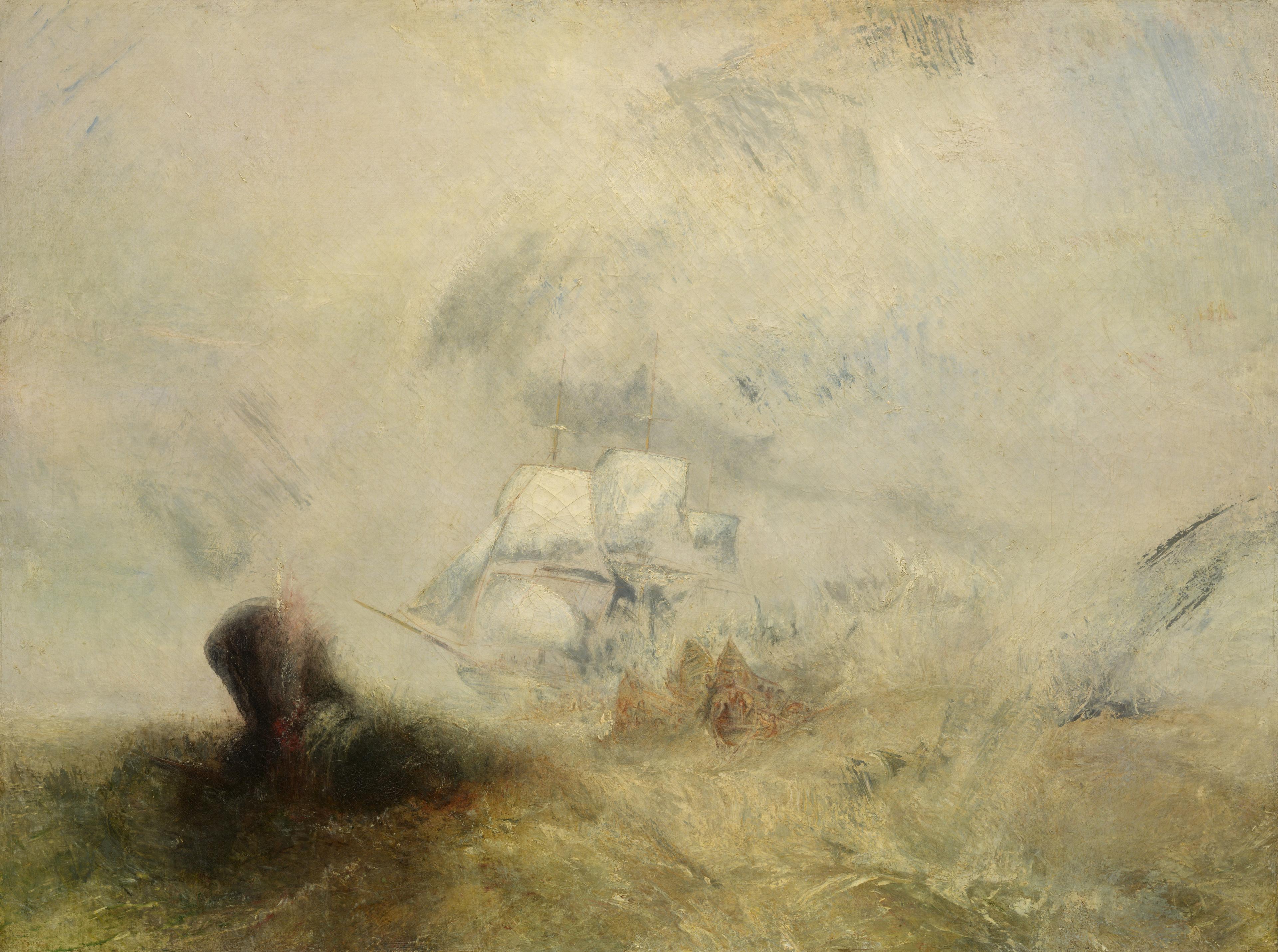
Joseph Mallord William Turner (British, 1775–1851). Whalers, ca. 1845. Oil on canvas, 36 1/8 x 48 1/4 in. (91.8 x 122.6 cm). The Metropolitan Museum of Art, New York, Catharine Lorillard Wolfe Collection, Wolfe Fund, 1896 (96.29)
I’m Raymond Pettibon. I’m an artist.
There’s great artists who learn their technique and come to a masterly point where they’ve reached their goal, and the next painting looks much like the previous one. And then there’s artists like Turner, who’s, in a way, an act of nature. You don’t know what he’s going to do.
As the years went by his interest in showing how well he could represent any subject lapsed and was won over by what paint can do on its own. He never went completely abstract, but his work prefigured where painting was going many years later.
I mean, he could do graphic, realistic technique if he wanted to. There’s the scene in Venice. Venice can be merely picturesque in a cartoonish, glossed over way, but with a painting like this you learn about painting in a way that you can put yourself in his position. You can see the ship, you can see every sail, but when you draw away from that it gets fuzzier and more loose. The reflection on the water is more painterly, or muddier.
I don’t have a good visual memory, nor am I particularly good at drawing from life. Nature has a tendency to not cooperate. I mean the sky—ten minutes later it’s an entirely different view. I mean, how would he draw this from life? In that sense it’s not pure representation. I mean, the clouds, the shadow, the position of the boat—you almost experience it at its source, like the story of him having himself lashed to the mast of a ship, to experience firsthand what it’s like to be in a storm at sea.
I like art where you can see the struggle in making the work: the hit or miss, the faith you have to work with a loaded brush and then to make a mistake, cover it up, to make it into something else. There’s fits and starts, there’s stops and new beginnings. When I do a painting it’s a process of learning with each one, rather than cranking them out. The brush can be an extension of the arm and the self, and yet you’re still extending yourself.
Any 'Joe Schmo' with apprenticeship and focus can learn to paint in a way that they could never do a Turner. It’s a basic difference between slickness and really painting. It’s unnerving. It’s dealing with the sublime and nature at its highest point.