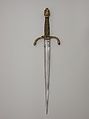
Striscia di Cristiano II, elettore di Sassonia
Artwork Details
- Titolo: Striscia di Cristiano II, elettore di Sassonia
- Artista: Israel Schuech, Tedesco, attivo tra il 1590 e il 1610, e Juan Martinez, Spagnolo, attivo nel XVI o nel XVII secolo
- Data: 1606
- Materiale e tecnica: Acciaio, bronzo, oro, pietre preziose, vetro, perline, smalto
- Dimensioni: Lungh. 121,9 cm
- Crediti: Fletcher Fund, 1970
- Numero d'inventario: 1970.77
- Curatorial Department: Arms and Armor
Audio
4412. Rapier of Prince-Elector Christian II of Saxony
DONALD LAROCCA: This is a rapier, a type of slender long sword, made for elector Christian the II of Saxony.
NARRATOR: Donald Larocca is Curator of Arms and Armor.
DONALD LAROCCA: The Dukes of Saxony were very well known as patrons of the arts, and they were great patrons of the armorer’s art as well. It gives an impression of how important a sword could be as a status symbol, almost as a piece of gentleman’s jewelry. It’s made in the shape and form of a type of rapier that would have been practical for battle, but it’s so heavily decorated that you know it’s a piece intended really for show, to demonstrate the rank and the importance of its owner. So rather than being made out of steel, which the handle a rapier generally would be all steel the handle of a rapier generally would be all steel for defensive purposes. This is a gilt bronze, and because it’s made out of that material, it could be much more elaborately worked. You see all these small figures throughout its decoration and then it also has pearls and different types of imitation jewels to give it a very, very elaborate appearance.
More Artwork
Related Content

Research Resources
The Met provides unparalleled resources for research and welcomes an international community of students and scholars. The Met's Open Access API is where creators and researchers can connect to the The Met collection. Open Access data and public domain images are available for unrestricted commercial and noncommercial use without permission or fee.
To request images under copyright and other restrictions, please use this Image Request form.
Feedback
We continue to research and examine historical and cultural context for objects in The Met collection. If you have comments or questions about this object record, please contact us using the form below. The Museum looks forward to receiving your comments.
Content Notice
The Metropolitan Museum of Art presents over 5,000 years of art from around the world, and our online collection reflects ongoing work conducted over the course of our more than 150-year history. You may encounter objects or images that may be inappropriate for some viewers or information that may be outdated.