Marble statuette of young Dionysos
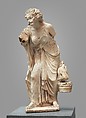
The god is nude except for the nebris (fawn skin) worn diagonally at his right shoulder. Long locks of hair are falling onto the shoulders and back. There are remains of a support on the left flank, while traces of red paint are still visible between the locks of hair in front.
The statuette belongs to a series of Roman eclectic sculptures that refer back to a late classical Greek type. The s-curve and slight twist of the torso to the right for example are direct quotes of works by Praxiteles. The young Dionysos became quite popular during the reign of Hadrian in the second century A.D. Most probably the statuette was a decorative piece, although a votive context should also be considered.
Artwork Details
- Title: Marble statuette of young Dionysos
- Period: Imperial
- Date: 1st–2nd century CE
- Culture: Roman
- Medium: Marble
- Dimensions: H.: 15 in. (38.1 cm)
- Classification: Stone Sculpture
- Credit Line: Gift of Edward Klagsbrun and Joan Saslow, in memory of Dr. Henny Durst, 2011
- Object Number: 2011.517
- Curatorial Department: Greek and Roman Art
More Artwork

Related Content

 Free to download
Research Resources
The Met provides unparalleled resources for research and welcomes an international community of students and scholars. The Met's Open Access API is where creators and researchers can connect to the The Met collection. Open Access data and public domain images are available for unrestricted commercial and noncommercial use without permission or fee.
To request images under copyright and other restrictions, please use this Image Request form.
Feedback
We continue to research and examine historical and cultural context for objects in The Met collection. If you have comments or questions about this object record, please contact us using the form below. The Museum looks forward to receiving your comments.
Content Notice
The Metropolitan Museum of Art presents over 5,000 years of art from around the world, and our online collection reflects ongoing work conducted over the course of our more than 150-year history. You may encounter objects or images that may be inappropriate for some viewers or information that may be outdated.