Figura magica Mangaaka
Artwork Details
- Titolo: Figura magica Mangaaka
- Data: Metà-fine del XIX secolo
- Area geografica: Repubblica democratica del Congo, regione del fiume Chiloango
- Cultura: Popolazioni Kongo
- Materiale e tecnica: Legno, pittura, metallo, resina, ceramica
- Dimensioni: Alt. 118 cm
- Crediti: Acquistato, donazioni di Lila Acheson Wallace, dott. Daniel e dott.ssa Marian Malcolm, Laura G. e James J. Ross, Jeffrey B. Soref, The Robert T. Wall Family, dott. Sidney G. Clyman e consorte, e Steven Kossak, 2008
- Numero d'inventario: 2008.3
- Curatorial Department: The Michael C. Rockefeller Wing
Audio
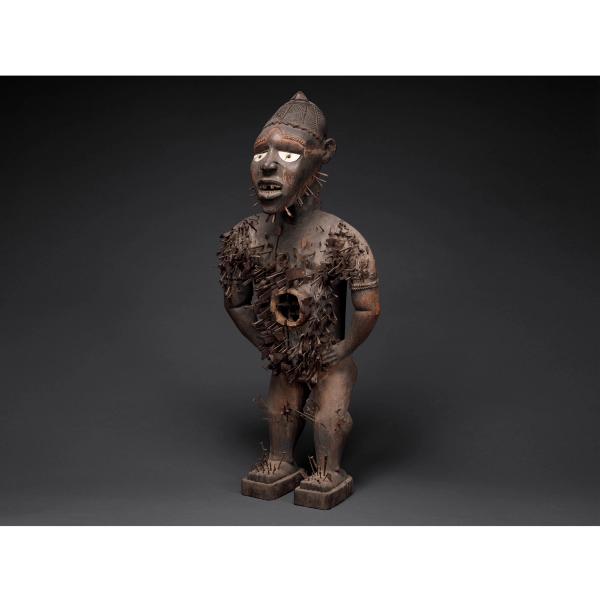
1547. Mangaaka power figure, Yombe-Kongo artist and nganga (ritual specialist)
Wyatt MacGaffey
WYATT MACGAFFEY: I would say that Mangaaka is, as far as we know, the most striking sculpture ever produced in Kongo.
ANGELIQUE KIDJO (NARRATOR): This sculpture belongs to a class of powerful objects called minkisi, made to contain and control forces invoked by a priest known as nganga. Minkisi allowed priests to address a variety of individual and social concerns. Mangaaka was specially designed to engage a force of law and order in defense of the community.
Here is Wyatt MacGaffey, professor emeritus of anthropology at Haverford College.
WYATT MACGAFFEY: A successful minkisi would be a large one, an important one, it would be used many times by different clients who came with their problems. Some minkisi were nailed, or other kinds of hardware, knife blades, whatnot, driven into them to arouse them. Minkisi could also be aroused by other means, including explosions of gunpowder and insults. On the other hand, the nails representing so many past curses were part of the figure's deliberately frightening appearance.
Anybody looking at a Mangaaka, it is quite an alarming experience. The figure seems to be walking towards you with aggressive intentions, and has its hands on hips in a pose that says, ‘Look here, so-and-so. Do you know who you’re dealing with? This is me, Mangaaka.’
###
Music: Recorded by Kongo Zabana for Buda Musique.
More Artwork
Related Content
 Free to download
Research Resources
The Met provides unparalleled resources for research and welcomes an international community of students and scholars. The Met's Open Access API is where creators and researchers can connect to the The Met collection. Open Access data and public domain images are available for unrestricted commercial and noncommercial use without permission or fee.
To request images under copyright and other restrictions, please use this Image Request form.
Feedback
We continue to research and examine historical and cultural context for objects in The Met collection. If you have comments or questions about this object record, please contact us using the form below. The Museum looks forward to receiving your comments.
Content Notice
The Metropolitan Museum of Art presents over 5,000 years of art from around the world, and our online collection reflects ongoing work conducted over the course of our more than 150-year history. You may encounter objects or images that may be inappropriate for some viewers or information that may be outdated.